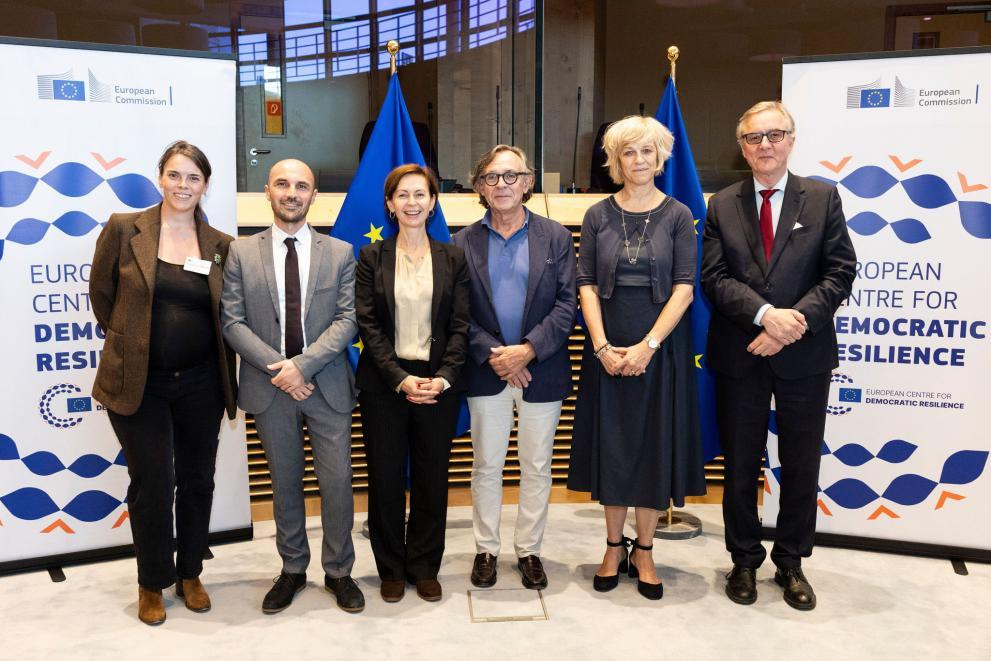
Bratislava: The European Centre for Democratic Resilience is opening its doors to civil society, after the European Commission invited independent organisations to apply for a new Stakeholder Platform. Fact-checkers, newsrooms and media literacy groups, from Bratislava to Bucharest, now have until 17 January 2027 to submit their applications.
The call for the European Centre for Democratic Resilience, published on 19 November, targets non-governmental organisations, networks and consortia working in civil society, media, research and academia. It also names fact-checking, media literacy and democratic resilience as core fields. The Commission expects the platform to start work in spring 2027.
Brussels designed the European Centre for Democratic Resilience as a hub that links EU institutions, national governments and civil society. It forms a core part of the European Democracy Shield, the package the Commission launched to protect elections and public debate from manipulation. The platform gives outside experts a formal channel into that structure.
According to the Commission, members will exchange expertise and good practice and feed into cooperation with public authorities. Their work will cover democratic resilience and information integrity across education, media and civic participation. Working groups and joint projects will carry most of the effort.
Foreign information manipulation and interference sits high on the agenda. Several member states have reported coordinated disinformation campaigns around national votes in recent years, and authorities often lack the local knowledge that small fact-checking teams hold. The platform aims to close that gap by pooling insight from groups that monitor online narratives every day.
The model also answers a long-running complaint from civil society. Many organisations argue that EU institutions consult them late, often after key decisions are taken. A standing platform attached to the European Centre for Democratic Resilience offers a permanent seat instead of one-off consultations.
Questions remain about independence and resources at the European Centre for Democratic Resilience. Fact-checkers rely on fragile funding, and some worry that close ties to public authorities could undermine trust among their audiences. The Commission stresses that membership is open to independent bodies, but applicants will want clarity on governance, selection criteria and how the platform handles disagreement with official positions.
The timing matters too. The Democracy Shield is moving from strategy to delivery, and the Commission wants visible results before the next cycle of national elections in 2027. A functioning network of trusted partners would give it early warning on emerging threats and a channel to spread counter-messaging.
Organisations that want to shape the European Centre for Democratic Resilience from the start should prepare their files now. The January deadline leaves less than two months, and the first working groups will likely set the priorities for the platform’s early years.