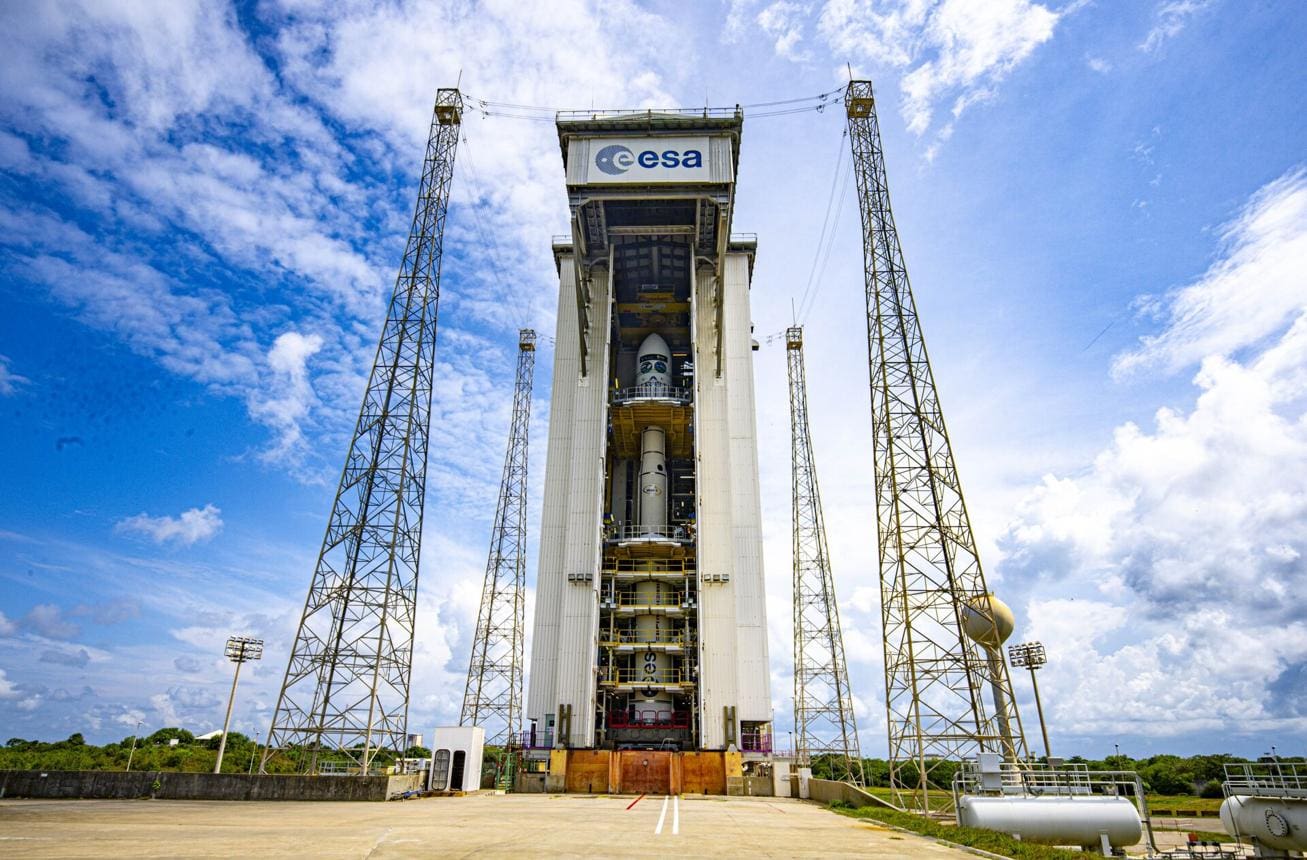
Kourou: European access to space moved to the centre of EU policy at the second EU Access to Space conference, held on 23 September 2026 at the Solvay Library in Brussels under the theme Ready to Launch: From Policy to Orbit. Defence and Space Commissioner Andrius Kubilius opened the event with a blunt line: no rockets, no access to space, no future in space.
The numbers behind that warning are large. The EU projects a need for 62 launches by 2034, serving programmes such as Copernicus, Galileo, IRIS² and the Earth observation governmental service. Ariane is planned to fly ten times a year but 14 launches will be needed in 2031. Vega is planned at six a year, while eight will be needed in 2030.
Funding context sharpens the picture. ESA’s 2026 Report on the Space Economy ranks Europe fourth worldwide by mass launched for government missions in 2025. Europe ranks third in public space investment, with 11 percent of global public spending, against 58 percent for the United States and 15 percent for China.
Recent flights show momentum. Vega-C launched Sentinel-3C, Ariane 64 made its first flight, and Ariane 6 lifted the MTG-I2 weather satellite on 27 August from French Guiana on its first mission to geostationary transfer orbit. Isar Aerospace carried out the first commercial launch from continental Europe, from the Andøya spaceport in Norway.
The Commission’s long-term vision for European space transportation, presented with ESA and member states at the International Space Summit in Paris, sets goals for public actors over the next 20 years. It rests on three focus areas: aggregating institutional launch demand, innovation for next-generation launchers, and critical ground infrastructure. Christoph Kautz, the Commission’s director for space policy, said delivering the vision means balancing competition and cooperation, public and private funding, and interoperability and resilience.
Kubilius argued that Europe needs reusable launchers and more public and private investment to build them. He suggested launch sites may have to interconnect and share services to raise launch cadence, comparing the idea to civil aviation. Emerging industrial players also need access to test and qualification facilities.
Next steps are already on the calendar. Kubilius will make an access to space tour of launch sites, factories and test facilities to find bottlenecks, and the Commission plans an action plan on European access to space in 2027. A Commission workshop on sustainable finance for space follows on 22 October, because the sector’s heavy upfront costs and long development cycles make financing a central test of whether Europe can secure its own access to space.