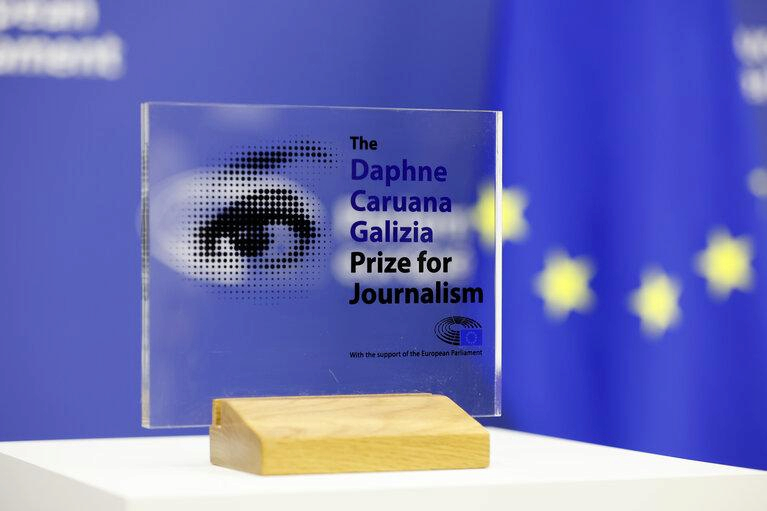
Bidnija: The 2026 Daphne Caruana Galizia Prize for Journalism went to an investigation into the migration deal between Italy and Albania, the European Parliament announced on 21 October 2026. The Daphne Caruana Galizia Prize carries 20,000 euros and honours reporting that defends democracy, the rule of law and fundamental rights in the European Union.
The winning team is Giacomo Zandonini of Italy and Maite Vermeulen of the Netherlands, who published their work with the Dutch platform De Correspondent. Photo editor Bebe Blanco Agterberg, information designer Sharon Coone and photographer Francesco Bellina also contributed to the project. Parliament President Roberta Metsola presented the award at a ceremony in Strasbourg, where Vice-President Pina Picierno, who is responsible for the prize, also attended.
The investigation examines how Italy built a detention facility and asylum processing centre on Albanian territory. Under the arrangement, migrants bound for Italy are intercepted, taken to Albania, which is outside the EU, and put through a fast asylum procedure with a view to rejection and deportation. The reporters also ask why several EU governments now regard the scheme as an innovative model for future migration policy.
The journalists spent 18 months on the story and filed more than 30 freedom of information requests across six countries, as well as with the European Commission, the Council and Frontex. They met strong resistance. Authorities denied access to the Italian-run centres, withheld basic figures such as the number of detainees, bypassed public procurement through emergency procedures and required staff to sign non-disclosure agreements. The reporting raises human rights questions and asks what the model means for the rule of law in Europe.
Metsola used the ceremony to honour the journalist whose name the prize carries. “Those who wanted to silence her failed,” she said, and she pledged that Parliament will keep standing with journalists. Daphne Caruana Galizia, a Maltese reporter and anti-corruption campaigner, died in a car bomb attack on 16 October 2017 near her home village. Five people have been imprisoned for carrying out the murder, but the alleged mastermind has not been convicted, and the public outcry over the handling of the case contributed to the resignation of Prime Minister Joseph Muscat.
The competition for the Daphne Caruana Galizia Prize was large. The Parliament received 344 submissions between 4 May and 31 July 2026, and an independent jury of journalists and civil society representatives from all 27 member states, together with the main European journalism associations, reduced them to 10 finalists. Those finalists covered topics from paid political advertising on Meta platforms to Europol’s parallel IT system and European ports receiving Russian liquefied natural gas.
Recent winners show how the Daphne Caruana Galizia Prize tracks Europe’s accountability gaps. The 2025 award went to a Follow the Money investigation into the financial networks behind Russia’s sanction-evading oil trade, while the 2024 prize honoured the Lost in Europe project on missing unaccompanied child migrants. In 2023 the jury chose the Pylos shipwreck investigation by Solomon and partners.
This year’s Daphne Caruana Galizia Prize choice lands while the EU is rolling out its Pact on Migration and Asylum and debating offshore processing ideas. By rewarding reporting that tests such ideas against transparency standards, Parliament sends a message to governments that secrecy around migration spending will not go unchallenged. The Daphne Caruana Galizia Prize now gives the Albania investigation a platform that officials in Rome, Tirana and Brussels will find hard to ignore.