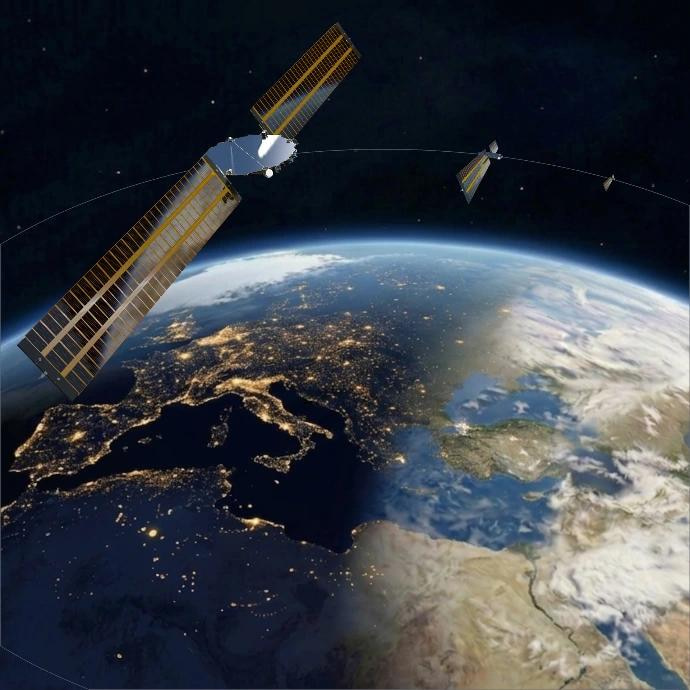
Toulouse: The IRIS² constellation will grow from 290 to 348 satellites after the European Commission and the SpaceRISE consortium signed the programme’s implementation agreement on 7 August 2026. The deal closes the negotiation milestone known as Rendezvous 1 and moves Europe’s secure connectivity project from design into construction.
The agreement adds a dedicated layer of 66 low-Earth-orbit satellites to the design that the partners fixed in the concession contract of December 2024. The main IRIS² constellation now counts 330 satellites in low orbit and 18 in medium orbit, plus optional elements. The Commission says the reinforced architecture lifts secure governmental capacity by 60 percent inside the Union and by 54 percent globally.
Andrius Kubilius, the Commissioner for Defence and Space, called the signing a decisive step for Europe’s security and digital sovereignty. Josef Aschbacher, Director General of the European Space Agency, said the milestone shows that Europe can deliver a secure and resilient capability. The added layer is built for defence, security and emergency services, and the operator will also sell spare capacity to other customers.
Member states are already putting money behind the IRIS² constellation. Poland has committed €656 million and Hungary €500 million, while Spain has announced between €1.6 billion and €2 billion. Further national contributions are under discussion, and several agreements are still being finalised. The Commission has not published a figure for the additional investment, and it ties the extra spending to the EU budget for 2028 to 2034.
The industrial split remains unconfirmed. Handelsblatt reported on 17 August that the Belgian company Aerospacelab would build about 264 satellites in a contract worth around €1.8 billion, and that Airbus lost out on that work. Neither the Commission nor the companies have confirmed those figures. The industrial team named for the programme includes Airbus Defence and Space, Thales Alenia Space, OHB and Aerospacelab.
Several steps follow before anything reaches orbit. Engineers must finalise the detailed satellite design, prepare construction of the satellites and the secure ground infrastructure, and secure launch services, since the Commission has not said where the launches will come from. The first launches are targeted for 2029, with service expanding progressively from that year. Authorised governmental users in the member states, plus Norway and Iceland, are the intended customers.
The IRIS² constellation is a government-secure service and not a consumer broadband project. Its success in 2026 and beyond will depend on how quickly national contributions turn into signed agreements and how the 2028 to 2034 budget treats the expansion. Until those decisions land, the IRIS² constellation remains a programme with a larger design than the funding the Commission has made public.