Brussels: Europe wants to stop renting its artificial intelligence and start building it, and a new tender for AI gigafactories carries that ambition. The Commission opened the call on 31 July 2026 and set out to fund up to seven vast computing sites across the bloc.
The scale is deliberate. The industry-led scheme offers up to EUR 10 billion in EU and national money and expects private investors to add at least EUR 20 billion, which pushes the total past EUR 30 billion. The Commission detailed the structure in its launch announcement, framing the sites as the physical backbone of a sovereign European AI sector.
What a gigafactory promises
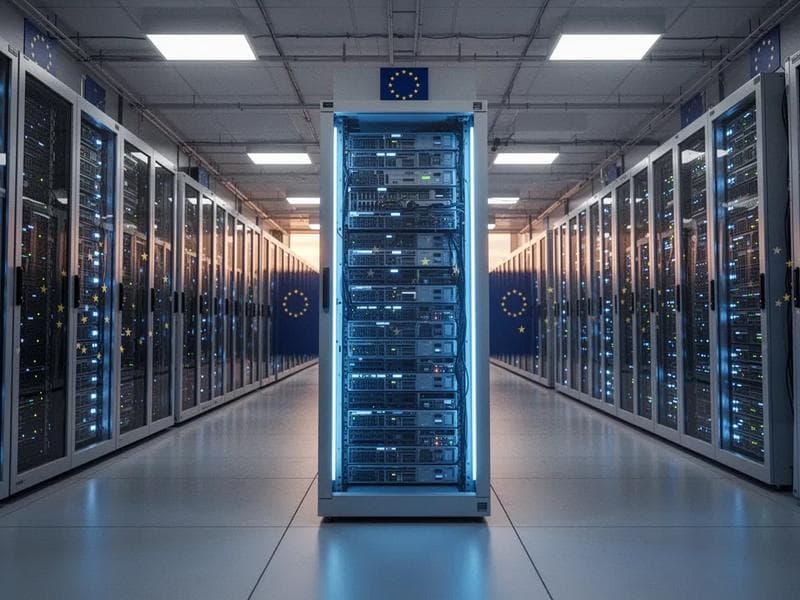
Each of the AI gigafactories bundles the ingredients that frontier AI demands. The facilities combine advanced processors, cloud and software layers, high-speed networks, and energy-efficient data centres, and they open that capacity to start-ups, scale-ups, small firms, universities, and public bodies. The pitch targets a specific weakness, because European researchers and companies today lean heavily on American clouds to train large models.
The timeline moves faster than most EU industrial projects. The call stays open until 12 November 2026, the Commission expects to award contracts in early 2027, and it wants selected sites running within 18 months of signing. The programme builds on the wider InvestAI strategy, which aims to mobilise EUR 200 billion for artificial intelligence across the Union.
Whether money alone closes the gap
Compute is necessary but not sufficient, and that truth shadows the plan. Europe can pour concrete and install chips, yet it still buys most of its top-end processors from a single American designer and relies on Asian foundries to make them. A gigafactory full of imported silicon expands capacity without deepening sovereignty, so the hardware supply chain remains the harder problem.
Energy poses a second constraint. These sites consume enormous amounts of electricity, and they will rise in a bloc where power already costs more than in the United States or China. The promise of energy-efficient design helps, but it cannot erase the gap, and cheap, reliable power will decide where the factories actually make economic sense.
Talent and demand complete the puzzle. World-class compute attracts researchers, yet Europe still loses many of its best AI scientists to better-funded American labs, and the continent lacks a homegrown model developer at the scale of its rivals. Empty capacity would embarrass the project, so the Commission needs European champions ready to use these machines at full tilt.
The strategic case nonetheless holds weight. Depending on foreign infrastructure for a general-purpose technology leaves Europe exposed to export controls, price shocks, and political leverage, and the pandemic and energy crises taught the bloc to fear such dependence. The Commission traces the policy’s logic through its digital strategy briefing.
The verdict rests on ambition matched by follow-through. Thirty billion euros signals seriousness, and the gigafactories could give European innovators a fighting chance to build at home rather than abroad. Skeptics warn that the bloc is funding buildings while neglecting the chips, the energy, and the talent that make those buildings matter. Both readings hold some truth, and the tenders that arrive by November will show which one Europe’s industry actually believes.