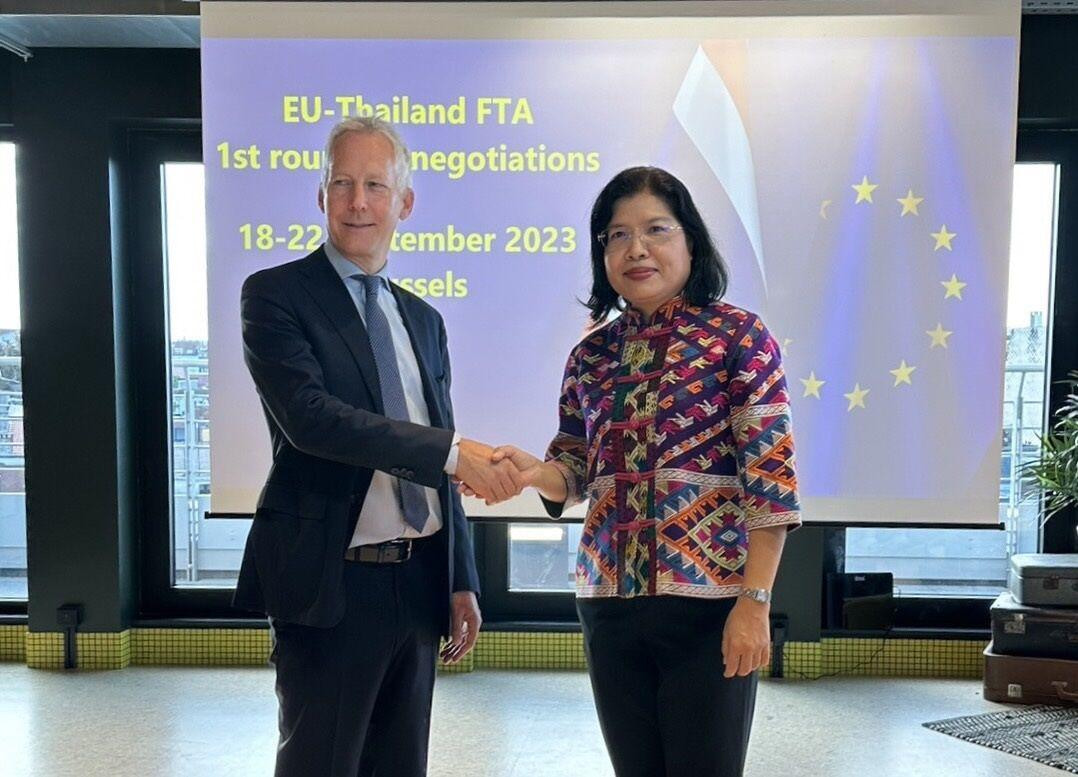
Laem Chabang: Thailand’s deepwater port moves most of what the kingdom sells to Europe, and the crews who load it have watched nine rounds of trade talks pass without shifting a single tariff line. The tenth round arrives in Thailand late this month, and it carries the chapters that decide whether the Thailand FTA closes this year or slides onto the next government’s desk.
Negotiators have banked fifteen of twenty-four chapters. That sounds like two-thirds of a deal, and it is not. The nine that remain hold the market access schedules for goods, services and investment, plus government procurement and intellectual property, which together account for most of the commercial value either side expects to capture. Trade talks always close the easy chapters first; the arithmetic of progress flatters the middle stretch and punishes the end.
Government procurement is the harder of the two headline files. Thailand does not belong to the World Trade Organization’s plurilateral procurement agreement, and its state agencies buy under rules that reserve advantages for domestic suppliers and for firms with local production. Brussels wants European bidders inside that market on published terms, with appeal rights and thresholds written into the treaty. Bangkok wants the reform sequenced slowly enough that Thai contractors can adjust. Thailand’s own trade representative has said the country needs structural reform to meet the standard, which reads less like a concession than a warning about timing.
Intellectual property carries its own politics. European negotiators press for geographical indication protection and for data exclusivity terms that Thai generic manufacturers read as a cost on public health budgets. Thailand exports generics across Southeast Asia and defends that position in every trade negotiation it enters. Neither side has found the landing zone in nine rounds, and the tenth round now has to find it under a self-imposed deadline.
The deadline matters more to Brussels than the file’s size suggests. The Commission has spent two years converting its Indo-Pacific strategy into signed paper, and a Thai agreement would connect the Singapore and Vietnam deals into something resembling a regional network rather than a set of bilateral one-offs. The Commission’s own account of the negotiation frames it in exactly those terms.
Thailand’s calculation runs differently. American tariff policy has made the United States a less predictable buyer for Thai electronics and agricultural goods, and Bangkok has spent the year widening its options. A European agreement offers scale and, more usefully, rules that do not change with an election cycle. Thai officials have described the talks as entering a final stretch after the Brussels round in June, and local reporting on that round put the remaining gaps in market access and procurement.
One structural question sits behind all of it. If the agreement covers investment protection alongside trade, it becomes a mixed agreement and every national parliament gets a vote, which historically adds three to five years. If negotiators split investment into a separate instrument, the trade half can move through Council and Parliament alone. Nobody has announced that choice, and the answer will shape when Thai exporters actually see lower duties.
Expect the September round to produce a communique about progress rather than a closure announcement. The chapters left are the ones where domestic constituencies push back hardest on both sides, and ministers who set an end-of-year target rarely enjoy explaining why the target moved. The useful signal will not be the number of chapters closed but whether procurement thresholds appear in the text at all.