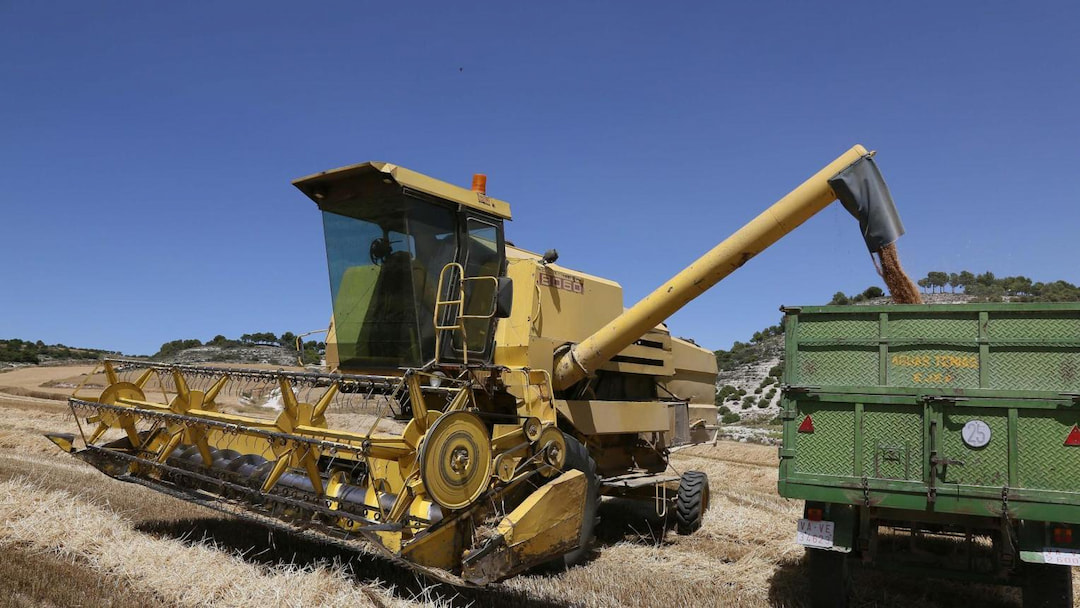
Szeged: Farmers along the Tisza watched a maize crop fail for the third summer in five, and the Commission’s late-August estimate confirmed what they already knew from walking their fields. The EU harvest will reach roughly 50.1 million tonnes, close to a two-decade low and about a fifth below the three-year average.
Commission analysts cut yield forecasts for every major spring and summer crop, trimming grain maize and sunflower by six to seven percent in a single revision. French cereal production alone falls by close to eight million tonnes against 2025. Soil moisture across the Pannonian basin and the Po valley stayed below normal from May through August, and irrigation covered only a fraction of the affected area.
The policy argument that followed splits ministers along a line that has hardened each drought year. Agriculture Commissioner Christophe Hansen told member states that Europe cannot compensate every climate-related loss indefinitely, and that without larger national contributions the budget for doing so does not exist. He wants the money directed toward irrigation infrastructure, water storage and insurance schemes backed by the European Investment Bank.
Central and eastern capitals reject the framing. Their agriculture ministries want a faster route to activate crisis support and quicker disbursement once activated, arguing that a farmer facing a failed crop in September cannot wait for an adaptation programme that delivers a reservoir in 2032. Both positions describe the same shortage of funds from opposite ends.
The agricultural reserve holds a few hundred million euros a year, drawn from unused direct payments. Set against losses that national farm bodies put in the billions, the instrument functions as a gesture rather than a backstop, and every exceptional measure taken from it since 2022 reduced what remained for the next emergency.
Insurance would carry more of this if the market worked. Coverage against drought remains thin across the countries most exposed, because reinsurers price a risk that now materialises with a frequency their models treated as exceptional. Public co-financing of premiums exists in Spain and Italy and barely elsewhere.
Consumers meet the result later. Global food prices sit at their highest level since early 2023, and maize feeds livestock before it feeds anyone directly, so the cost surfaces in pork and poultry through the winter rather than at harvest.
Analysts tracking the Commission’s crop monitoring note that the run of poor years has already changed planting. Hungarian and Romanian growers shifted hectares toward sunflower and sorghum, which tolerate heat better and earn less. That adaptation is happening without a policy, which is roughly how European agriculture has handled every shock since 2018.
Ministers meet again in October with the same file and a smaller reserve.