
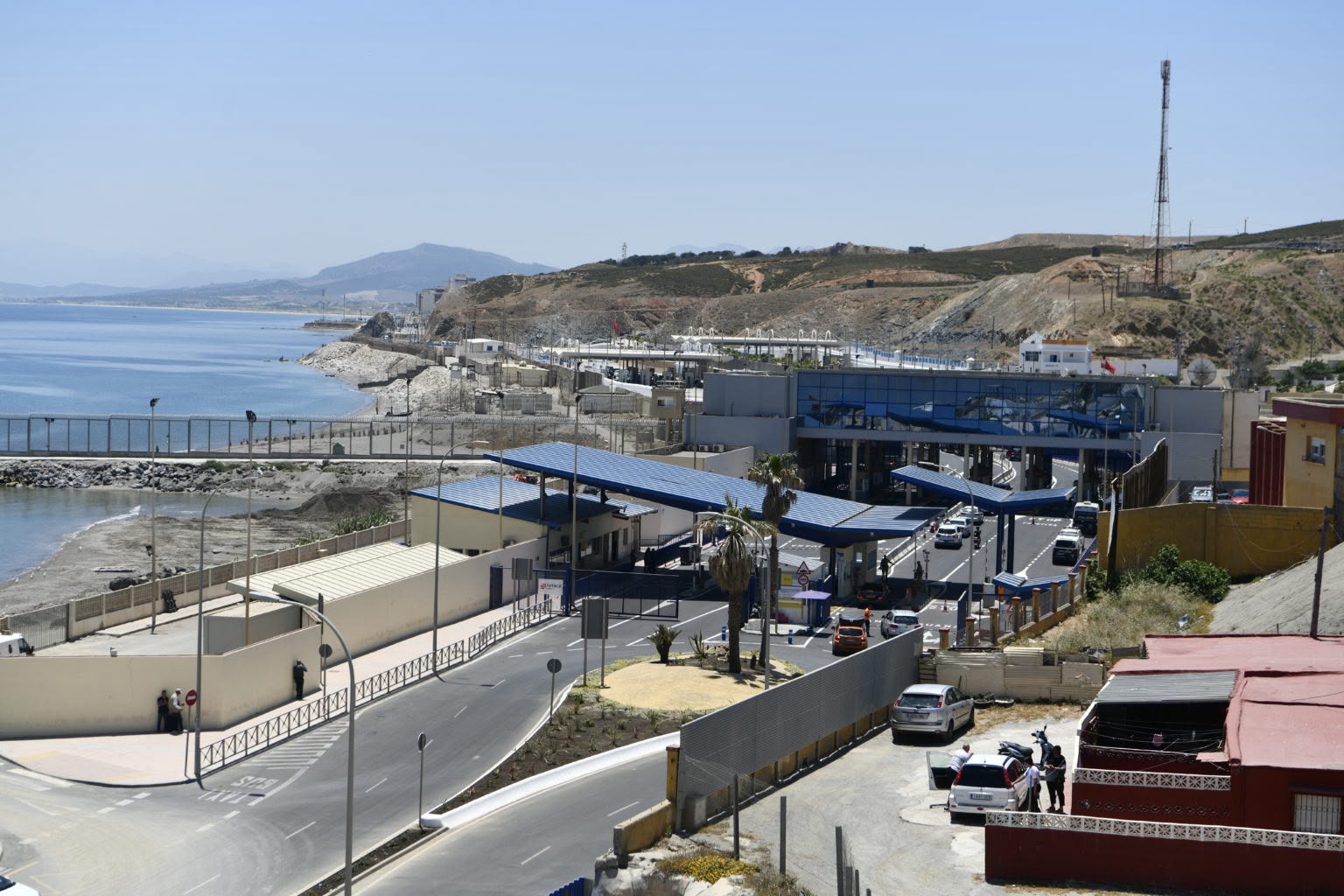

Sixty-seven people have died this week at Ceuta. Some drowned. Others were crushed in the stampede across the Tarajal breakwater, the stone spur where the border fence runs out into the sea. Between fifty and sixty thousand crossed from Morocco into a city of eighty-five thousand across Thursday and Friday, by land and by swimming around the end of that barrier, and by Saturday the Spanish interior ministry reported that most had gone back.
Spain has now announced a five-hundred-metre containment barrier along that spur, carrying it further into the water.
Hold that detail. It is the whole argument, and to see why, you have to read the court judgment that everyone this week has been characterising and almost nobody has been citing.
The Exception, The Rule, And The Distance Between Them
A word first on what was at stake, since the mechanism has no equivalent in most member states.
Spain operates two regimes for irregular entry. The ordinary one, article 58.3 of the Aliens Act, treats a return as an administrative act: a file is opened, the person is identified, a resolution issues, and with it come the right to a lawyer, an interpreter, and the chance to ask for international protection. Slow, documented, reviewable.
The other is the exception. A provision added to the statute in 2015 permits authorities at Ceuta and Melilla to reject people at the border line on the spot, without a file, without a resolution, and without any of the safeguards that accompany the ordinary route.
Spaniards call it devolución en caliente, a hot return. It has been litigated to Strasbourg and through Spain’s Constitutional Court, and it survives, on the reasoning that the two cities present a border unlike any other in the country.
The gap between the two regimes is the gap between someone who can lodge an asylum claim and someone already back in Morocco. This case decided which one applies to swimmers.
On 29 June the Fifth Section of the Contentious-Administrative Chamber of Spain’s Supreme Court decided a case brought by an Algerian man intercepted at sea on 14 November 2024, with two others, while swimming toward Ceuta, and handed to Moroccan authorities with no file opened, no lawyer, and no opportunity to claim international protection. He sought six thousand euros and readmission. A Ceuta court and the High Court of Andalusia found for him on everything but the money.
The question on appeal was narrow: does that exceptional provision reach people intercepted at sea? The Chamber held that it does not, and that article 58.3 governs instead.
The reasoning turns on six words. The provision applies to foreigners detected at the border line while attempting to overcome the established containment elements. An exception to a general rule is construed strictly, so the phrase had to be given its ordinary sense: physical structures, such as the fences. A person swimming around the end of a breakwater surmounts nothing. No structure, no exception, and the general regime applies with every safeguard it carries.
Which is also why the announcement of a maritime barrier matters legally and not merely operationally. Put a structure in the water and there is once again something to be overcome.
Two findings in that judgment deserve a European readership, and neither has travelled.
The first is a limit on technology. It found that containment elements cannot be equated with technological border-control devices such as drones, thermal cameras, or sensors, which perform surveillance, detection, and alert rather than material containment: they register that a person is there but cannot physically prevent the crossing or hold anyone attempting it.
The second is the remedy. Because the provision speaks of border containment elements without confining them to land or to fences, the judgment observes that nothing would prevent the summary regime applying were such structures established in the water.
The court, in other words, set out the exact fix. Build in the water, and the regime returns. That was published on 8 July. The barrier was announced on 1 August, with the dead counted in between.
MEASURES AIMED AT THE WRONG OBJECT
Now set the European response beside it.
Italy has temporarily restored border controls on travel from Spain. France has ordered additional checks along the Spanish frontier. The Commission president has called it unacceptable.
Earlier in the week the Netherlands instructed Madrid to protect the external frontier, and ministers in Helsinki backed an Italian proposal to suspend Schengen arrangements with Spain altogether.
Not one of those measures puts a metre of steel into the sea at Tarajal. None amends the Aliens Act, which is what Spain’s opposition has proposed in the Congress of Deputies. None reaches Moroccan enforcement at Fnideq, which rests on a bilateral relationship Madrid and Rabat conduct without Brussels.
What Europe did, faced with a failure at its external border, was close its internal ones.
The case on the other side deserves stating, because there is a real one. Free movement inside the Union was always premised on the perimeter holding, and external control genuinely is a shared obligation.
A state whose arrangements weaken that perimeter imposes costs on neighbours who had no say in them. Spain’s regularisation programme, covering some five hundred thousand people, was a sovereign decision with effects well past Spanish territory, and governments arguing it functions as an inducement are making a claim that deserves testing rather than dismissal.
Grant all of it. The remedy still misses, because the argument for shared responsibility is an argument for building a common instrument, and reaching for the only existing one is not the same thing.
EUROPE’S EXTERNAL BORDER IN TWENTY-SEVEN LEGAL ORDERS
Here is what should trouble a European policy reader more than any figure in this article.
The operating rules at the Union’s only land border with Africa turned, this summer, on how a Spanish chamber construed a Spanish provision drafted in 2000, in litigation no European institution joined, applying a statute no European institution wrote. The distinction that decided it, between defeating a fence and swimming past one, appears in no Union instrument. The finding that surveillance technology is not containment is a proposition of Spanish administrative law, and it lands directly on twenty years of European investment in detection: Eurosur, Frontex aerial surveillance, sensor networks along the southern maritime approaches. A national court has held that seeing is not stopping. Europe has spent two decades buying sight.
Europe is not powerless in general terms, and pretending otherwise would be sloppy. The Commission can open infringement proceedings where national practice breaches Union law. National courts can refer questions to the Court of Justice. Strasbourg has ruled on summary returns at this very frontier. What none of those routes reaches is a national court’s reading of a domestic statute, because that reading is a matter of Spanish law properly settled by Spanish judges.
So Europe’s external border is administered through twenty-seven national legal orders, and the practical rules at any given point are whatever the relevant national statute provides, as construed by the relevant national court, discovered by everyone else after the fact. A frontier defined that way is not a common frontier. It is a set of national frontiers the Union has agreed to call one.
COMPETENCE, NOT CULPABILITY
The productive question is not whether the Spanish court erred, which is not a European matter, nor whether the regularisation was prudent, which is a Spanish argument being conducted loudly in Spain.
It is whether a union holding one land crossing from Africa intends to govern it in common. That would mean a European legal framework for interception and return that member state courts construe against Union law rather than against national statutes written before the question arose. It would take a returns arrangement with Morocco negotiated by the Union instead of inherited from a bilateral relationship. And Frontex would need a mandate matching its reputation, which at present it does not have.
Each is slow, contested, and difficult, and the difficulty is not only political. Border management is a shared competence, and the Treaties carry a standing reservation for member states’ responsibilities in maintaining law and order and safeguarding internal security, which is exactly the clause governments reach for when a common rule would bind them. The last attempt at a common asylum and migration settlement took years to agree and satisfied almost nobody.
Restoring checks at the Pyrenees, by contrast, is quick, and it resembles action.
They died at a frontier where the legal remedy had been published five weeks earlier, in a judgment that named the structure now being built. Europe’s contribution was to close itself. Both facts belong in the same paragraph, and they will keep appearing together until the second one is addressed.
ABOUT THE AUTHOR
Alejandro Ruiz is a Contributing Editor and Policy Analyst specialising in migration and border management. He writes on European border policy, regional mobility, and strategic asylum management for The European Post.