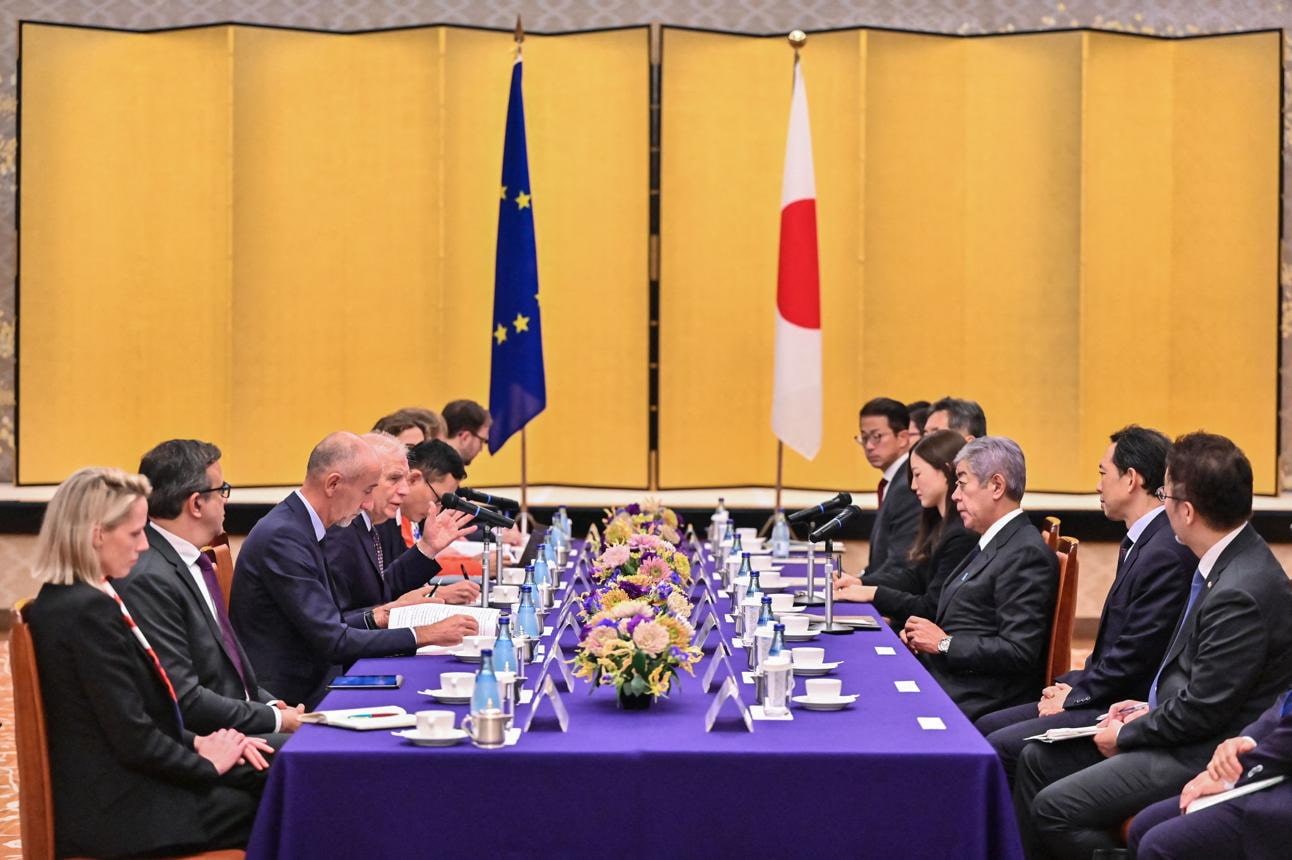
Tokyo: Europe and Japan have spent years calling each other like-minded partners. This year they started proving it on the water. In May, officials from both sides met in Tokyo for their second Security and Defence Dialogue and agreed to move their young partnership from paper pledges toward joint operations. That shift makes defence cooperation the most concrete strand of a relationship long dominated by trade.
The dialogue built on the Security and Defence Partnership that leaders signed in November 2024, the first accord of its kind the European Union has struck with an Indo-Pacific country. That framework spans maritime security, cyber defence, space, hybrid threats and crisis management, and it hands Brussels and Tokyo a standing structure to coordinate rather than merely react to each new shock.
Naval activity now sits at the centre of the effort. Both governments want to run joint exercises and port calls, and they have left the door open to inviting partner navies from third countries into those drills. For Japan, the logic is plain. China’s coast guard presses daily around contested waters, North Korea keeps firing test missiles, and Russian and Chinese warships increasingly patrol together near Japanese shores.
Europe brings its own stake to the table. The bloc ships much of its trade through the sea lanes that run past the Korean peninsula and the South China Sea, and any disruption there would ripple straight back to European ports. Brussels has therefore treated Indo-Pacific stability as a direct economic interest, not a distant concern, and it has sent frigates from member states through the region to underline the point.
Industry marks the next frontier. The two sides agreed to exchange information on defence procurement and to explore where their manufacturers might work together, a step that could gradually knit European and Japanese supply chains. Japan already co-develops a sixth-generation fighter with Britain and Italy under the Global Combat Air Programme, so Tokyo enters any European talks as a producer, not a buyer.
Officials also widened the agenda beyond hardware. They pledged closer work on countering foreign information manipulation, on space security, and on disarmament, threading civilian resilience through what began as a military conversation. That breadth reflects a shared reading of modern conflict, where cables, satellites and social feeds matter as much as fleets.
Obstacles remain. Distance, differing legal rules on arms exports, and Europe’s own stretched defence budgets all limit how fast the partnership can grow. Yet the direction looks settled. By treating deeper defence cooperation as a strategic necessity, Tokyo and Brussels have signalled that the Indo-Pacific and Europe now share one security horizon, and that the two intend to guard it side by side.