November 22, 2026
LATEST
Digital Markets Act Compliance Is Cosmetic, BEUC Warns GatekeepersBanking Competitiveness Report Heads to a 1 December ECON ShowdownAviation Emissions Trading Plan Meets Gulf Pushback at ICAO MontrealEPPO Powers Expansion Wins Backing in Joint Committee VoteOceanEye Alliance Reaches 33 Members After COP31 PushRussian Athletes Divide EU Sport Ministers Over Visa CurbsDublin Consumer Summit Puts AI, Scams and Parcels Before EU LeadersCommon Agricultural Policy Must Stay European, Regional Leaders WarnEU-Egypt Migration Cooperation Widens to Police Training via CEPOLAU-EU Partnership Gets a Four-Pillar Delivery Plan in Addis AbabaEU-Taiwan Semiconductor Cooperation Grows as Beijing Leans on MEPsNorth Korea Sanctions Gain Ten European Partners Beyond the UnionEU-Thailand Trade Deal Enters a Decisive Final Stretch in BangkokCOP31 Climate Deal Puts the EU’s Fossil Fuel Red Line to the TestGDPR Simplification Turns One as MEPs Table 1,840 AmendmentsAudiovisual Media Services Directive Rewrite Hits StrasbourgJaume Duch Takes CPMR President Role With MFF Cohesion Fight AheadEight States Launch EDU-EDIC for Digital Sovereignty in EducationMauritania Fisheries Protocol Lapse Leaves EU Boats Idle at CouncilSerbia EU Accession Gets a Second Wind After the Student List WinDigital Markets Act Compliance Is Cosmetic, BEUC Warns GatekeepersBanking Competitiveness Report Heads to a 1 December ECON ShowdownAviation Emissions Trading Plan Meets Gulf Pushback at ICAO MontrealEPPO Powers Expansion Wins Backing in Joint Committee VoteOceanEye Alliance Reaches 33 Members After COP31 PushRussian Athletes Divide EU Sport Ministers Over Visa CurbsDublin Consumer Summit Puts AI, Scams and Parcels Before EU LeadersCommon Agricultural Policy Must Stay European, Regional Leaders WarnEU-Egypt Migration Cooperation Widens to Police Training via CEPOLAU-EU Partnership Gets a Four-Pillar Delivery Plan in Addis AbabaEU-Taiwan Semiconductor Cooperation Grows as Beijing Leans on MEPsNorth Korea Sanctions Gain Ten European Partners Beyond the UnionEU-Thailand Trade Deal Enters a Decisive Final Stretch in BangkokCOP31 Climate Deal Puts the EU’s Fossil Fuel Red Line to the TestGDPR Simplification Turns One as MEPs Table 1,840 AmendmentsAudiovisual Media Services Directive Rewrite Hits StrasbourgJaume Duch Takes CPMR President Role With MFF Cohesion Fight AheadEight States Launch EDU-EDIC for Digital Sovereignty in EducationMauritania Fisheries Protocol Lapse Leaves EU Boats Idle at CouncilSerbia EU Accession Gets a Second Wind After the Student List Win

OceanEye Alliance Reaches 33 Members After COP31 Push

The OceanEye alliance for global ocean observation has grown to 33 members after a new wave of countries signed up at COP31, the European Commission announced on 18 November 2026. The expansion gives the Union and Canada, which co-chair the initiative, a broader base to fund the sensors, vessels and data systems that track how the ocean is changing.

The new members were welcomed at a COP31 side event titled “Stronger Together for Ocean Observation”, co-hosted by Commissioner for Fisheries and Oceans Costas Kadis and Diana Fox Carney, Canada’s Ocean Envoy and chair of the 12th Our Ocean Conference. IOC-UNESCO and the World Meteorological Organization helped organise the session.

Participants included Albania, Belgium, Cyprus, France, Iceland, Palau, Mexico, the Netherlands, Brazil and India. The Monterey Bay Aquarium Research Institute became the first research organisation to join, a signal that the OceanEye alliance intends to bring scientific institutions alongside governments.

The OceanEye alliance has moved fast. The Commission adopted its OceanEye initiative in June 2026, and the EU and Canada launched the international alliance on the margins of the UN General Assembly in New York in September. At that point it counted 31 members, and the Union put total pledges at no less than €211 million, a mix of cash, in-kind contributions and physical assets such as research vessels, sensors, drones and data-processing capacity.

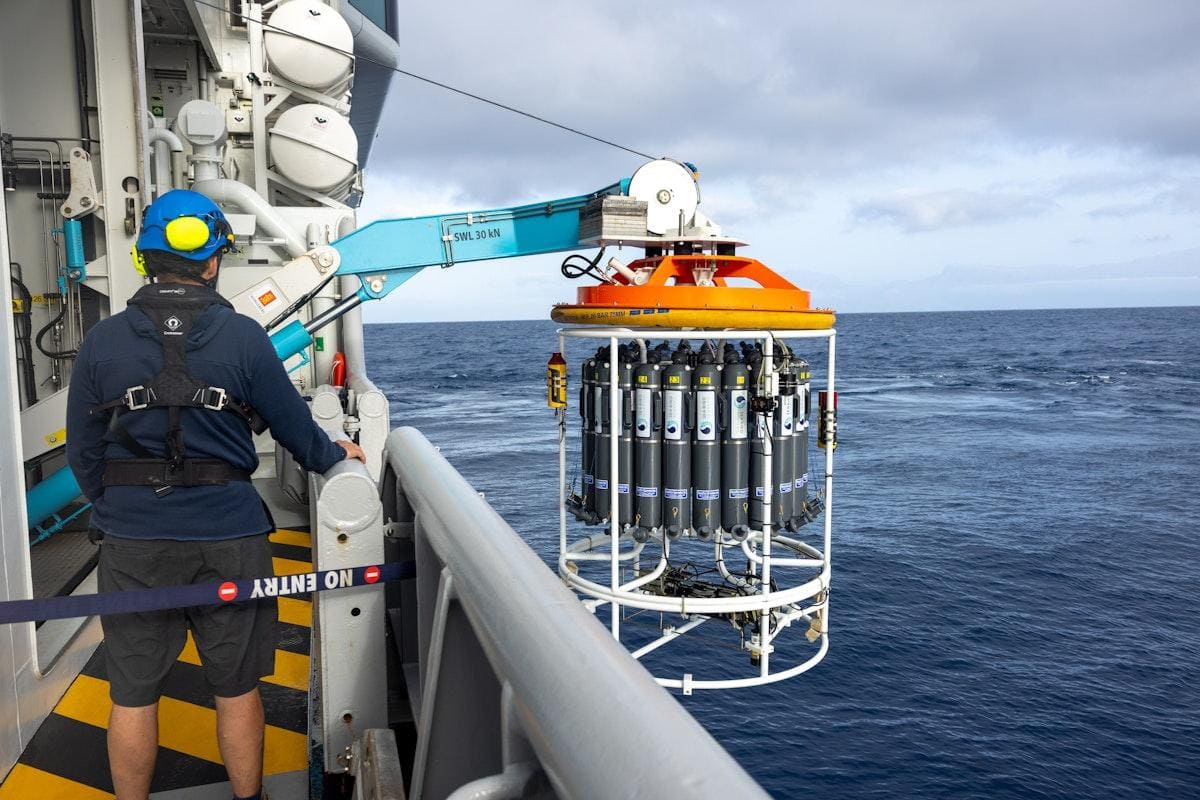
Brussels backs the OceanEye alliance with its own research money. Horizon Europe contributes €50 million for 2026 and 2027, aimed at strengthening the Global Ocean Observing System, the network coordinated through IOC-UNESCO that feeds weather forecasts, climate models and fisheries science.

National pledges show what membership means in practice. Greece, for example, committed to ratify the convention that turns Mercator Ocean International into an intergovernmental organisation, to provide computing power from its EU-financed AI infrastructure for the Digital Twin of the Ocean, and to contribute satellite assets and in-situ observation from the eastern Mediterranean.

The rationale is both scientific and strategic. Large stretches of the deep ocean and the southern hemisphere remain poorly monitored, and gaps in data weaken everything from storm warnings to stock assessments for fishing fleets. For EU maritime policy, better observation underpins the European Ocean Pact, the Common Fisheries Policy and the protection of undersea infrastructure.

There is also a diplomatic dimension. Expanding the OceanEye alliance at a climate summit, at a moment when the EU’s climate leadership is under strain, gives the Union a cooperative ocean agenda that brings in partners such as India, Brazil and small island states like Palau.

The harder test is sustained funding. Ocean observing systems depend on long-term maintenance of buoys, floats and ships, and pledges announced at summits do not always translate into multi-year budgets. With the 2028-2034 EU budget still under negotiation, the scale of future support from Brussels remains open.

The next milestone is turning commitments into operational capacity. The OceanEye alliance will be judged on whether new members fill specific observation gaps, share data openly and keep paying for the infrastructure once the conference spotlight fades.