
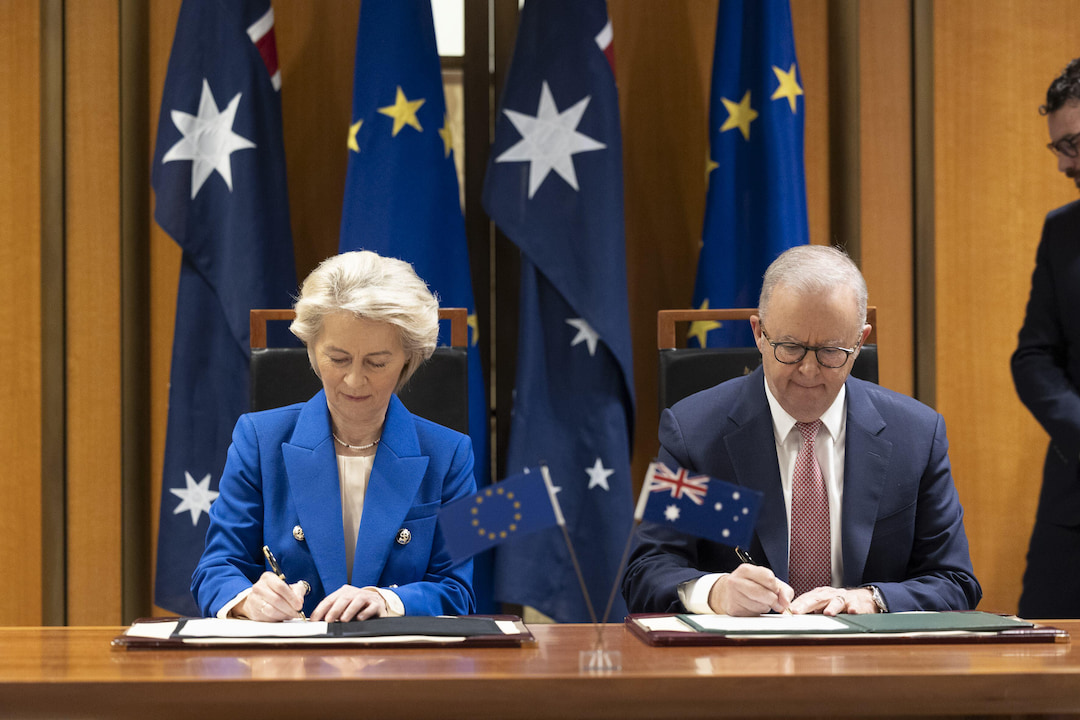
Canberra: The EU-Australia trade agreement has finished its negotiating phase, yet the harder part of its journey, which runs through legal review, Council approval and two parliaments, is only beginning.
Negotiators concluded the text after years of talks, and the deal came alongside a new security and defence partnership between Brussels and Canberra. The pairing shows that both sides treat trade as an instrument of strategic alignment rather than a purely commercial exercise, at a time when supply chains and market access carry geopolitical weight.
According to the Australian government’s published next steps, the draft text must first clear legal checks and translation into the EU’s 24 official languages. That work sounds technical, but it takes months for an agreement as large as the EU-Australia trade agreement, and any drafting disputes can reopen sensitive compromises on agriculture, services or rules of origin.
The European Commission will then submit the agreement to the Council of the EU, where member states can approve it by qualified majority. On the Australian side, officials must complete domestic preparations, including approval by the Federal Executive Council, before signature. Canberra expects that signature in late 2026 or early 2027.
Signature does not end the process. Each side then runs its own ratification procedure, which the Australian government says may take up to another year. In the EU, the European Parliament must give consent, and its trade committee tends to scrutinise sustainability and agricultural chapters closely. In Australia, the Joint Standing Committee on Treaties will examine the agreement, and Parliament may need to pass implementing legislation.
This sequence matters for businesses that already plan around lower tariffs under the EU-Australia trade agreement. Exporters of machinery, food, wine and professional services cannot count on preferential treatment until every domestic step finishes, and the published materials give no firm date for entry into force. Companies should budget for 2027 at the earliest and treat earlier projections with caution.
The timetable also tests the Commission’s recent pattern of concluding deals faster than it ratifies them. Agreements with partners such as Mercosur and Indonesia have shown how legal scrutiny, farm lobbying and parliamentary politics can stretch the calendar well beyond the announcement. The EU-Australia trade agreement looks like an easier case, since Australia is a stable democracy with high regulatory standards, but easy cases still need votes.
Brussels and Canberra now hold a strong political narrative and a long administrative checklist. The EU-Australia trade agreement will deliver its promised benefits only if both governments move the text through translation, Council approval, signature and ratification without letting momentum fade.


