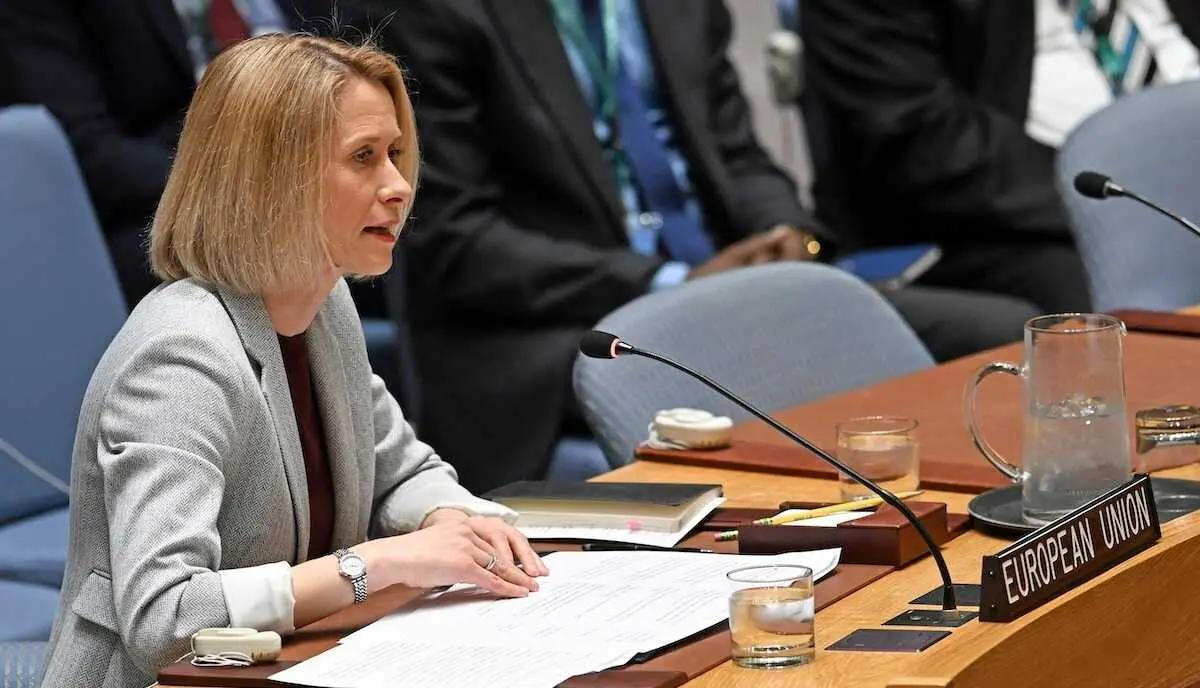
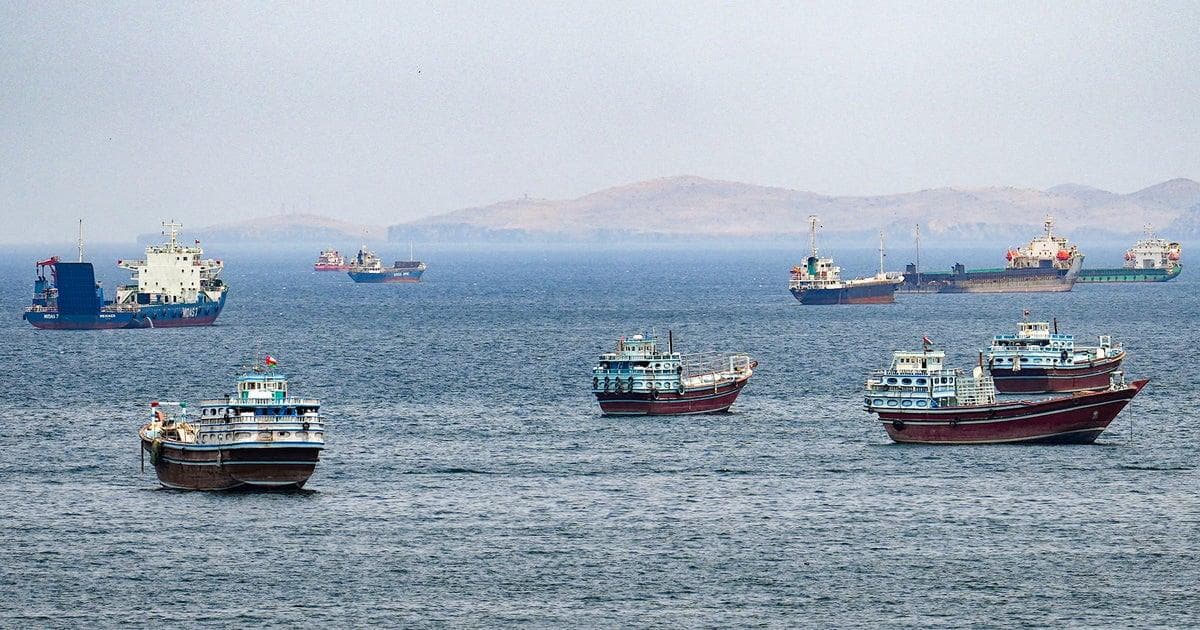
Bandar Abbas: Strait of Hormuz tolls have become the newest fault line in Europe’s dealings with Tehran, after the European Union’s foreign policy chief Kaja Kallas used a meeting with Iranian Foreign Minister Abbas Araghchi on the margins of the UN General Assembly in New York to insist that ships must not pay to pass once the war between the United States and Iran ends. From the waterfront of this Iranian port city, where commercial vessels have sat at anchor for weeks, the argument looks less like a legal abstraction and more like a question of who will own the aftermath of the conflict.
Kallas framed her position in the simplest terms available to a diplomat. No tolls or fees were charged before the war, she said after the talks, and navigation must remain free and unimpeded both in Hormuz and in the Bab al-Mandab at the southern end of the Red Sea. The message was aimed as much at Iran’s parliament as at its foreign ministry, because Iranian lawmakers have already approved rules allowing fines on vessels that cross the strait without authorisation. That legislation sits uneasily with the principle of transit passage set out in the UN Convention on the Law of the Sea, which Europe regards as settled customary law for international straits, and it hands Tehran both a potential revenue stream and a lever over global energy flows.
The timing matters. Kallas spoke as American envoys Steve Witkoff and Jared Kushner held indirect talks with Iranian negotiators in New York, and as Washington described a first round as successfully completed. Europe is not a party to that channel, and the Strait of Hormuz tolls question is one of the few places where Brussels can still shape the terms of any settlement. By setting down a marker now, before a ceasefire text exists, the EU is trying to ensure that freedom of navigation is treated as a baseline rather than as a bargaining chip to be traded against sanctions relief or security guarantees.
The European stake is concrete. A large share of the liquefied natural gas and crude that reaches European refineries and terminals either transits Hormuz or is priced off cargoes that do, and the Gulf states that have become important suppliers since 2022 depend on the same corridor. The EU and the Gulf Cooperation Council already condemned Iranian attacks on GCC territory at an extraordinary ministerial meeting in March, and the Union’s naval operation Aspides remains committed to the Red Sea. A permanent toll regime in Hormuz would set a precedent that other coastal states, from the Horn of Africa to the Black Sea, could be tempted to follow.
Tehran’s reply was predictable in tone. In a separate meeting with Dutch Foreign Minister Tom de Bruijn, Araghchi accused European governments of double standards, arguing that they defend international law while staying silent on American and Israeli military action against Iran. That charge resonates in parts of the Global South, which is precisely the audience the EU is courting in New York this week. Kallas also raised the sharp rise in executions and death sentences inside Iran, a reminder that the Union is trying to hold human rights and maritime security in the same conversation rather than trading one for the other.
The harder question is enforcement. The EU has no naval presence in Hormuz comparable to its Red Sea deployment, and its leverage over Iran rests mainly on sanctions and on the prospect of eventual economic normalisation. If Strait of Hormuz tolls become a condition of Iranian consent to any deal, European capitals will have to decide whether to accept a fee they regard as unlawful or to insist on a principle they cannot easily defend at sea. Kallas has chosen to state the principle early and loudly. Whether that choice holds when the negotiating text arrives will be the real test of Europe’s influence over the settlement of the 2026 Gulf war.