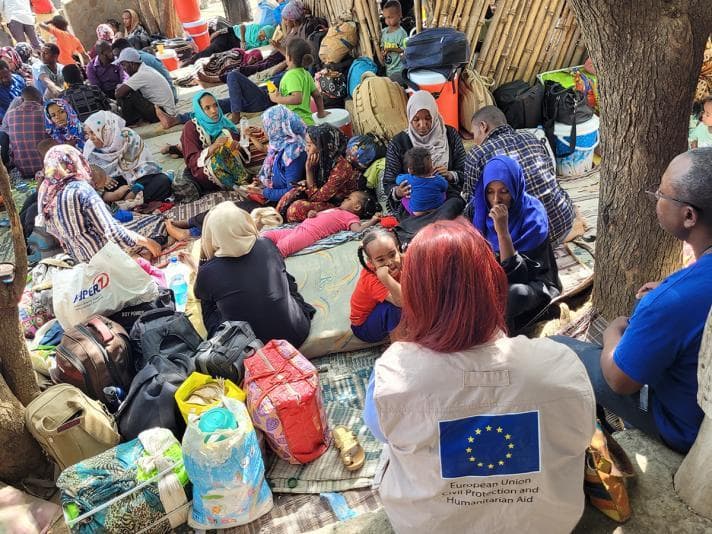
Addis Ababa: The Sudan war has become the gravest test of Europe’s claim to be a humanitarian heavyweight, and the response increasingly runs through the Horn of Africa’s fragile neighbours. When EU foreign policy chief Kaja Kallas travelled to the Ethiopian capital in July, she called Addis Ababa a key partner and spent much of the visit on a conflict that has driven millions across borders.
The numbers explain the urgency. As the Sudan war entered its fourth year, the EU and its member states pledged more than 811 million euros at an April donor conference, with the European Commission putting up 360.8 million. Of that sum, 215.5 million euros goes to people trapped inside Sudan and 145.3 million supports refugees who have fled into Chad, South Sudan, Ethiopia, the Central African Republic and beyond.
Ethiopia matters because it absorbs much of the overflow while wrestling with its own strains. Kallas used her talks with Prime Minister Abiy Ahmed to tie the Sudan war to a wider regional agenda, from the threat posed by Al-Shabaab in Somalia to instability along the Red Sea corridor. A Commission statement on the crisis framed aid and security as two sides of the same problem.
The backdrop is a squeeze on global relief budgets. The Commission set an initial humanitarian budget of 1.9 billion euros for 2026 at a moment when 239 million people worldwide need help and several traditional donors are cutting back. That leaves Brussels shouldering a larger share of a bill it cannot cover alone.
Critics warn that money follows headlines. Sudan’s war has drawn a fraction of the attention given to Ukraine or Gaza, and aid workers say access inside the country remains the binding constraint, not pledges made in European capitals. Fighters block convoys, loot warehouses, and starve whole districts of Darfur and Kordofan.
Ethiopia’s own recovery from years of internal conflict complicates the picture. Addis Ababa needs European investment and debt relief as much as it needs help sheltering refugees, and Kallas signalled that Brussels is willing to bundle the two. That linkage worries some analysts, who fear humanitarian funding could become a bargaining chip in negotiations over migration control or security cooperation. The counter-argument is blunt: without stable neighbours, no amount of aid will reach Sudan’s displaced, and Europe has few alternatives to working through the governments already carrying the load.
A strategic calculation runs underneath the generosity. By deepening ties with Ethiopia and its neighbours, Europe hopes to steady a region where Gulf states, Russia and others compete for influence. Humanitarian aid buys goodwill, yet it also buys a foothold. The danger is that money measured in euros fails to translate into safe passage for the people it is meant to reach. For Europe, the Horn of Africa is now where its values and its interests are tested at once.