

Opting out of paying for Ukraine has never meant giving up the power to block it. Berlin’s budget linkage should be spent on ending that veto, not on buying one more year of money.
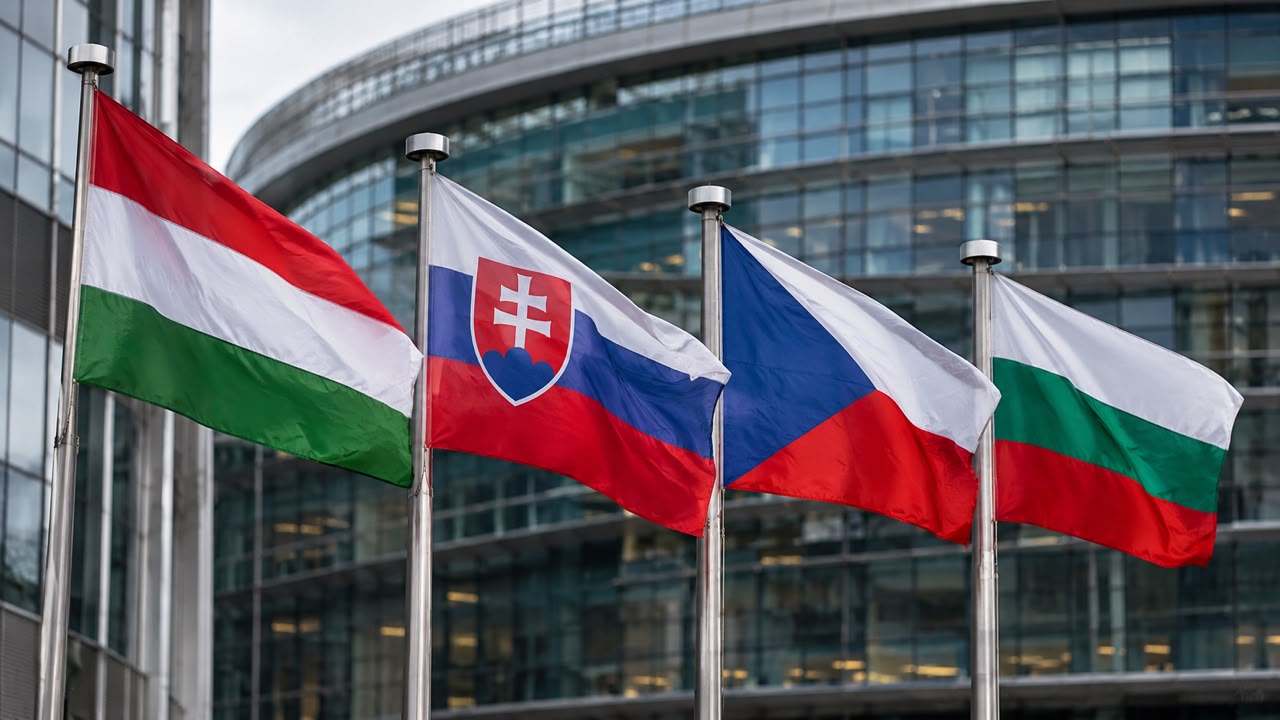
When EU leaders sit down on Thursday, the agenda will read like a question of money. The Commission wants a new Ukraine loan of up to €45 billion for 2027, split between €25 billion for weapons and €20 billion for budget support, to fill two-thirds of a €70 billion gap. Kyiv would repay the principal only once Russia pays reparations. Four governments, those of Hungary, Slovakia, Czechia, and Bulgaria, say they will not take part. On the figures alone, that looks manageable: twenty-three states can carry a loan that four decline.
It is not, because declining to pay and declining to permit are different powers, and the Treaty gives the four both. None of them needs to put in a cent to stop the Ukraine loan. They only need the veto they already hold.
The Case for Linkage
The argument for Berlin’s approach deserves a fair hearing. Chancellor Friedrich Merz has written to European Council President António Costa making German support for the 2028–2034 budget conditional on the €45 billion and on a financing outlook for Ukraine beyond 2028. The logic is plain. All four holdouts draw heavily on cohesion funds. Tie Ukraine to the seven-year budget, and refusing Kyiv starts to cost them their own regional money.
There is a fairness point too. Germany will put €11.6 billion of bilateral aid into Ukraine next year. The Nordic and Baltic governments have given heavily since 2022. When Slovak Prime Minister Robert Fico says “we’ve done enough,” the contributors are right to ask why the bloc’s shared budget should keep serving those who opt out of its shared duties.
Linkage may well work this week. Ursula von der Leyen says she is “very confident” all 27 will join. Costa has tabled a compromise that reportedly sets aside €100 billion of headroom for Ukraine in the next budget, and capitals are aiming for a deal before the year is out.
What the €90 Billion Taught
The trouble is that Europe ran this test twelve months ago and learned the wrong lesson from it.
In December 2025, leaders agreed a €90 billion Ukraine Support Loan for 2026 and 2027. Czechia, Hungary, and Slovakia refused to back it, so the other 24 went ahead through enhanced cooperation, the treaty route that lets a willing group act without everyone. The Council confirmed that the three would face no change to their budget contributions. The European Parliament approved the procedure by 499 votes to 135.
It looked like a clean escape from the holdouts. It was not. The loan itself rested on Article 212 and passed by qualified majority. But the guarantee behind it required an amendment to the budget regulation, and that needed all 27 governments. On 23 February, Hungary blocked that amendment, citing the delivery of Russian oil through Ukraine, despite having agreed to it earlier, as the European Parliament’s research service records. A country that had opted out of paying kept €90 billion from reaching Ukraine for two months over its own oil supply. Budapest lifted the block in late April, after Orbán lost the 12 April election and once Russian oil was flowing again, and the Council completed the package on 23 April.
The new Ukraine loan repeats the design. Alongside the loan itself, the Commission’s package includes a change to the current budget regulation so that spare budget room can guarantee the money. That change falls under Article 312(2) of the Treaty: the Council adopts the budget regulation unanimously, after Parliament consents by a majority of its members. Any one of the four can block it, whether or not it ever lends Kyiv a euro. On Wednesday, a Commission spokesperson was reported as saying no member state would make a direct payment, since the EU would borrow against budget headroom. The Commission’s own proposal is more exact. Any draw on the guarantee would be met above the budget’s spending ceilings, up to the limit of what the EU can draw from national budgets. Interest is left open: the Union “may decide” to subsidise it, with bills expected from 2028 and their coverage left to the next seven-year budget. No direct payment is not the same as no cost. It is a cost deferred into the very budget now on the table, and the holdouts are refusing a share of that exposure, not an invoice of their own.
The Price of Unanimity
This is why the headline numbers mislead. The 2027 Ukraine loan is presented as a burden to be shared. In practice it is a veto to be bargained over. The bargaining has begun: von der Leyen has suggested that reluctant governments could steer their commitment to the civilian portion, and Fico has threatened to veto the budget itself. It also has a calendar. National ambassadors met on Tuesday and could not settle even whether interest on existing Ukraine debt sits inside or outside the budget ceilings. A Commission analysis puts that interest at €55.4 billion over the next seven years. Paris has reportedly warned that if talks drift into January, a deal before France’s April presidential election becomes much harder.
Merz’s linkage makes this worse, not better. Once Ukraine money and regional money travel together, every holdout has a price, and the price is paid in cohesion funds, energy exemptions or rule-of-law leniency. The bloc then has to pay it again next year, because the €45 billion covers only 2027. The cost of Ukraine to the Union stops being the loan and becomes the concessions needed to unlock it each time.
Moscow understands this better than Brussels admits. A government that wants to stall each Ukraine loan no longer has to win a debate in the Council. It needs one friendly capital and one budget amendment.
Where Berlin’s Card Belongs
Berlin holds a strong card. It should play it for a lasting rule change on the Ukraine loan, not a single year’s money.
Article 312(2) contains its own exit. The European Council may decide, unanimously, to let the Council act by qualified majority “when adopting” the budget regulation. Unlike the Treaty’s general bridging clause, this one gives national parliaments no veto. No European Council has yet used it. Two cautions apply. The switch itself needs all 27, so the holdouts can refuse it. And the clause speaks of adopting the regulation, not amending it. Every budget-backed guarantee for Ukraine so far has been added by amendment, and whether the clause reaches later amendments is untested. That is a question for the Council’s lawyers to settle before leaders rely on it, which is reason to ask it now. The loan instruments already pass by majority; only the guarantee needs the switch. Germany has already said it wants future increases in Ukraine funding decided by qualified majority. The next budget talks, where Berlin’s consent is needed too, are the one moment it can trade for that switch.
If the holdouts refuse even that, the willing have a route that bypasses the budget rule, and Ukraine has already tested it. In 2022, the EU lent Kyiv €6 billion through two decisions adopted by Parliament and Council, €1 billion in July and €5 billion in September, neither requiring unanimity. The second decision, based on Article 212, also restructured the cover for both loans. Of the €6 billion, 70% was covered: 9% paid in from the EU budget and 61%, up to €3.66 billion, through callable guarantees that member states volunteered in line with their share of national income. The SURE instrument used the same device on a larger scale in 2020. A 2027 Ukraine loan might be built on that model, with the willing signing guarantee agreements and the Commission borrowing against them, and no budget amendment required. The Treaty’s rule that participants in enhanced cooperation bear its costs points in a similar direction. But these pieces have never been assembled together, and whether they can be is for the Commission and Council legal services to establish, not for a summit communiqué to assume. The differences are real. At €45 billion, the proposed Ukraine loan would be seven and a half times that €6 billion, and because Kyiv repays only from reparations, a call on the guarantees is a working assumption, not a remote risk. Finance ministries would have to say so. What it buys is certainty.
Neither route is ready to use tomorrow. Both could be ready by the next budget, if Berlin asks for the legal work this week instead of trading its card for the 2027 cheque alone.
The four governments are entitled to decline to pay. What they should not keep is the power to decide, every year, whether everyone else may. This week’s summit can buy Ukraine another twelve months, or it can end the annual hostage-taking. Only the second is worth what Germany has put on the table.
ABOUT THE AUTHOR
Matthias Schneider is a Senior Analyst specialising in external relations and diplomacy. He writes on European foreign policy, diplomatic strategy, multilateral alliances, and international security cooperation for The European Post.