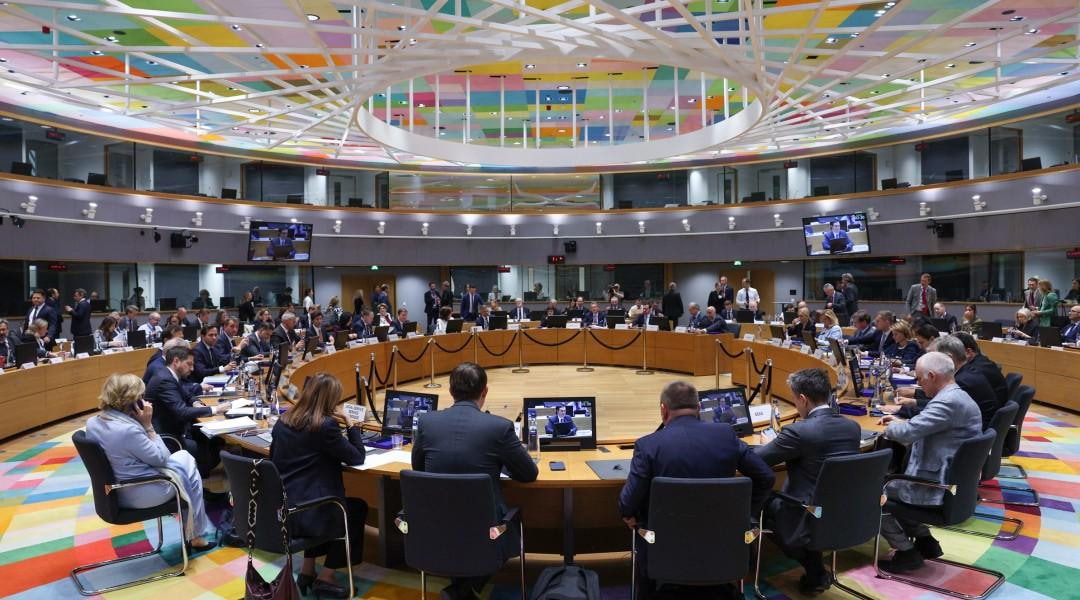
Rue de la Loi: The CPTPP trade dialogue will share the table with Washington when EU trade ministers meet in Brussels on 30 November 2026. The Irish Council Presidency has set an agenda covering relations with the United States, economic security, trade diversification and the Comprehensive and Progressive Agreement for Trans-Pacific Partnership, and the timing gives the Pacific item more weight than a routine briefing.
A Trade Council shaped by Section 301
On 25 November, President Donald Trump imposed new tariffs on 14 trading partners, the EU among them, under a Section 301 investigation into alleged industrial overcapacity. Commission deputy chief spokesperson Olof Gill said the EU strongly rejects the premise that Europe causes structural overcapacity.
Brussels insists that any new duty must respect the all-inclusive 15% ceiling in the Turnberry joint statement. Ministers will also meet US Trade Representative Jamieson Greer on 30 November. Steel and aluminium derivative surcharges, which Washington must lift before the end of the year, are expected to dominate that exchange.
Why the CPTPP trade dialogue matters now
The CPTPP brings together 12 economies: Australia, Brunei, Canada, Chile, Japan, Malaysia, Mexico, New Zealand, Peru, Singapore, Vietnam and the United Kingdom. The EU and the bloc held their first trade and investment dialogue in November 2025. A year later, ministers are asking what that channel can deliver while transatlantic rules grow less predictable.
The answer starts with existing deals. The EU already has trade agreements with most CPTPP members, including Japan, Canada, Singapore, Vietnam, Mexico, Chile, New Zealand and the UK. A CPTPP trade dialogue therefore does not open new markets so much as connect agreements Brussels has already signed.
Rules of origin and supply chains
The practical prize of the CPTPP trade dialogue lies in regulatory cooperation. Talks could cover customs procedures, digital trade rules and supply-chain transparency for critical inputs. Convergence on these technical files would let firms treat a web of bilateral deals as something closer to one rulebook. For exporters squeezed by US tariffs, cheaper compliance across the Pacific is a tangible gain.
Where diversification runs into hard limits
Diversification through the CPTPP trade dialogue has its arithmetic limits. The United States remains the EU’s largest export market, and no Pacific partnership can replace that demand within a budget cycle. EU membership of the CPTPP is not on the table either. The Union negotiates as a customs union, and joining would require it to reopen its own trade architecture.
There is also a coherence risk. The Commission is tightening economic-security tools, from foreign direct investment screening to export controls, while courting partners that prize open markets. Ministers will hear the Commission’s annual progress report on simplifying and enforcing trade and economic-security legislation. That report should show whether Brussels can be both a defender of rules and a builder of openness.
What to watch on 30 November
Three signals will matter. The first is whether ministers back a work programme for the CPTPP trade dialogue, with named topics and dates, rather than a general statement of interest. The second is how firmly they defend the 15% ceiling in the session with Greer. The third is whether the Council links diversification to the deals still pending, such as the EU-Malaysia and EU-Philippines talks.
The EU’s leverage in Washington grows when its alternatives look credible. A structured CPTPP trade dialogue, backed by concrete cooperation on rules, would give Brussels that credibility at a moment when the transatlantic relationship offers little of it.