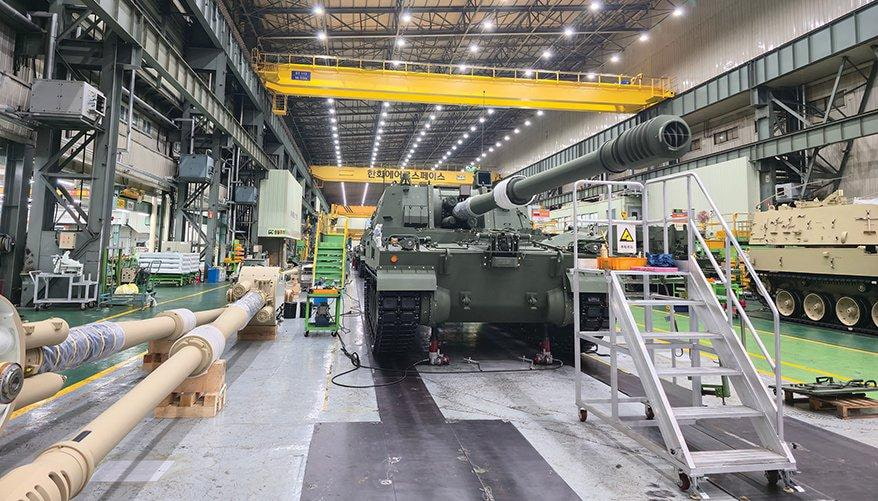
Changwon: The industrial belt along South Korea’s southern coast turns out artillery systems and armoured hulls at a tempo European plants have not matched in a generation. Poland discovered that first, ordering K2 tanks and K9 self-propelled guns when domestic suppliers quoted delivery dates a decade out. The defence partnership Brussels signed with Seoul in November 2024 now faces a narrower and harder test than any summit communique admits, because political alignment and funding eligibility are not the same thing.
The European Union created its Security Action for Europe instrument to lend member states roughly 150 billion euros for joint procurement of priority capabilities. The regulation opens the door to third countries, but it opens it in two stages. A country first needs a security and defence partnership with the Union. It then needs a separate bilateral agreement that member states endorse. Canada walked through both doors and became the first non-European participant in December 2025.
South Korea holds the first credential and not the second. Seoul and Brussels signed their partnership alongside Japan, making the two countries the earliest Asian signatories, and leaders reviewed implementation at the summit in Brussels in June 2026. None of that converts a Korean subsystem into an eligible cost under the loan instrument.
The gap matters more than it looks. SAFE caps how much of a contract’s component value may originate outside the Union, the European Economic Area and Ukraine. European primes read that cap as the whole point of the exercise: the instrument exists to rebuild continental production lines, not to subsidise imports that arrive faster. Warsaw, Tallinn and Bucharest read it differently. They want ammunition and tubes this decade, and Korean yards already deliver on schedules European order books cannot promise.
Korean industry has an answer that suits both readings, and it has been executing it quietly. Hanwha and its peers have moved toward licensed production, joint ventures and local assembly inside Poland rather than pure export. Every hull welded in Gliwice counts as European content. That structure turns an eligibility argument into a factory-location argument, which is far easier for Brussels to accept and far more valuable to Polish suppliers than another shipment from Changwon.
The counterargument deserves a hearing. Opening the instrument to a major exporter risks locking European buyers into foreign design authority, foreign spare-part chains and foreign export-licence politics precisely when the Union argues for strategic autonomy. Korea also sells to states the Union sanctions or scrutinises, and its own export-control decisions answer to Seoul, not to any European capital.
What is missing is a decision rather than a debate. The Commission can negotiate a Korean participation agreement on the Canadian template, with conditions on technology transfer, industrial offsets and end-use controls, or it can leave Seoul outside and accept that member states will keep buying Korean equipment with national money instead. The second outcome achieves nothing the first prevents. It simply moves the same purchases off the Union’s books and out of its leverage.
Japan sits in the identical position and watches the same precedent. Whichever country Brussels handles first will set the terms for the other, and for every Indo-Pacific partner that signs a defence partnership expecting it to lead somewhere.