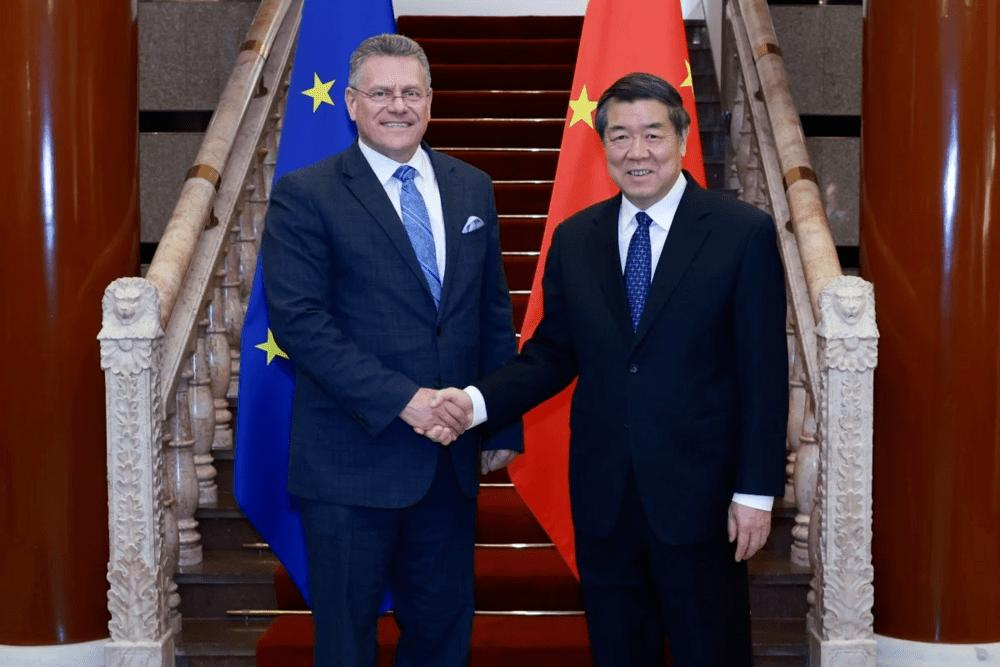
Beijing: The EU China trade talks held on 8 and 9 October 2026 ended with a sixteen-point consensus covering hybrid vehicles, rare earth licences and export controls, although the hardest questions were postponed rather than solved. Trade Commissioner Maroš Šefčovič met Commerce Minister Wang Wentao for the second China-EU trade and investment consultation, and he also saw Vice Premier He Lifeng, according to Chinese state media.
The consultation mechanism is young. It was set up on 29 June 2026 in Brussels with four working groups, and by late July each side had held more than twenty consultations. That cadence explains why the EU China trade talks produced a written outcome instead of a general statement of goodwill. A ministerial video meeting is planned for January 2027 and a third consultation for March 2027.
The concrete deliverables of the EU China trade talks are narrow. Both sides reached an understanding on hybrid vehicle trade in line with World Trade Organization rules, and China agreed to keep facilitating export licences for rare earths and permanent magnets through a so-called green channel. The EU, for its part, will work with member states on priority dual-use export licence cases for China. The two sides also said they would keep exploring lower tariffs on certain products.
Electric vehicles remain unsettled after the EU China trade talks. The Chinese account says the procedures on company-specific price undertakings continue, and that the EU anti-subsidy investigation will keep being reviewed. That wording keeps the dispute alive without escalating it, which suits both governments while the licensing questions are still moving.
The tone of the EU China trade talks was careful. Wang said China is not the source of the EU’s problems but a partner in solving them, and he urged both sides to manage frictions through dialogue consistent with WTO rules. Šefčovič called China an important trade partner and said he was willing to deepen the consultations. The report also notes that 44 European industry associations have urged tougher trade defence, a reminder of the pressure Brussels faces at home.
A green channel is an administrative promise, not a legal guarantee. European makers of motors, electronics and defence components need licences that arrive on predictable timelines, and delays can occur without any formal change in policy. The reciprocal EU pledge on dual-use licences shows that China has its own complaints about export controls, so the EU China trade talks are a swap of procedural assurances rather than a reduction of leverage on either side.
One caveat matters for readers of the EU China trade talks. Most of these details come from Chinese state media, so the Commission’s own readout deserves a close comparison before conclusions are drawn. Where the two accounts differ, the gap will usually sit in the wording on electric vehicles and on how quickly licences are processed.
The next test is delivery. If rare earth and magnet licences keep flowing and the hybrid vehicle understanding is turned into clear rules, the EU China trade talks will have lowered the temperature at modest cost. If licences stall before the January 2027 video meeting, the sixteen points will look like a pause in a longer contest over supply chains and market access.