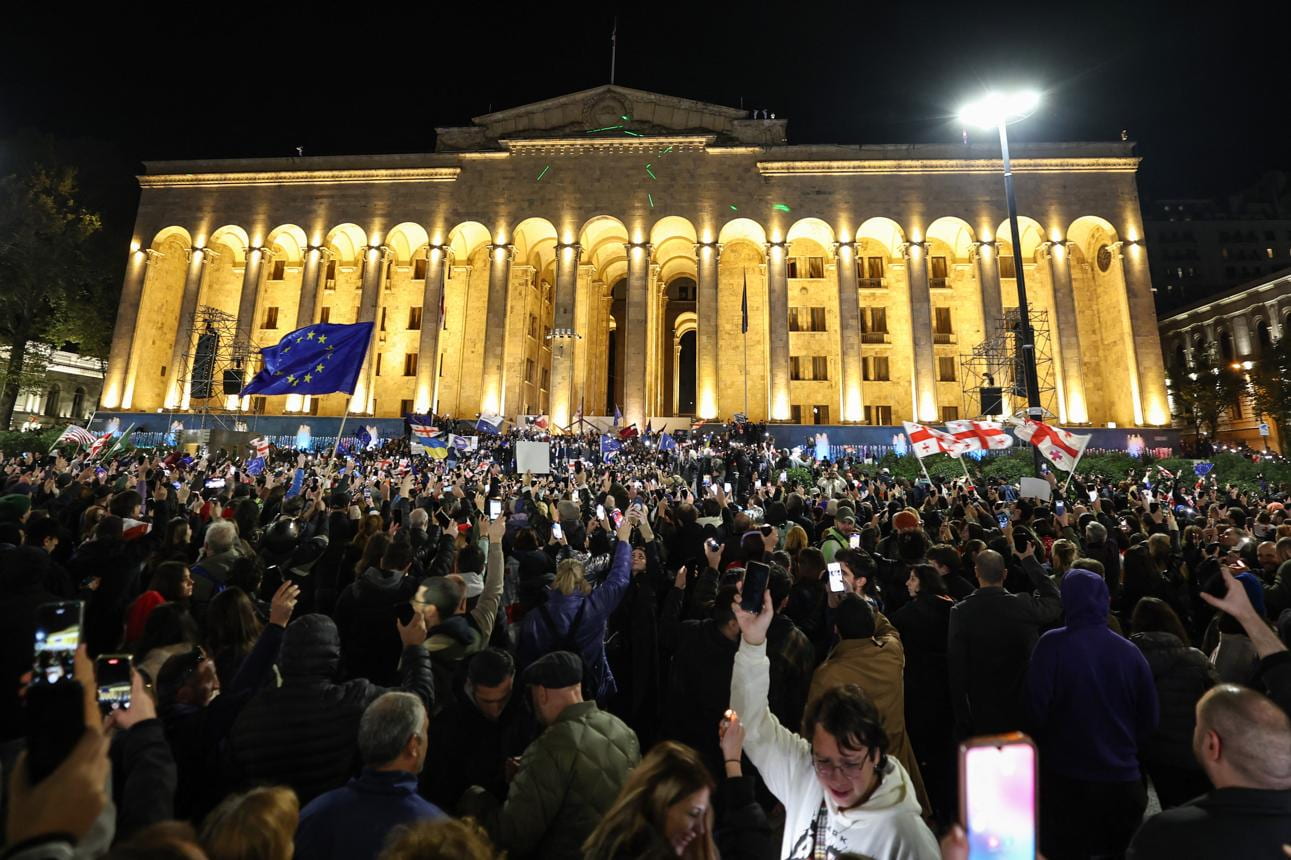
Tbilisi: The Georgia opposition party ban case has become the clearest test of how far Brussels will go to defend democratic standards in a candidate country whose accession path is already frozen. Eighty-eight governing-party lawmakers asked the Constitutional Court to outlaw five opposition groups: Unity – National Movement, Coalition for Change, Strong Georgia, the Federalist Party and Gakharia for Georgia. The court was scheduled to hear the case from 21 to 23 October 2026, and a ruling had not been widely reported at the time of writing.
The weight of the Georgia opposition party ban request is hard to miss. Four of the five parties cleared the 5 percent threshold in the 2024 parliamentary election, and the Central Election Commission counted 784,820 votes for them, or 37.79 percent of ballots cast. The ruling party justifies the move by pointing to the opposition’s refusal to recognise the 2024 results, its calls for Western sanctions and alleged sabotage. Critics see an attempt to remove most of the political competition through the courts.
Brussels has responded to the Georgia opposition party ban in several registers. Commission spokesperson Christian Wigand said the EU was closely monitoring the case and described it as a concerning instrumentalisation of the judicial system. He also called for the release of journalist Vakho Sanaia, held in administrative detention, and for repeal of repressive laws. The European Parliament went further on 8 October 2026, adopting a resolution by 445 votes to 37 with 97 abstentions that demands the claim be withdrawn and calls for targeted sanctions and visa bans on named leaders, including Bidzina Ivanishvili.
The legal tools beyond the Georgia opposition party ban case are real but slow. After a Visa Suspension Mechanism report of 19 December 2025 found further backsliding, the Commission began by suspending visa-free travel for holders of diplomatic, service and official passports. Ursula von der Leyen has said a second stage could reach all Georgian citizens if violations continue. Financial assistance to the government is already suspended, and the European Council concluded in 2024 that the accession process was effectively on hold. Sanctions on individuals still require unanimity, and diplomats say one member state has obstructed that step.
The outcome of the Georgia opposition party ban hearing will shape the next decision in capitals. A ban would give supporters of tougher measures a concrete trigger, while a rejection could leave the government claiming vindication without changing its course. Either way, the Georgia opposition party ban case shows that Brussels now has more leverage through visa rules and targeted measures than through the enlargement framework itself, and it will have to decide whether to use it.