September 16, 2026
LATEST
Software Makers Face Europe’s Product Liability Deadline in DecemberCage-Free Promises Land Before the Transport File Is FinishedTwo New Calls Will Test How Flexible Horizon Europe Really IsEurope’s Innovation Act Counts 10 Billion It Has Not Found YetProcurement Is the Chapter That Could Stall the Thailand DealMobility Week Returns With a Test of Intergenerational FairnessMinisters Debate the Chips Act Next Week With No Money AttachedTaiwan Wants Tax Treaties That Brussels Has No Power to SignNorth Korea Now Earns From Europe Without Shipping AnythingPalm Oil Is the Last Hard Question Before the Indonesia SigningCan One Year Deliver Both a Trade Deal and a Sea CodeVietnam Reached Europe’s Top Partnership Tier With Little DetailLeaked Draft Puts Europe’s Social Media Age Limit at FifteenA Ceuta Debate Whose Title Has Already Reached a VerdictFP10 Clears Committee and the Budget Gap Stays Wide OpenEurope’s New Merger Guidelines Face a Council Test Next WeekEurope’s Culture Capitals Face Their Biggest Rewrite Since 1985Only Italy Has a Bill as Platform Work Deadline NearsCustoms Fraud Charges Land in Germany Over Wrecked CarsCar Tariffs Show Why the India Deal Still Needs Two VotesSoftware Makers Face Europe’s Product Liability Deadline in DecemberCage-Free Promises Land Before the Transport File Is FinishedTwo New Calls Will Test How Flexible Horizon Europe Really IsEurope’s Innovation Act Counts 10 Billion It Has Not Found YetProcurement Is the Chapter That Could Stall the Thailand DealMobility Week Returns With a Test of Intergenerational FairnessMinisters Debate the Chips Act Next Week With No Money AttachedTaiwan Wants Tax Treaties That Brussels Has No Power to SignNorth Korea Now Earns From Europe Without Shipping AnythingPalm Oil Is the Last Hard Question Before the Indonesia SigningCan One Year Deliver Both a Trade Deal and a Sea CodeVietnam Reached Europe’s Top Partnership Tier With Little DetailLeaked Draft Puts Europe’s Social Media Age Limit at FifteenA Ceuta Debate Whose Title Has Already Reached a VerdictFP10 Clears Committee and the Budget Gap Stays Wide OpenEurope’s New Merger Guidelines Face a Council Test Next WeekEurope’s Culture Capitals Face Their Biggest Rewrite Since 1985Only Italy Has a Bill as Platform Work Deadline NearsCustoms Fraud Charges Land in Germany Over Wrecked CarsCar Tariffs Show Why the India Deal Still Needs Two Votes
September 16, 2026
LATEST
Software Makers Face Europe’s Product Liability Deadline in DecemberCage-Free Promises Land Before the Transport File Is FinishedTwo New Calls Will Test How Flexible Horizon Europe Really IsEurope’s Innovation Act Counts 10 Billion It Has Not Found YetProcurement Is the Chapter That Could Stall the Thailand DealMobility Week Returns With a Test of Intergenerational FairnessMinisters Debate the Chips Act Next Week With No Money AttachedTaiwan Wants Tax Treaties That Brussels Has No Power to SignNorth Korea Now Earns From Europe Without Shipping AnythingPalm Oil Is the Last Hard Question Before the Indonesia SigningCan One Year Deliver Both a Trade Deal and a Sea CodeVietnam Reached Europe’s Top Partnership Tier With Little DetailLeaked Draft Puts Europe’s Social Media Age Limit at FifteenA Ceuta Debate Whose Title Has Already Reached a VerdictFP10 Clears Committee and the Budget Gap Stays Wide OpenEurope’s New Merger Guidelines Face a Council Test Next WeekEurope’s Culture Capitals Face Their Biggest Rewrite Since 1985Only Italy Has a Bill as Platform Work Deadline NearsCustoms Fraud Charges Land in Germany Over Wrecked CarsCar Tariffs Show Why the India Deal Still Needs Two VotesSoftware Makers Face Europe’s Product Liability Deadline in DecemberCage-Free Promises Land Before the Transport File Is FinishedTwo New Calls Will Test How Flexible Horizon Europe Really IsEurope’s Innovation Act Counts 10 Billion It Has Not Found YetProcurement Is the Chapter That Could Stall the Thailand DealMobility Week Returns With a Test of Intergenerational FairnessMinisters Debate the Chips Act Next Week With No Money AttachedTaiwan Wants Tax Treaties That Brussels Has No Power to SignNorth Korea Now Earns From Europe Without Shipping AnythingPalm Oil Is the Last Hard Question Before the Indonesia SigningCan One Year Deliver Both a Trade Deal and a Sea CodeVietnam Reached Europe’s Top Partnership Tier With Little DetailLeaked Draft Puts Europe’s Social Media Age Limit at FifteenA Ceuta Debate Whose Title Has Already Reached a VerdictFP10 Clears Committee and the Budget Gap Stays Wide OpenEurope’s New Merger Guidelines Face a Council Test Next WeekEurope’s Culture Capitals Face Their Biggest Rewrite Since 1985Only Italy Has a Bill as Platform Work Deadline NearsCustoms Fraud Charges Land in Germany Over Wrecked CarsCar Tariffs Show Why the India Deal Still Needs Two Votes

CBAM Extension Reaches Plenary With 180 Products in Scope

The CBAM extension has spent nine months moving between three institutions and is now close to the point where it stops being a proposal. Parliament’s environment committee has approved its amendments, plenary adoption follows this month, and trilogue negotiations with the Council open once that vote lands. Importers who assumed the carbon border levy would stay confined to raw steel and aluminium have until then to reconsider.

The Commission opened this file in December 2025 with a proposal to pull roughly 180 downstream products into scope. Engines, refrigerators, fasteners, wire, springs, vehicle components, domestic appliances, fabricated metal parts and construction equipment all appear on the list. The logic runs simply: a levy that taxes imported steel slab but ignores an imported machine made from the same slab creates an obvious route around the rule, and importers found it quickly.

Member states went further than the Commission asked. The Council agreed its position on 12 June 2026 and backed a broader industrial product range, with the extension biting from 1 January 2028. Capitals also supported the anti-circumvention package, which brings pre-consumer steel and aluminium scrap in as CBAM precursors, tightens controls on misdeclaration, and lets the Commission restrict the use of actual emissions values where declarations look unreliable.

Parliament’s committee took the same direction and pushed harder on processed goods, adding finished steel and aluminium products that the Commission had left out. Two chambers arriving at broadly the same answer from different starting points usually means a short trilogue. The remaining fights sit in the detail rather than the principle.

Those details carry real money. The conditions for temporary exemptions in exceptional circumstances remain contested, and every exporting government from Ankara to New Delhi reads that clause as the escape valve. The treatment of scrap will decide whether European recyclers gain a protected market or lose access to cheap imported feedstock, and the two readings point in opposite directions. Restricting actual emissions values protects the system from creative accounting while penalising genuinely clean producers who cannot get their data verified to European standards.

Downstream coverage also changes who has to comply. A steel importer runs a procurement department that can absorb a reporting obligation. A mid-sized company importing pumps or gearboxes does not, and it now has to trace embedded emissions through a supply chain it did not build and cannot audit. The Commission’s own guidance assumes a level of supplier cooperation that many buyers will struggle to obtain from factories in third countries with no reason to help.

Trade partners have not gone quiet. India, Turkey, Brazil and China have all challenged the mechanism’s compatibility with World Trade Organization rules, and extending it to downstream goods widens the exposed surface. The EU’s defence rests on treating CBAM as an internal carbon price applied at the border rather than a tariff, and that argument holds more comfortably for a tonne of slab than for a finished appliance whose embedded emissions require estimation.

The de minimis threshold introduced earlier this year cuts the other way and deserves credit. Exempting importers below a 50 tonne annual limit removed most small operators from the reporting burden while retaining coverage of the great majority of emissions. Whether that threshold survives contact with a product list that now includes small, high-value manufactured goods is one of the questions negotiators will settle.

Steel producers inside the EU want the extension and want it faster, arguing that carbon leakage has already moved down the value chain while lawmakers debated. Importers and downstream manufacturers argue that 2028 barely allows time to rebuild procurement systems. Both are describing the same problem from opposite ends, and neither will get the full answer.

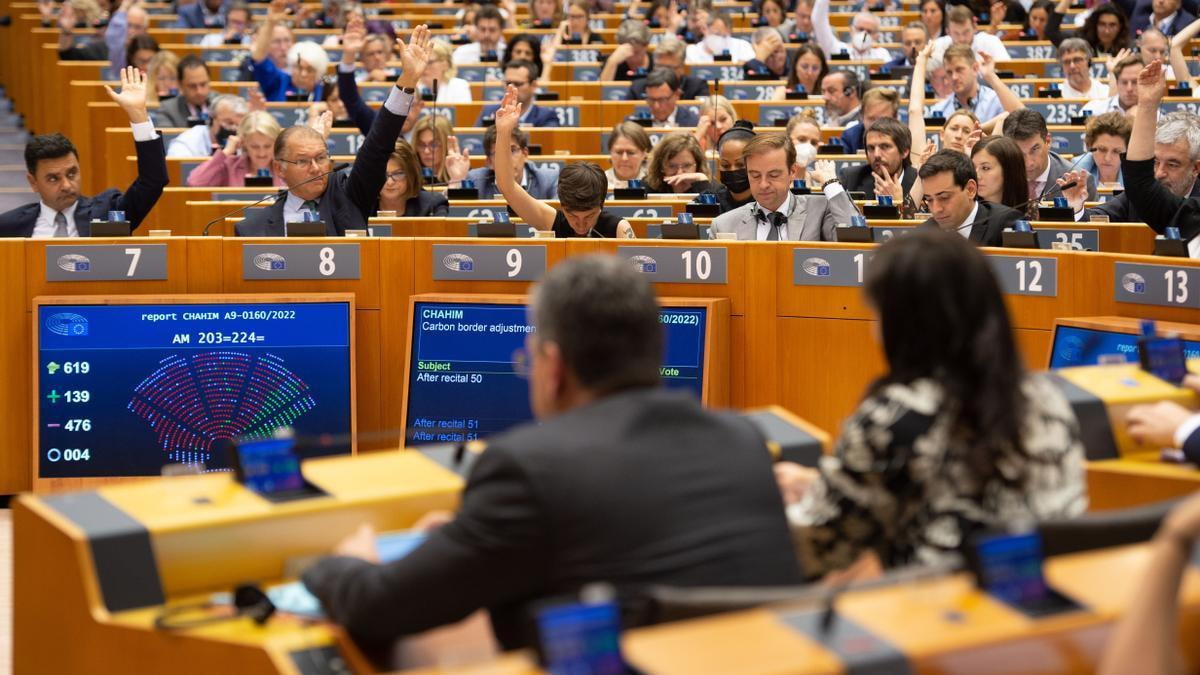
Watch the plenary margin. A comfortable majority hands Parliament’s negotiators room to hold their position on scope; a narrow one invites the Council to trade downstream coverage against exemption flexibility. The parliamentary research briefing on the revision sets out where the two positions still diverge, and that gap is what trilogue has to close before the end of the year.