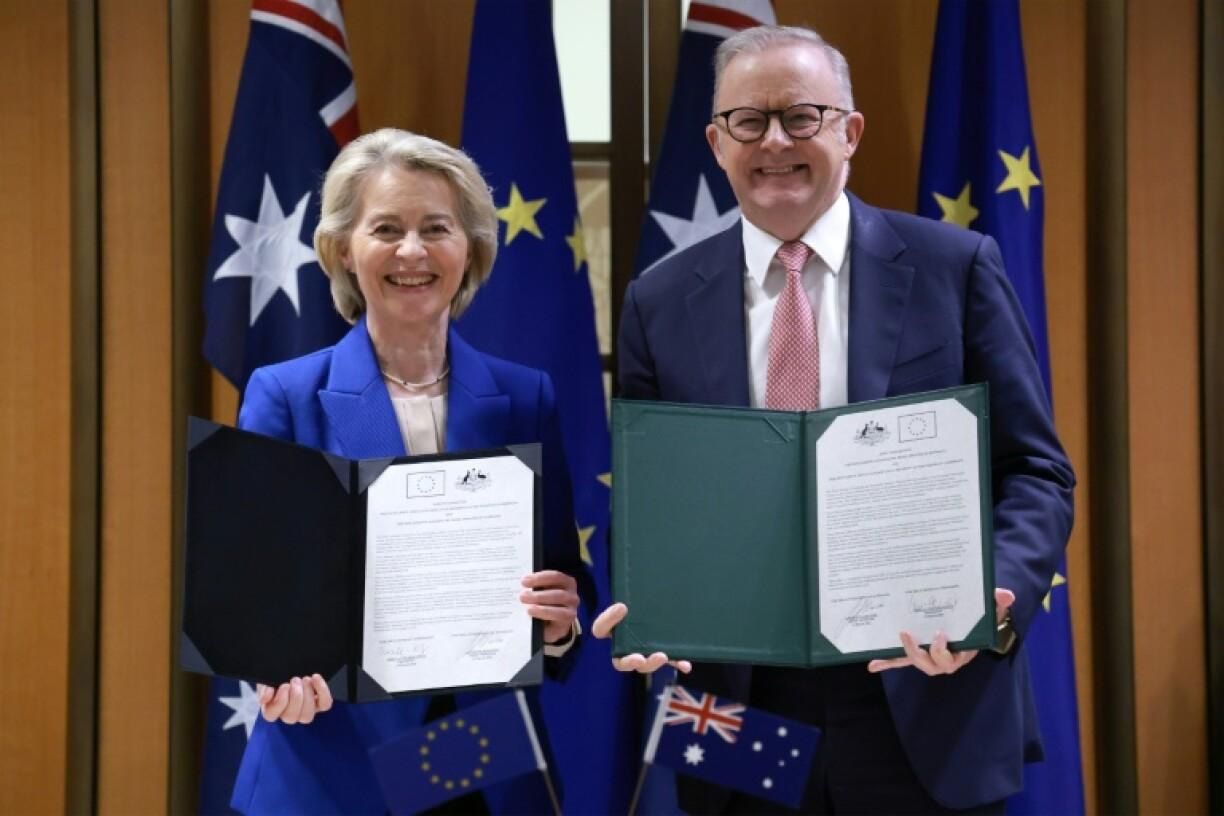
Kalgoorlie: Nickel and gold built this Western Australian town, and lithium now keeps its contractors busy. Mine managers here watched European negotiators walk away from a trade deal twice before, so the agreement concluded on 24 March 2026 arrived with a certain weary scepticism attached.
Eight years of talks produced a text that removes more than 99 percent of tariffs on European goods and lets 98 percent of Australian export value enter the Union duty free. Lithium, antimony, tungsten and rare earths gain tariff-free access. The parties also agreed to upgrade the 2024 strategic partnership on sustainable critical minerals and wrote in professional mobility provisions running to four years.
Concluding negotiations settles almost nothing about when any of this applies. Lawyers on both sides must now scrub the text, translators must render it into 24 official languages, and the Council must adopt a decision authorising signature. Officials on both sides point to late 2026 or early 2027 for the formal signing ceremony.
The European Parliament then has to give consent. Australia’s Joint Standing Committee on Treaties will run its own scrutiny and Canberra must pass implementing legislation. If member states classify the agreement as mixed rather than exclusively European in competence, national parliaments join the queue and the timetable stretches further.
Miners reading the Australia trade text quickly notice that tariffs were never their binding constraint. European duties on unprocessed ores were already close to nothing. What changes their economics sits elsewhere in the European rulebook, in the carbon border adjustment mechanism, the deforestation regulation and the due diligence obligations written into the battery rules.
Those instruments reward producers who can document the provenance and the carbon intensity of every shipment. Australian operators who invest in that documentation gain a commercial edge over suppliers who cannot. Operators who skip it will find the tariff line irrelevant and the compliance line decisive.
Canberra counts 49 mining projects and 29 midstream processing ventures currently seeking investment, with critical minerals export earnings projected at 18 billion Australian dollars in 2026-27. Resources ministers describe the agreement as the investment signal those projects have been waiting for.
Brussels wants something narrower. It wants a supplier whose politics it can predict, because China refines roughly nine tenths of the world’s rare earths and has shown a willingness to use that position. Researchers at the University of Technology Sydney have pointed out the awkward part. Australian ore frequently still travels to Chinese plants for separation, so a tariff schedule does not by itself relocate the chokepoint.
Agriculture, as in every previous round, supplied the last obstacle. European farm lobbies fought quota expansions on beef and sheepmeat, and Australian negotiators walked out of the 2023 round in Osaka rather than accept what Brussels offered. The 2026 compromise trades restrained agricultural access for the minerals and mobility chapters that Canberra wanted more.
Australia’s foreign affairs department still lists the agreement among treaties not yet in force. That classification, rather than the announcement in March, describes where exporters actually stand this September.
Both capitals have an interest in compressing the ratification calendar, and both know that a deal signed in principle carries no legal weight for a shipper filling a container. The real test of the agreement arrives on the day a customs officer applies it.