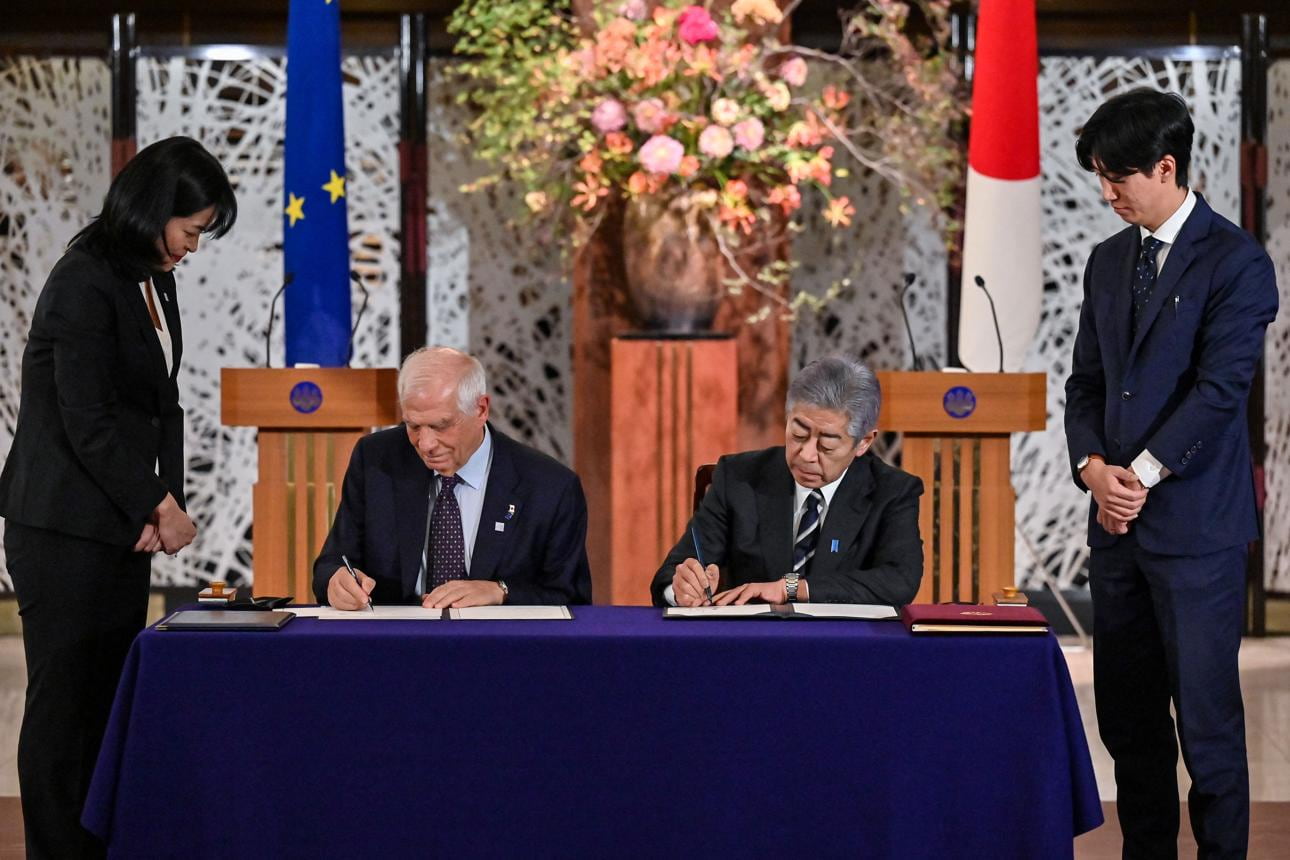
Tokyo: The factories and shipyards of western Japan have become an unlikely stake in Europe’s search for economic security. When European and Japanese leaders met in Tokyo on 23 July 2025 for their thirtieth summit, they launched a Competitiveness Alliance meant to bind two of the world’s largest advanced economies against the pressures squeezing both. A year on, that pledge is turning into working machinery.
The alliance sets out to guard supply chains, cut strategic dependencies and steer investment toward the technologies that decide industrial power. Its named priorities read like a map of the modern economy: critical minerals, batteries, clean energy, offshore wind, hydrogen, steel, robotics, biotechnology, and the defence and space industries. Each is an area where a single dominant supplier can hold rivals hostage.
Both partners arrive with the same anxiety. China controls the processing of most critical raw materials, and Washington’s tariff turn under a second Trump administration has made even friendly markets feel unreliable. Brussels and Tokyo concluded that neither can secure resilience alone, so they chose to pool standards, research and purchasing power instead. The logic is defensive, but the ambition is not.
Momentum has held into 2026. The two sides folded trade, industrial policy and economic security into a single high-level dialogue rather than treating them as separate files, and in September 2025 they agreed to accelerate the alliance’s rollout. The Commission set out the founding commitments in its Tokyo summit statement, and officials now meet to convert headline goals into concrete projects.
The value runs both ways. For Europe, Japan offers a technological equal in fields where the Union struggles to keep pace, from advanced robotics to semiconductor materials. For Japan, the EU offers a rules-based market of 450 million consumers and a partner that shares its wariness of coercion. Their existing free trade and strategic partnership agreements gave the two a running start that most new alignments lack.
Doubts remain. Grand frameworks often stall once the summit lights dim, and the alliance still lacks the binding funding that would prove its seriousness. Japan guards its farm sector, Europe its steel, and each will defend domestic interests when the projects touch home. Coordination across thirteen time zones and two very different bureaucracies will test the patience of both capitals.
Yet the direction is unmistakable. Two economies that once treated trade as a purely commercial matter now treat it as a question of survival in a divided world. The Competitiveness Alliance will not remake global supply chains overnight, but it plants a marker: the middle powers of the democratic economy intend to shape the rules rather than merely absorb the shocks. In an age of blocs, that intent may prove as important as any single deal.