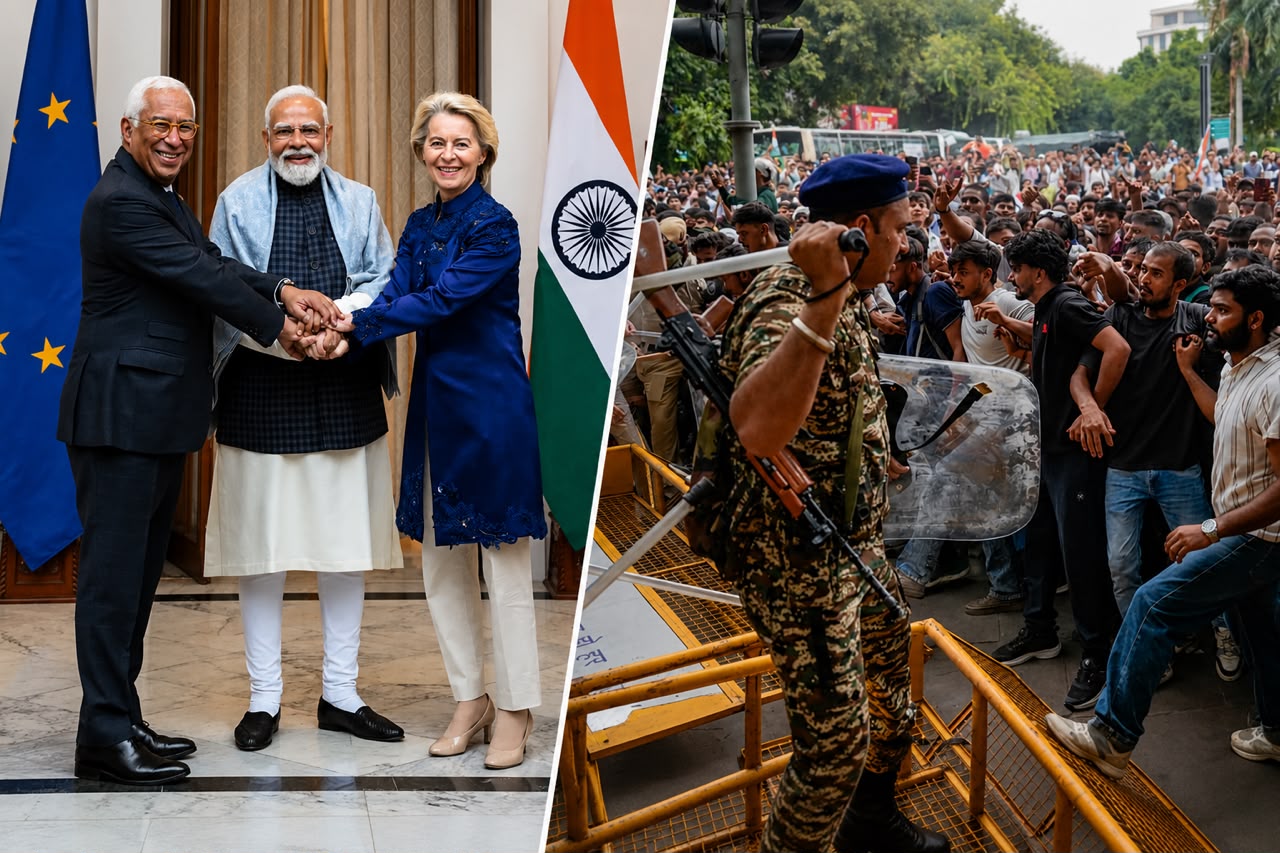

Six months ago, the leaders of the European Union stood in New Delhi and signed a free trade agreement with the world’s most populous democracy, one they described as resting on shared values.
The joint statement from the 16th EU-India Summit committed both sides to a partnership grounded in “shared values and principles including democracy, human rights, pluralism, rule of law,” language the Commission’s own account of the agreement echoes almost exactly: the deal’s final chapter recognises that human rights and democratic principles constitute essential elements of the agreement.
Between 20 and 25 July, Delhi police used tear gas and batons against student protesters demanding an education minister’s resignation, injured close to 180 people by their own count, and suspended mobile internet in the heart of the capital. On Saturday, the minister resigned, meeting the protesters’ central demand, though not the two smaller ones they say remain outstanding. The acute crisis is over.
Brussels never said a word about any of it, from the first tear gas canister to the resignation letter, in the country whose scale supposedly made this partnership too important to leave to Washington or Beijing.
What the clause actually promises
Before going further, the claim that this amounts to a treaty violation needs to be handled carefully, because it is not quite accurate, and the more precise version is the more interesting story. Three limits apply.
First, the FTA that contains this language has not entered into force. It was concluded politically in January and now needs European Parliament consent, a process expected to take roughly a year, with entry into force targeted for early 2027. A clause in an unratified treaty carries no legal weight yet.
Second, even once active, comparable clauses in recent EU trade agreements do not usually permit suspension. The European Parliament’s own research service has documented that the equivalent clause in the EU-Vietnam FTA allows only for measures proportionate to a failure to meet treaty obligations, not suspension of the trade agreement itself.
That is a considerably softer mechanism than the human rights clauses found in the EU’s Cotonou-style agreements.
Third, the power to suspend the EU-India relationship over human rights already exists, but it sits in a different, older instrument: the 1993 EU-India Cooperation Agreement, whose own essential elements clause, according to the European Parliament’s research service, does expressly permit suspension. That agreement is separate from the new FTA and has effectively gone unused in over three decades.
None of this means the language in January’s joint statement was empty. It means the mechanism that would give it teeth is untested, procedurally slow, and would require the Commission or Council to formally determine that a serious breach has occurred, a political decision neither institution has shown any sign of contemplating.
What Delhi’s protests offer, six months into the deal’s life, is the first real occasion to notice how far that promise sits from anything enforceable.
What happened in Delhi
The protest movement itself began as satire. In May, India’s Chief Justice compared unemployed young people to cockroaches during a court hearing; within days, a political communications strategist named Abhijeet Dipke had turned the insult into the Cockroach Janta Party, a self-declared platform for the unemployed that gathered millions of social media followers before it held a single rally.
It stopped being satire once national medical entrance exam papers leaked, and protesters began demanding the resignation of Education Minister Dharmendra Pradhan. By July, the movement had spread to at least nine Indian cities beyond Delhi, including Mumbai, Bengaluru and Kolkata.
On 20 July, an estimated 20,000 protesters tried to march on Parliament. Delhi police used tear gas and batons to disperse them; the police’s own count put injuries at close to 180, including 118 of their own personnel and 60 protesters, while the movement’s founder said as many as 150 protesters were hospitalised.
Human Rights Watch, in a report titled “India: Excessive Force Used Against Student Protesters” published 23 July 2026, said the police response was disproportionate; its deputy Asia director, Meenakshi Ganguly, said “the police met them with batons, tear gas, and internet shutdowns.”
Amnesty International’s India board chair, Aakar Patel, said separately, in a statement issued 20 July 2026 titled “India: Crackdown on Peaceful Protesters in New Delhi Raises Serious Human Rights Concerns,” that the images from the protest showed “how peaceful dissent is being suppressed in India,” and that mobile internet and metro services had been suspended around the protest site.
Environmentalist Sonam Wangchuk, who joined the movement with a hunger strike, was forcibly removed to a hospital by police before ending his fast after twenty-six days, citing a lengthy negotiation over conditions and concern about further unrest.
Talks between government ministers and CJP leaders continued through the week, and police fired tear gas at the protest site again on Saturday, hours before what was meant to be another round of negotiations.
That same day, Education Minister Dharmendra Pradhan posted his resignation letter, writing that he did not want “anti-national forces” to exploit the situation further. CJP declared victory and withdrew its nationwide occupation, but its own statements since have been less than fully settled.
The government has agreed in principle to the movement’s two remaining demands, compensation for the families of students who died by suicide and assurance that no cases will be pursued against protesters, but CJP has since said both remain unmet in practice, posting that the movement has “just started” rather than declaring full resolution.
Five days of documented police violence against a protest movement ended, in the end, in the resignation of the minister who had authorised the government’s response, if not yet in the full concession CJP says it is still owed.
EXHIBIT: EEAS SPOKESPERSON STATEMENTS ON COMPARABLE CRACKDOWNS, 2026
| Country | EEAS Response |
| Iran | Statement issued January 2026, urging security forces to exercise maximum restraint against protesters |
| Peru | Statement condemning the disproportionate use of force by security forces |
| Syria | Statement urging protection of civilians amid escalating violence |
| Belarus | Statement on protests and arrests |
| India | No public EEAS or Commission statement identified as of this writing |
This publication searched the EEAS’s public press material archive and general web sources for any EEAS or Commission statement, spokesperson remark, or readout referencing the Delhi protests, between 20 and 26 July 2026. None was found. Absence of a public statement is not proof that no private diplomatic contact occurred, but it departs from the EEAS’s own recent pattern on comparable crackdowns.
A choice, not an incapacity
The point of that comparison is not that Brussels is uniquely silent, but that it is selectively so, and selectivity implies a choice rather than an institutional inability to speak.
The European Parliament, notably, has not been silent on India before. It passed a resolution in July 2023 on the ethnic violence in Manipur, and another in January 2024 criticising the use of foreign funding law to constrain Indian civil society, both of which India’s government dismissed as reflecting a colonial mindset.
Parliament’s willingness to criticise sits uneasily beside the Commission and Council’s preference for quiet dialogue, and that gap between institutions, not a uniform EU silence, is the more accurate description of where things stand.
Neither institution has explained its silence, and this publication found no on-record comment from either the Commission or the Council addressing why. What follows, then, is this publication’s own reading of the incentives, not a claim about anyone’s actual reasoning.
The FTA is being sold domestically as a major economic win: the Commission’s own estimate puts around 800,000 EU jobs as dependent on exports to India, and Commission President Ursula von der Leyen said at the summit that the deal would reduce Europe’s strategic dependency at a moment when global trade is being weaponised.
Parliament’s consent vote, expected within the next year, is plausibly the point at which the Commission most needs India’s cooperation to look uncomplicated. That would make raising a domestic Indian political crisis in public, six months after a summit built around celebrating the relationship, carry a diplomatic cost that raising it privately does not.
That is an inference from timing and incentives, not something either institution has confirmed.
The thread back to Brussels’s own instincts
There is a second, quieter tension worth naming, one this publication has traced before in the context of the EU’s approach to digital markets.
The mobile internet shutdown around Jantar Mantar sits awkwardly next to a Brussels that has spent the past year asserting, at home, that connectivity and platform access are matters worth fighting over, not leaving to member states or trading partners to decide alone.
A Union willing to fine a technology company hundreds of millions of euros over market access has not yet found a public register for raising connectivity restrictions used against its own strategic partner’s protesters. That is not hypocrisy so much as evidence of how firmly external silence and internal assertiveness can coexist when the domain and the partner both change.
What would give the clause meaning
There is a genuine diplomatic case for the approach Brussels appears to have taken. Quiet engagement, conducted through the existing EU-India Human Rights Dialogue rather than public statements, can sometimes extract more from a government sensitive to being seen to bow to foreign pressure than a spokesperson’s rebuke ever would.
India’s Ministry of External Affairs has a documented pattern of dismissing public criticism as interference rather than engaging with it. If private channels were used here, they would not show up in any public search, and this publication cannot rule that out.
None of this argues that Brussels should have issued statements about another country’s education minister while talks were live; a foreign trade bloc weighing in on an internal cabinet reshuffle would rightly be seen as overreach, and the crisis resolved through domestic pressure and negotiation, exactly as it should.
The point is narrower and, for that reason, harder to wave away: the entire arc, from the first tear gas canister on 20 July to the resignation letter on 25 July, ran its course without Brussels commenting once, even in the terms it has used for Iran, Peru, Syria and Belarus this year.
There is a real, calendared moment coming where the clause’s meaning gets tested regardless of how this particular episode ended: European Parliament’s consent vote on the FTA, expected over the next year. Parliament has already shown, on Manipur and on civil society law, that it is willing to raise human rights concerns about India when the Commission and Council are not.
Whether it treats this crackdown as relevant to that vote, or as a domestic matter now closed and therefore irrelevant, will do more to define what “essential elements” means in this agreement than anything written into the text in January.
This publication’s own judgment, and it should be read as judgment rather than established fact, is that Brussels prioritised the commercial and strategic weight of the relationship over the human rights language it had just signed. No official has confirmed that trade-off, and none may ever have consciously made it in those terms.
But when a five-day crackdown with documented casualties draws no public response from an institution that speaks up readily elsewhere, the silence itself becomes the evidence, and evidence of that kind does not require a confession to be read plainly.
The deal was six months old when this test arrived, and it is already over: the minister resigned, the protesters went home, and Brussels never had to decide what to say, because it never said anything.
That silence, sustained through a genuine crisis and its resolution alike, is itself an answer about how much weight “shared values” carries in this agreement, whatever the next joint statement claims.
ABOUT THE AUTHOR
Azfar Bukhari is a senior analyst specialising in geopolitics, public diplomacy, migration, international trade, and investment. He is a regular contributor to The European Post.