
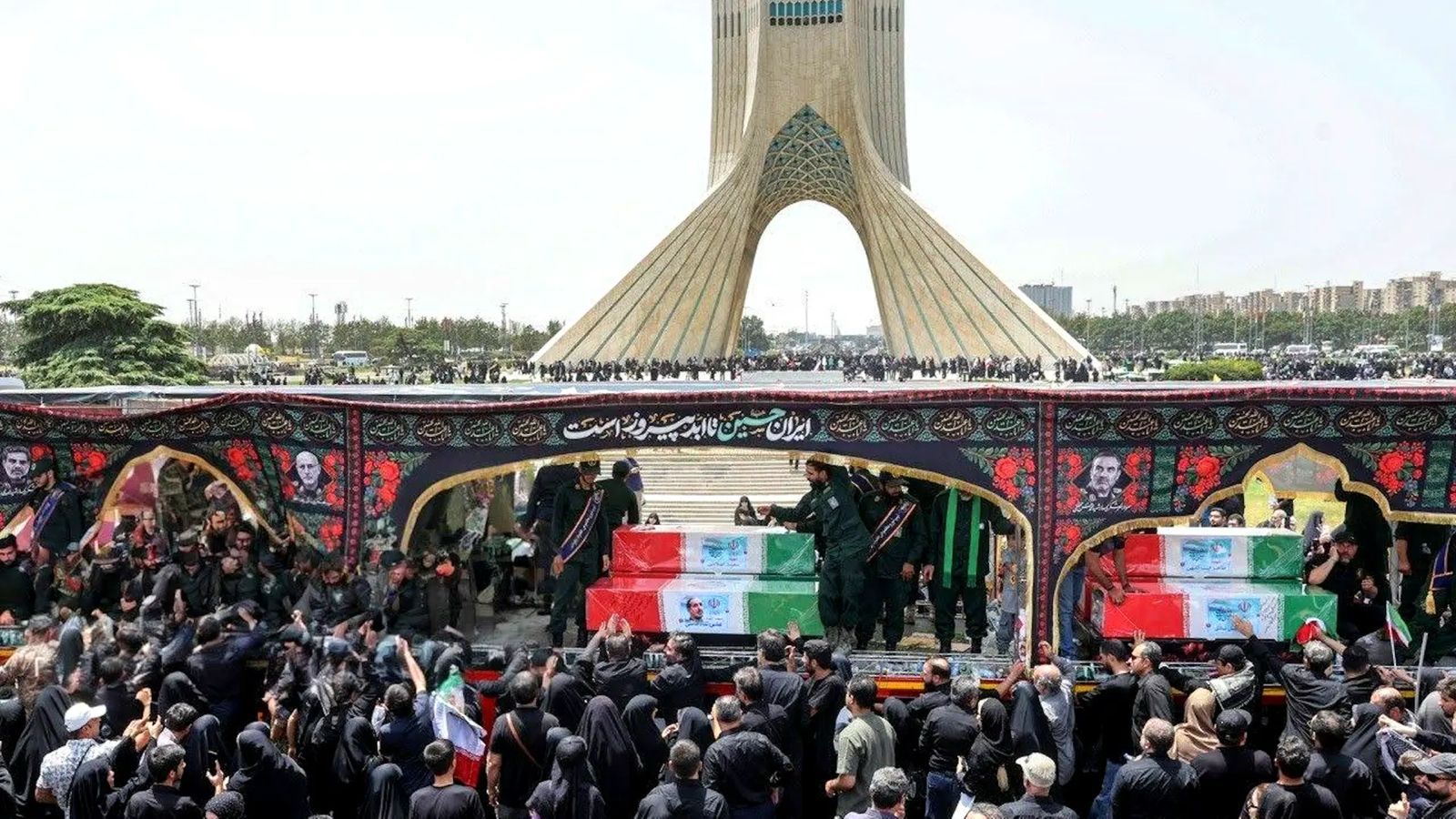

Iran let scripture do the speaking at Khamenei’s funeral, grading each delegation by verse. The sharpest signal was the chair no European state was ever going to fill.
A state that has just emerged from war rarely holds its tongue. Iran, burying the man who defined it for a generation, chose to hold its tongue and let scripture speak in its place. Across the opening days of ceremony at Tehran’s Grand Mosalla, foreign delegations filed past the coffins, and as each stepped forward a reciter began a passage that appeared chosen for them alone. No ministry explained the sequence. No communiqué decoded it. Yet by the second day Iranian outlets were reading the verses the way diplomats read a seating chart, and the question had already moved from whether the selections carried meaning to how sharply they cut.
Grant the ceremony its most innocent reading first. Qur’anic recitation attends every Iranian state occasion, and a reciter facing a hundred delegations might reach for whatever passage the moment suggested. Grief does not draft talking points. On this account the verses were liturgy, not messaging, and the world’s habit of decoding Tehran had simply found a new surface to work on.
That reading did not survive contact with Iran’s own press. The reformist outlet Fararu wrote that the passages appeared chosen “not randomly, but deliberately.” The conservative site Tabnak went further, calling the practice “an innovation in public diplomacy” and describing the tailored recitations as ethical and political messages addressed to each delegation. When a government’s supporters and its critics converge on the same reading, the interpretation gains weight, even if it cannot be called conclusive. The remaining question is what the work, if intended, was meant to say.
Scripture as a sorting mechanism
The pattern, once read across delegations, resolves into a hierarchy. To the movements Tehran counts as its own, the passages spoke of martyrdom and of pledges kept. Hamas heard a verse honouring those “who have proven true to what they pledged to God,” some who “fulfilled their pledge” and none who “changed their commitment in the least.” Hezbollah’s reading promised the “upper hand” to true believers. For the Houthis, the reciter turned to Al-Faṭḥ 48:29, a passage on loyalty and discipline “in the face of pressure.” These were not condolences. They were confirmations of membership.
A second tier received warmth without enlistment. Egypt was told that “those who believe and do good” are “the best of all beings,” a benediction extended to a partner Tehran wants close but does not fold into its resistance story. Qatar, the mediator, drew the opening of Al-Faṭḥ 48:1, the same “clear triumph” verse read for Palestinian Islamic Jihad and the Taliban, softened by diplomatic context into thanks for its offices rather than a summons to the fight.
Then came the pointed readings. As the Saudi delegation approached, the reciter turned to Āl ʿImrān 3:13, the Battle of Badr: “one fighting in the way of Allah and the other rejecting faith,” a smaller force sustained because “Allah strengthens with His help whom He wills.” The setting sharpened the choice. Badr was fought near present-day Arabia, and the verse was recited before Riyadh’s envoy after a war in which Saudi territory reportedly hosted American operations. Iranian and Arab commentators read it variously, some as a pointed message, others as an appeal to a shared civilisational memory, and seldom as coincidence. Turkey heard a verse elevating those who strive over those who “stay behind” without cause, interpreted as a comment on Ankara’s caution.
Pakistan, which brokered the ceasefire and sent its prime minister and army chief, received Al-Isrāʾ 17:80, a supplication for “a truthful entrance” and “a truthful exit,” and for “a supporting authority” from God, a reading of legitimacy and sincerity that tracks the standing of the state Tehran most needed in the room. India, in Āl ʿImrān 3:173, a verse widely read as a comment on New Delhi’s conduct during the war, heard the answer of those told that “the people have gathered against you, so fear them,” who replied only that “Allah is sufficient for us.” Read by Iranian and Arab commentators alike, the sequence arranges Tehran’s guests along an axis running from kinship through gratitude to distance, and it does so without a single word of the state’s own.
Not everyone received the performance as artistry. The reaction across the Arab world was sharp, and it belonged to Tehran’s neighbours rather than to any Western critic. The Iraqi commentator Yaseen Aziz, writing as footage of the ceremony spread, called the Saudi recitation an indicator of “hatred and the diplomatic stupidity” of Iran’s present leadership. Gulf commentators noted the timing. Riyadh and Tehran restored relations only three years ago through Chinese mediation, and Doha and Muscat have kept their channels open throughout. Against that patient work, a ceremonial slight to states that had troubled to send envoys read, in those capitals, as a squandering of trust rather than a show of command. Religious voices inside Iran pressed a further objection, that scripture turned against mourners who came to pay respects sits poorly with a tradition holding hospitality sacred.
A message the analyst might name
Here a term suggests itself. What unfolded at the Mosalla was neither ordinary public diplomacy nor clerical preaching, but a fusion of the two: statecraft conducted through liturgy, signals graded in scripture and deniable by design. I propose the term scriptural diplomacy: the projection of a state’s strategic map through sacred text, calibrated to each recipient. It is not the avowed persuasion of public diplomacy, nor the mediation between states that religious diplomacy describes. Its defining feature is deniability: a signal delivered through scripture, addressed to one recipient, and dismissed as mere liturgy the moment it is questioned. No envoy was summoned, no démarche delivered, no sentence exists to be quoted back at a negotiating table. The message travels in a register no foreign ministry can formally protest. To protest is to admit one was reading meaning into prayer.
The instrument is old, even if the occasion was new. In Islamic statecraft the pairing known as khutba wa sikka, the sermon and the coinage, marked the two recognised prerogatives of sovereignty. For centuries the naming of a ruler in the Friday sermon, or the pointed omission of it, signalled whose authority a territory acknowledged. A weaker state that pronounced the sermon in a stronger patron’s name declared its allegiance; a governor who dropped the caliph’s name declared his independence. Liturgy has long carried the grammar of suzerainty. Iran knows this grammar intimately. As the Encyclopaedia Iranica records, the revolution of 1979 reinstituted the Friday sermon as an instrument of the republic’s legitimacy, binding the leader’s name to God and the Imams. What changed at the Mosalla was only the audience. A state reached, at its moment of greatest exposure, for the oldest tool it owns.
The restraint reads differently against what Washington was saying aloud. In an interview with Axios, President Trump observed that Iran’s leadership had gathered in a single place and that one strike could reach all of them, adding that the United States would refrain only because it would then have “nobody to negotiate with.” A funeral was thus also a demonstration of exposure. Tehran assembled its allies and staged its composure while the American president narrated, in public, the ease of ending the entire assembly. The verses of endurance and vindication were recited under that shadow, which is what gives them their edge. A state signalling that it will honour the truce, even as its adversary muses aloud about the target of opportunity the mourning presented, is not performing confidence for its own sake. It is converting exposure into a display of nerve.
The content of the message matters as much as its form. This was not the Iran of maximal threat. The verses spoke of endurance, vindication, and faith rewarded, the vocabulary of a state signalling that it has survived and intends to abide by the truce rather than reopen the war. Read whole, the sequence is the liturgy of a power consolidating after a shock, sorting its friends and marking its disappointments while binding itself, in front of witnesses, to the pact it has just signed. It is messaging that lets Tehran look both unbroken and restrained, which is precisely the posture a ceasefire requires.
The chair no one filed
The sharpest signal, though, was not any verse. It was an absence. Across the delegation lists, from Moscow and Beijing to Islamabad, Ankara, Baghdad, and the Central Asian capitals, not one European state appears. No member government sent a minister. The Union’s diplomatic service sent no one. The Secretary-General of the United Nations offered condolences by telephone and was publicly rebuked by Israel’s envoy for the courtesy, which tells its own story about the cost of even a phone call. Europe did not decline a seat. It was never going to occupy one, and Tehran was never going to press.
The reasons are sound, and they deserve their hearing. Khamenei commanded the system Europe has spent years sanctioning, and ministerial attendance at his funeral was politically impossible for any EU capital. He was killed in an American and Israeli strike, so presence in Tehran would have read in Washington and Jerusalem as siding with the target against two partners. Europe’s remaining channel to Iran runs through the nuclear file and de-escalation, not through mourning, and offered no dividend to justify the domestic cost. On every count, staying away was the defensible choice.
Yet absence is also a forfeit, and this is what the empty chairs exposed. By reciting a hierarchy of the region’s actors, Iran drew a map of the post-war order as it wishes it seen, and Europe does not appear on it. Russia wrote itself back into relevance through Medvedev. China signalled endorsement through a senior legislator. Pakistan converted mediation into standing. Each was ranked, because each was present in Tehran’s moral universe. Europe was not ranked, because Europe had placed itself outside the frame. The verses sorted the guests. The empty European chairs defined the guest list, and Iran was content to let the vacancy speak.
For a Union that describes its ambition as strategic autonomy, being unranked is not the same as being neutral. It is the discovery that a war can be fought on its periphery, concluded on its doorstep, and narrated in a language it has chosen not to enter. Tehran’s message to the Western world was delivered by omission and required no verse at all. The region’s future was being recited aloud, and Europe was not in the room to hear which passage it had been assigned. It had been assigned none.
ABOUT THE AUTHOR
Azfar Bukhari is a senior analyst specialising in geopolitics, public diplomacy, migration, international trade, and investment. He is a regular contributor to The European Post.