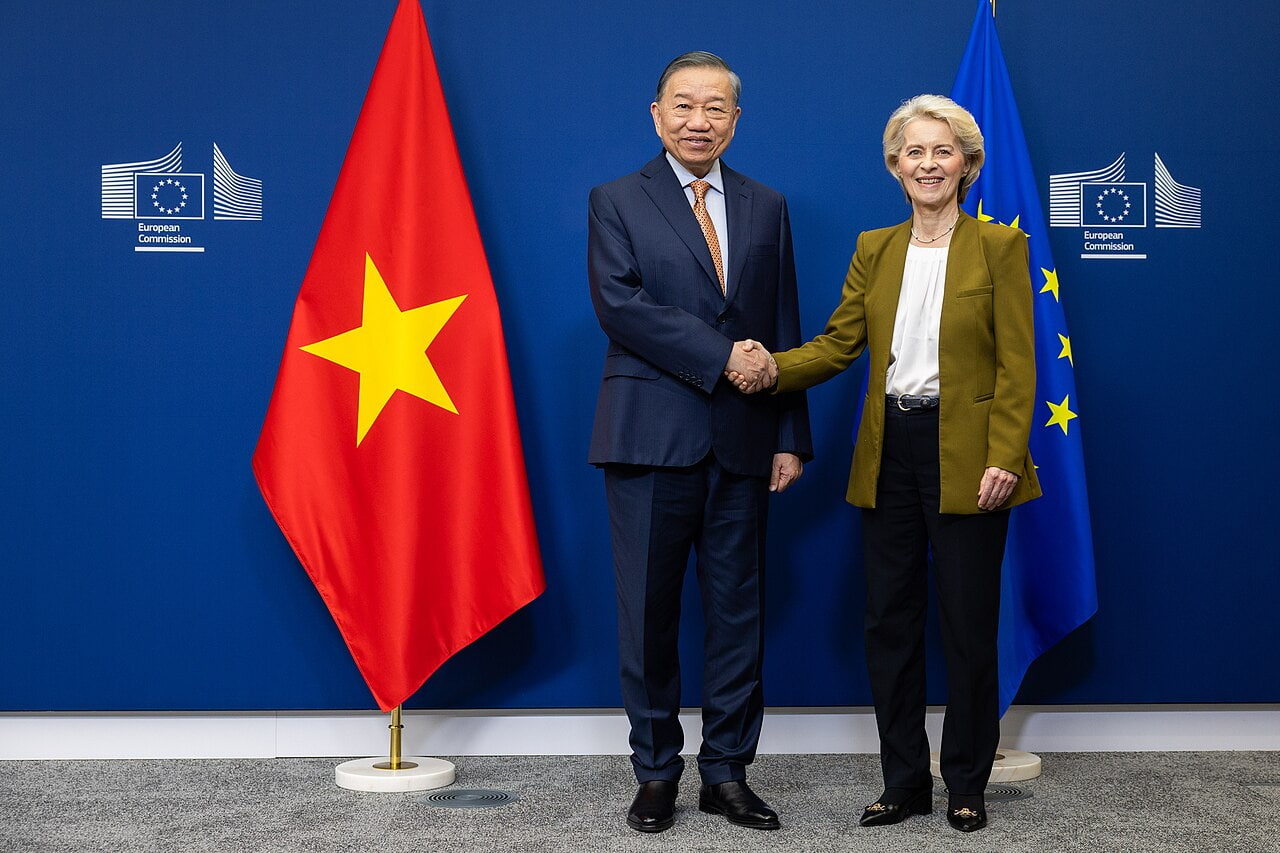
Hanoi: The Vietnam partnership entered a more practical phase on 22 October 2026, when Commission President Ursula von der Leyen, European Council President Antonio Costa and Vietnamese leader To Lam signed a joint statement in Brussels. The text confirms that relations, upgraded to a Global Strategic Partnership in January 2026, are now expected to produce measurable results rather than ceremony.
The statement stresses resilience, diversified partnerships and stability in the Indo-Pacific, and it explicitly references the EU Indo-Pacific Strategy. That wording matters. Europe wants trading and security partners in Southeast Asia that are not dependent on a single great power, and Vietnam, with its large manufacturing base and open economy, is one of the most obvious candidates.
On trade, the Vietnam partnership rests on a free trade agreement, and both leaders called for full implementation of the EU-Vietnam free trade agreement and for swift ratification of the investment protection agreement. Von der Leyen cited a projected 53 percent rise in trade, a figure that signals the ambition behind the deal. The investment protection agreement remains the missing piece. Without it, European investors in Vietnamese factories and infrastructure lack the dispute settlement guarantees that the trade agreement alone does not provide, and ratification across member states can be slow.
The cooperation list is broad. It covers raw materials, technology, education, the green and blue economies and strategic infrastructure, and it reaffirms the Global Gateway and the Partnership for a Just Energy Transition as delivery vehicles. A defence and security dialogue is also noted, a modest but telling sign that the Vietnam partnership is no longer purely commercial. In parallel, Vietnam’s education minister and Education Commissioner Roxana Minzatu signed a letter of intent, an example of the smaller, concrete steps that often outlast headline summits.
Both sides also look ahead to a commemorative EU-ASEAN summit in 2027, marking fifty years of relations between the two blocs. Vietnam is positioned to play a bridging role in that setting, and Brussels will want the bilateral groundwork finished before then.
The Vietnam partnership is not without friction. Diaspora groups protested in Brussels, criticising political repression in Vietnam, a reminder that the Union’s values agenda and its strategic interests do not always point in the same direction. How the Commission and member states handle that tension will shape the credibility of the Vietnam partnership, especially in the European Parliament, which must consent to key agreements.
For now, the benchmark is simple. If the investment pact is ratified and trade volumes follow the projections, the Vietnam partnership will become a template for engagement with other Southeast Asian economies. If ratification stalls, the 2027 summit may arrive with warm declarations but an unfinished legal framework.