
Ukraine struck sanctioned shipping and a Lukoil platform in the Caspian on 25 July. Ten billion euro has been mobilised for the European corridor that crosses those waters. The Union has never once said where the weapons it funds may be used.
A cargo ship burned in the Caspian Sea on 25 July. One sailor died. Tehran summoned Ukraine’s chargé d’affaires the following day, and Foreign Minister Abbas Araghchi picked up the telephone. He made two calls. One went to Moscow. The other went to Brussels.
That second call is the reason this column exists. Europe was on the notification list for an escalation it did not order, could not have prevented, and has never publicly discussed.
Anatomy of the Caspian Strike
Ukraine’s security service set out its target list on 25 July. Drones struck the Filanovsky oil platform, which Lukoil calls its largest asset in the Russian sector of the sea. They also struck a Project 12418 missile boat and two cargo ships, the Port Olya 2 and the Begey.
The service says both merchant vessels sit under international sanctions and were carrying military cargo between Iran and Russia. Ukrainian military intelligence ties the Port Olya 2 to MG-Flot, a sanctioned Russian company. It also records eleven calls by the Begey at Iranian ports, alongside gaps in the vessel’s transponder signal near port approaches. President Zelensky confirmed the Caspian strike himself, reporting strong results from long-range operations against shipping involving Iran and against a warship.
Tehran tells it differently. Iran’s foreign ministry says the ship hit was Iranian-flagged and carrying iron. One crew member died and others were hurt. Tehran calls the operation a hostile and criminal act. It summoned Ukraine’s chargé d’affaires the next morning.
So the flag is in dispute, not only the cargo. Kyiv’s ambassador to Israel, Yevgen Korniychuk, says the vessels carried drone and missile components. The Caspian strike was not the first of its kind, he adds, and it will not be the last. Ukraine treats these shipments as legitimate military targets. The precedent supports him: Ukrainian forces destroyed the Port Olya 4 at its Russian berth in August 2025.
Tehran called the operation an act of aggression capable of widening the war, and warned of retaliation. Iran maintains the ship carried civilian goods. Araghchi then told Kallas and Lavrov that the Caspian strike could not go unanswered.
He added a reading of motive worth pausing on. Kyiv had acted at Israel’s prompting, he wrote, “to drag Europe into its war”. Take the accusation as propaganda if you like. The premise underneath it is that Europe can be manoeuvred into a conflict by the decisions of others, and on that narrow point Tehran and this column agree.
Kyiv’s Case Is Strong
Let me be direct about where I stand, because this argument is easily misread. Ukraine is in the right on the narrow question.
Iranian-designed Shahed drones have been falling on Ukrainian cities since 2022. Thousands of them. A state that supplies the munitions killing your civilians has made itself part of the war, whatever its diplomats say in Vienna.
The legal question is narrower than that, and it does not resolve the way either side would like. The San Remo Manual, the expert restatement of the law of armed conflict at sea, makes the answer turn on the flag.
An enemy merchant vessel that makes an effective contribution to military action, by carrying materiel for the enemy’s forces, is a military objective. If the ships were Russian, as Kyiv says, the operation sits inside that rule without much difficulty.
A neutral merchant vessel is governed differently. Paragraph 67 permits attack only on two conditions. There must be reasonable grounds to believe the vessel carries contraband. And it must, “after prior warning”, clearly refuse to stop or resist visit, search, or capture. Paragraph 146 makes capture, taken as prize for adjudication, the ordinary remedy rather than destruction. Nothing in the public account suggests a warning was given or that visit and search was attempted, and a long-range drone is not an instrument for either.
So the flag dispute is not a detail of the reporting. It is the question. On Kyiv’s version of the facts the strike is defensible. On Tehran’s it is considerably harder to defend. Neither version has been independently verified, and no tribunal has tested whether Iran’s supply relationship makes it a co-belligerent rather than a seller.
My own reading is that Kyiv’s account of the facts is the more plausible one, given the sanctions listings and the port-call record. That is a judgement about evidence, not a legal conclusion, and I would not want it read as one.
The Caspian adds a complication of its own. The five littoral states signed the Convention on the Legal Status of the Caspian Sea at Aktau in 2018. Among its principles is the non-presence in those waters of armed forces not belonging to the parties. Ukraine is neither a party nor a littoral state, so the clause imposes nothing on it. That is rather the point. Russia and Iran pressed for the provision to keep Western navies out of the basin, and against that threat it worked. They are now discovering that a long-range weapon requires no presence at all.
Nor does Kyiv owe Europe a promise to fight only in theatres Europe finds convenient. Ukraine did not choose the Caspian. Russia and Iran chose it, by routing the supply chain across water they assumed nobody would touch. Ukraine has also sent military personnel to Gulf states, according to Al Jazeera, to help intercept the same class of drone. It is behaving like a serious military actor with global reach, which is precisely what four years of European funding has produced.
So this is not a complaint about Kyiv. It is a complaint about Brussels.
The Question Brussels Has Not Answered
Europe has financed Ukrainian defence at a scale without modern precedent. Money, munitions, training, satellite intelligence, and industrial capacity. That support was justified, and I have argued for it in these pages.
But the Union has never stated a doctrine governing where the capability it funds may be employed. Individual capitals have set conditions bilaterally, some of them public and some not. That is not the same thing.
There is no publicly stated EU-wide geographic limit. There is no publicly disclosed EU-level consultation mechanism. There is no published position on whether European-financed long-range strike may be used against third states outside the European theatre.
Washington negotiates these limits explicitly and loudly, and has done so for years.
Brussels has never held the conversation collectively. The result is an arrangement in which Europe supplies the means, Kyiv selects the target, and Europe receives the phone call afterwards.
The Sea Europe Has Been Buying
Here is the part that should concentrate minds in the Berlaymont, and it has gone almost unmentioned in the coverage.
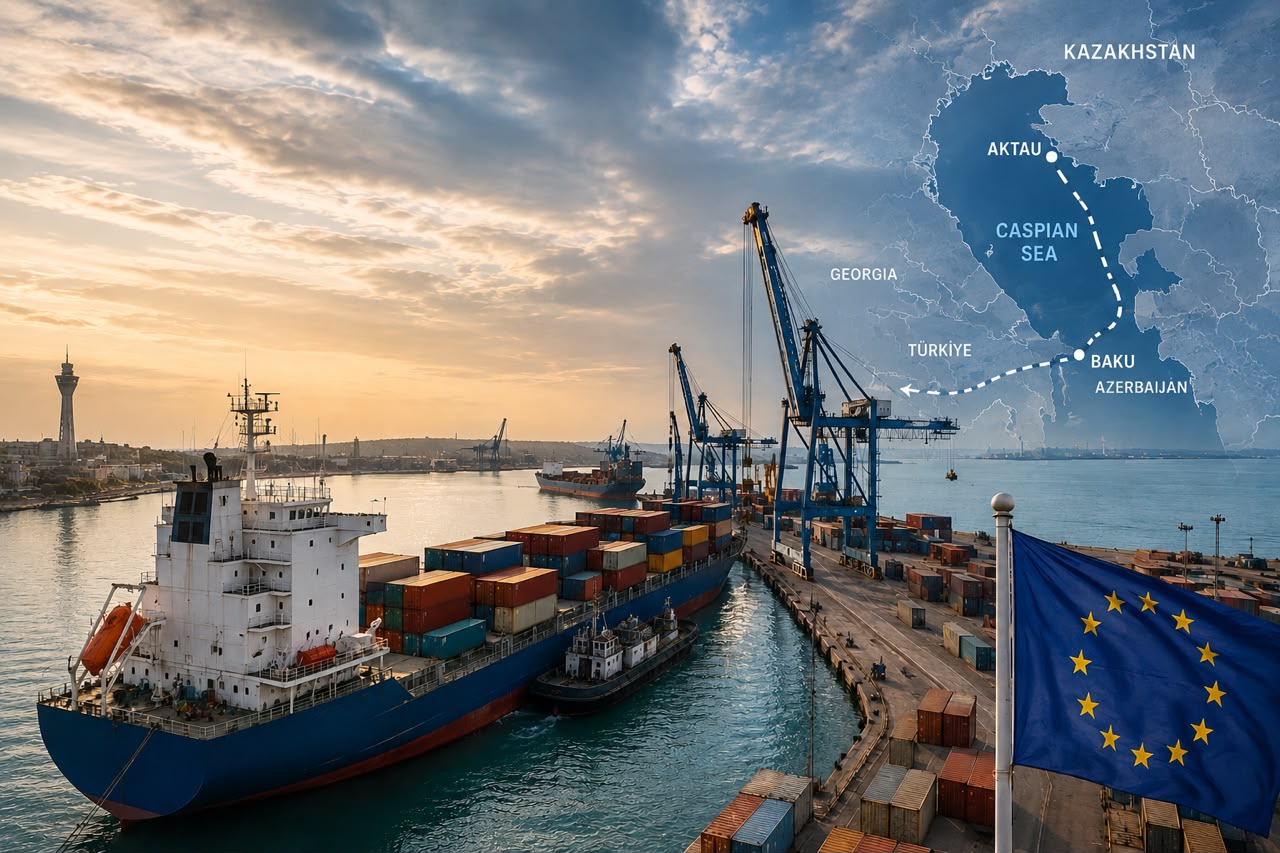
The Caspian is not a distant body of water in which Europe has no stake. It is the middle segment of the Trans-Caspian Transport Corridor. That route carries freight from China through Kazakhstan and across the Caspian to Azerbaijan. From there it reaches Europe through the Caucasus and Türkiye.
Two corridors cross this sea, and they run at right angles. The north-south route between Iranian ports and Astrakhan belongs to Russia and Iran, and that is the one Ukraine struck. The east-west route is the one Europe pays for. They share the same water, the same ports, and the same underwriters, and war risk does not respect the distinction. The Filanovsky strike widens the target set further, from shipping to fixed energy infrastructure.
European and international financial institutions mobilised ten billion euro for that corridor in 2024 under Global Gateway. Leaders met at the first EU-Central Asia summit in Samarkand the following April. They called that mobilisation key to building the route, and backed a coordination platform for infrastructure along the Middle Corridor. Von der Leyen used the same summit to launch a twelve billion euro Global Gateway package spanning transport, critical raw materials, digital connectivity, water, and energy.
The entire strategic premise of that investment is that the corridor bypasses Russia. It is the Union’s answer to dependence on the Northern Corridor, and its most tangible piece of connectivity statecraft anywhere in Eurasia.
It now runs through a sea where vessels are being struck by a military Europe pays for. Insurers price war risk quickly and remove it slowly. Kazakh and Azerbaijani ports will read the same wire copy that Lloyd’s does. No public assessment of that exposure exists. The Commission has published nothing on it. Neither has the External Action Service, nor the coordination platform set up to steer the corridor. What armed attack in those waters does to freight volumes, insurance, and the timetable is simply not on the public record. Whatever thinking is under way inside the institutions has not reached the governments, ports, and underwriters who would need it.
Six Names and a Press Release
Set the Caspian strike beside what the Union actually did in this theatre last week, and the asymmetry is hard to miss.
On 24 July the Council sanctioned six individuals. Five are judges of Iran’s regional Revolutionary courts who presided over trials of religious minorities and political dissidents. The sixth is a figure from a cyber group. The listings are deserved. The judges sentenced people, including Narges Mohammadi, on charges the Council rightly calls vaguely defined. Kallas said Tehran’s crackdown would meet accountability.
Twenty-four hours later came the Caspian strike. The Union’s contribution to events in this theatre was six names and a press release. The consequential decision was taken in Kyiv, executed with European-funded capability, and communicated to Brussels by the government on the receiving end.
That is not a partnership. It is a subscription.
That is not a partnership. It is a subscription.
The answer is not to restrict Ukraine’s ability to defend itself, which would be both wrong and self-defeating. The answer is for Europe to know its own mind and say so.
First, a stated position on third-state targeting. The Union should set out, in writing, whether it regards strikes on third-state assets outside the European theatre as within the scope of the support it provides. Yes or no are both defensible answers. Silence is not.
Second, a consultation channel that works before rather than after. Europe does not need a veto over Ukrainian operations. It needs enough notice to prepare the diplomatic and economic consequences it will be made to absorb.
Third, a Caspian risk assessment for the corridor. The coordination platform exists. It should be asked, this quarter, what a militarised Caspian does to freight volumes, insurance, and the credibility of Global Gateway as an instrument.
The Cost of Not Deciding
Strategic autonomy has been the Union’s favourite phrase for a decade. It is usually deployed to describe independence from Washington.
The Caspian strike exposes a different dependency, and a more awkward one. Europe has outsourced a share of its escalation risk to a partner it funds, admires, and does not direct. That may well be the right arrangement. It cannot be the unexamined one.
Ten billion euro was mobilised to make the Caspian a European trade route. A good deal more has gone into making Ukraine a military power. In the Caspian strike those two commitments collided in the same water. If anyone in Brussels had prepared for that, they have not said so.
ABOUT THE AUTHOR
Julian Mercer is a Syndicated Columnist and Policy Analyst specialising in defence, security, and strategic affairs. He writes on global conflict, military capabilities, and transatlantic security policy for The European Post.