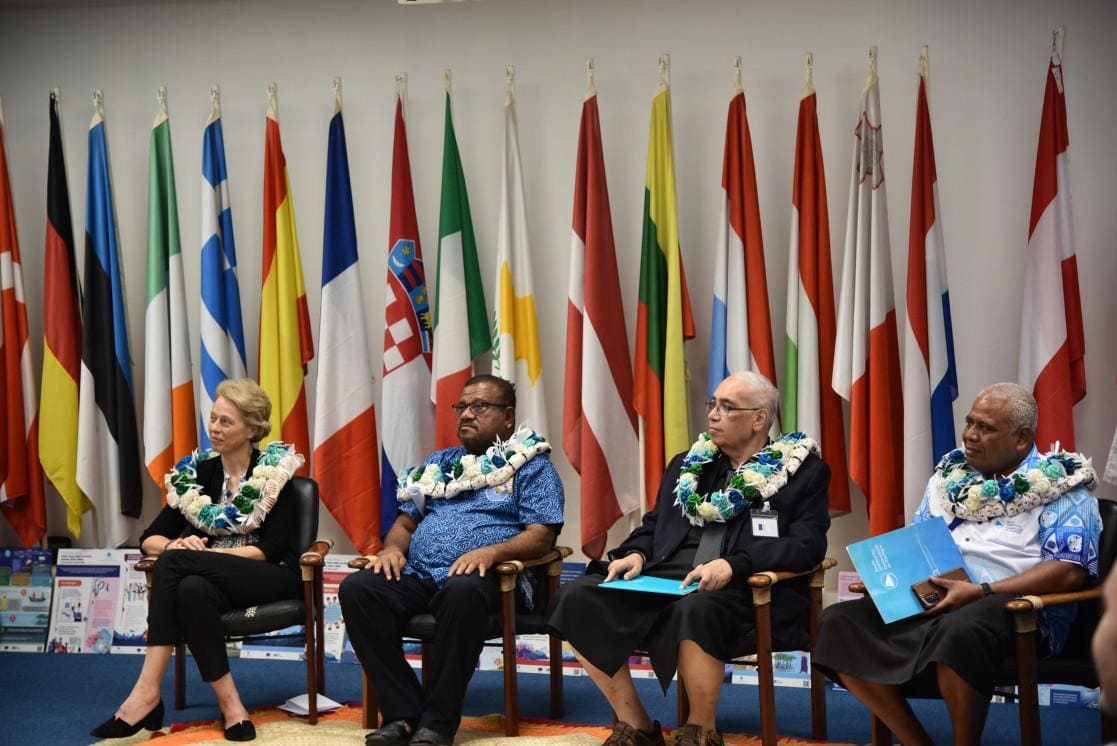
Suva: Officials signed a renewed ocean partnership in Fiji’s capital on 27 February that commits 20 million euros to fisheries and marine governance across an area covering roughly a tenth of the planet’s surface. Set the money against the water and the figure looks absurd. Set it against what the money actually buys and it looks better.
The second phase of the Pacific-EU Marine Partnership runs until 2030 and continues a programme launched in 2018. Three regional institutions deliver it. The Pacific Community handles science and training, the Pacific Islands Forum Fisheries Agency handles tuna management and compliance, and the University of the South Pacific handles education across twelve campuses. The Office of the Pacific Ocean Commissioner coordinates. Pacific Island countries and Timor-Leste are the beneficiaries.
The work programme is narrow and deliberate. Strengthen ocean governance. Manage oceanic and coastal fisheries sustainably. Improve value chains and market access so more of the catch value stays in the region. Combat illegal, unreported and unregulated fishing. The design aligns with the 2050 Strategy for the Blue Pacific Continent, which the region wrote for itself rather than receiving from a donor.
That alignment is the substance of the diplomacy. European development spending in the Pacific has historically arrived with European priorities attached, and Pacific governments have said so publicly and repeatedly. Building a programme around a regional strategy, and delivering it through regional agencies instead of European contractors, answers that complaint in the only way that counts.
The fisheries focus also serves a European interest that nobody hides. Western and central Pacific tuna supplies a large share of the canned product sold in European supermarkets, and the Union polices that supply through its regulation against illegal fishing, which can bar a country’s exports outright. Funding regional monitoring and compliance capacity makes the enforcement system work without Brussels issuing another warning card. Cooperation is cheaper than sanction, and it lasts longer.
Scale remains the honest objection. Twenty million euros over five years, divided among fifteen countries and a territory, funds training, research, laboratories and technical assistance. It does not fund patrol vessels, port infrastructure or the climate adaptation that Pacific leaders name first in every communique. China, Australia and Japan all commit larger sums to Pacific infrastructure, and the comparison is made in Suva and Port Moresby whether or not European officials raise it.
Europe’s answer is that capacity outlasts concrete. A trained fisheries observer, a functioning national laboratory and a negotiator who can hold their own in tuna commission talks generate returns for decades, and none of them appear in a headline figure. The claim is credible. It is also convenient for a donor whose Pacific budget is small.
The real measure arrives before 2030. If Pacific states convert stronger compliance systems into higher licence revenue and more onshore processing, the partnership will have shifted value rather than merely counted it. If the tuna keeps leaving in foreign hulls to be processed elsewhere, the programme will have trained excellent people to watch it go.