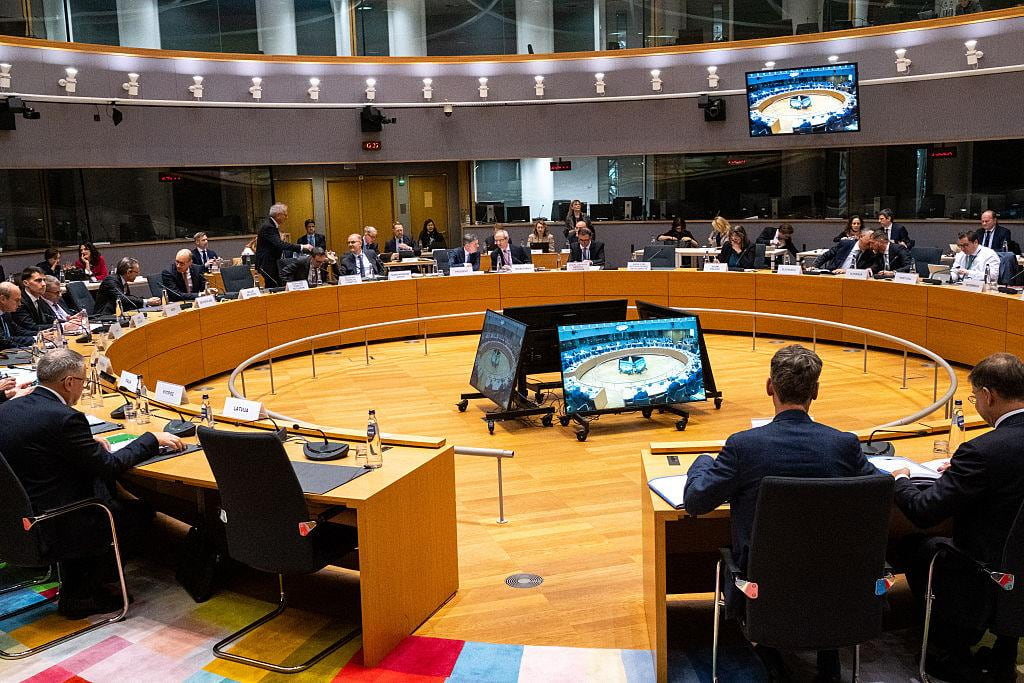
Brussels: The Stability and Growth Pact returns to the centre of euro area politics on 9 November 2026, when finance ministers meet in the Eurogroup and then in the Economic and Financial Affairs Council. The agenda joins fiscal surveillance with defence financing, two goals that pull in opposite directions.
The Eurogroup is due to discuss euro area macro and fiscal developments, banking union and defence financing. ECOFIN will then take up the Stability and Growth Pact, simplification and the Recovery and Resilience Facility alongside tobacco taxation and support for Ukraine.
Why the Stability and Growth Pact is under strain
The numbers explain the tension. Euro area government deficits reached 3.3 percent of GDP in the second quarter of 2026, which sits above the 3 percent reference value. In July the Eurogroup called for a broadly neutral fiscal stance in 2026 while deficits and debt were rising, a sign that ministers saw little room for stimulus.
Inflation adds pressure. The October flash estimate put euro area inflation at 4.0 percent, driven by a 20.8 percent jump in energy prices. Higher prices raise interest costs, and they make it harder for governments to defend both budgets and household incomes at once.
How the national escape clause shapes defence budgets
The main safety valve is the national escape clause, which lets countries lift defence outlays above the usual net expenditure path without triggering an excessive deficit procedure. The Council has already approved leeway for several capitals. Germany’s defence plans have been cleared, Spain has received room for extra spending, and Greece’s finance minister called the clause a strategic win.
The clause solves one problem and creates another. Governments with strong public finances can borrow for defence without much market penalty, while heavily indebted states face higher yields for the same spending. Ministers will have to ask whether the Stability and Growth Pact still treats all members fairly when security spending rises unevenly.
Defence financing and the limits of national budgets
Eurogroup ministers will also weigh how to fund defence beyond national budgets. Options include joint borrowing, loans through the Security Action for Europe instrument and a bigger role for the European Investment Bank. Each carries a political price, because frugal states resist common debt while southern members argue that national escape clauses alone will not close the capability gap.
These choices connect to the next financial framework. The Commission wants a larger envelope for competitiveness and defence from 2028, yet member states have not agreed on own resources or the overall ceiling. Until they do, the Stability and Growth Pact will carry much of the adjustment.
What happens next
The Commission will publish its European Semester autumn package on 24 November, and that document will show how it reads national budget plans against the Pact. Leaders then take up the long-term budget on 26 and 27 November.
Markets and governments will watch for any sign that ministers want to reopen the rules. A formal reform looks unlikely before the 2028 budget settles, so the Stability and Growth Pact will probably keep bending through exceptions rather than breaking through revision.