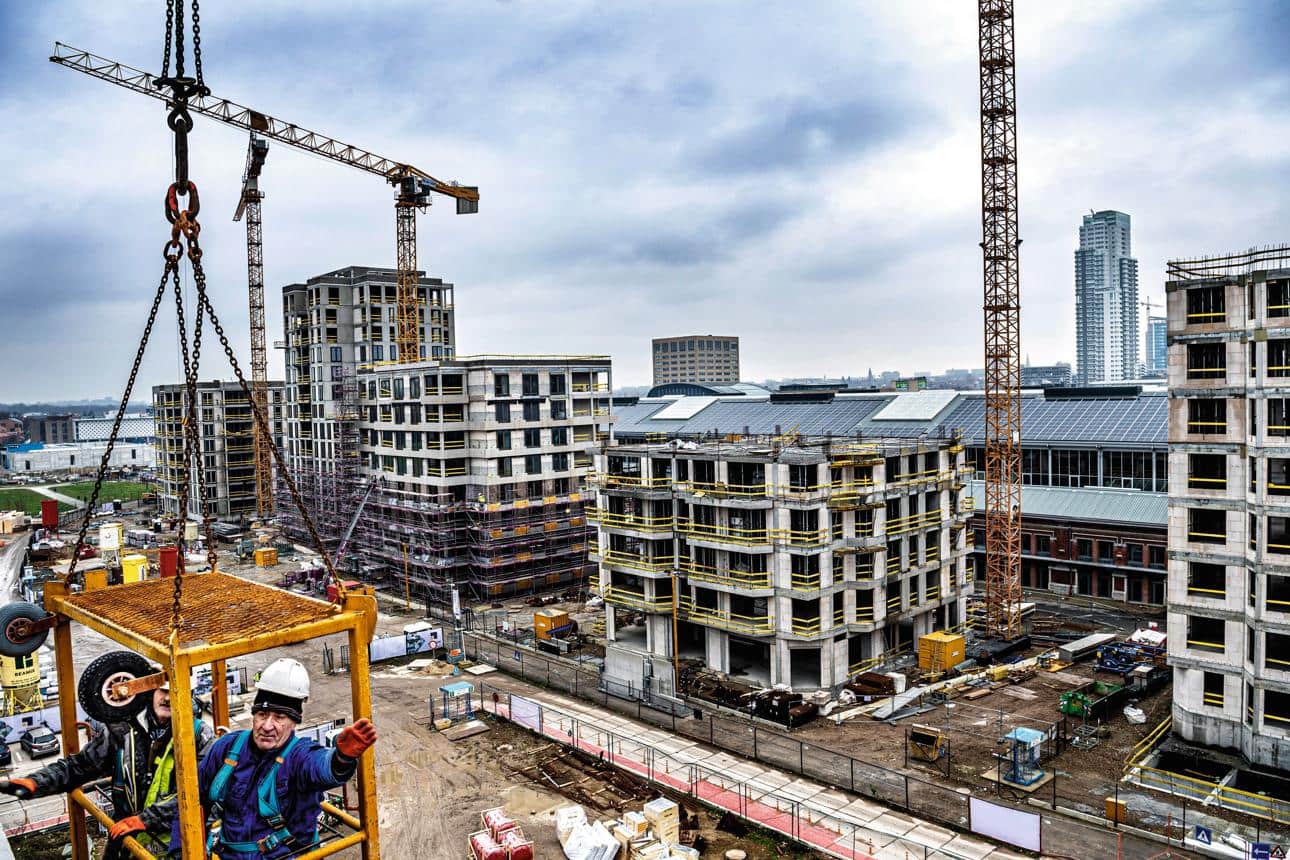
Construction has become the awkward exception in Europe’s economic story. Confidence readings improved across the bloc this summer in every sector but one, and the hard data released on 20 August explains why builders remain the outlier.
Production in construction fell 1.3 percent in the euro area and 1.0 percent across the EU in June compared with May, according to Eurostat. Measured against June 2025, euro area output sat 0.7 percent lower while the wider EU managed a 0.2 percent gain, a split that says less about European construction than about how heavily the currency union’s average leans on three large national markets.
The monthly breakdown leaves nowhere to hide. Buildings dropped 0.9 percent in the euro area, civil engineering 1.4 percent, and specialised activities 1.8 percent. Every category moved in the same direction, which rules out the comfortable explanation that one segment dragged the index while the rest held firm. The EU-wide figures repeat the pattern with slightly gentler numbers.
Civil engineering is the reading that should worry policymakers most. Roads, grids, rail and water infrastructure are precisely the categories that European recovery funds and cohesion envelopes were supposed to underwrite. A 1.4 percent monthly decline in that segment suggests public money is either arriving too slowly to offset private weakness or is being absorbed by cost inflation rather than physical output. Both explanations point at the same problem, which is that a spending commitment on paper has not converted into work on site.
National figures scatter widely. Spain recorded the steepest annual fall at 8.5 percent, followed by Hungary at 5.0 percent and France at 4.5 percent. Spain’s number is striking because the country spent much of the past two years being cited as the euro area’s growth engine, and a contraction of that size in a sector employing hundreds of thousands does not sit comfortably alongside that description. France’s decline compounds a domestic construction slump that has now run long enough to shape national budget arithmetic.
Survey evidence points the same way. The S&P Global eurozone construction purchasing managers’ index fell to 42.8 in June from 43.7 in May, a reading deep below the fifty mark that separates expansion from contraction, and one that has stayed below that line for an uncomfortably long stretch. Residential work registered as the weakest segment, with commercial activity next and civil engineering least bad, which broadly matches what the official statistics show.
Interest rates explain part of this. Residential development responds to borrowing costs faster than almost any other activity, and the rate cycle that cooled European inflation also cooled the mortgage market that finances new housing. The awkward point is that easing has already begun, and construction has not turned. Something beyond the cost of money is holding the sector down.
Labour supply is the candidate most contractors name. Skilled trades remain scarce across northern and western Europe, and the pipeline of new entrants has not kept pace with retirements. Permitting timelines are another. Developers in several member states report that approval processes lengthened rather than shortened over the past three years, even as governments promised the opposite in housing strategies.
The policy consequence lands squarely on the EU’s housing ambitions. The Commission has made affordability a headline theme and has floated an affordable housing plan built on the assumption that supply can expand. A sector contracting month after month cannot expand supply on command, and no amount of financing instruments will build homes that nobody has the crews or the permits to construct.
There is a reasonable counterargument. Monthly construction data is volatile, weather-sensitive and prone to revision, and a single June reading proves nothing on its own. Output rose 0.4 percent in May and 0.8 percent in April on earlier releases, so the trend line is not uniformly bleak. The concern is that the sector keeps failing to string good months together, and that a quarter of alternating small gains and larger losses is not recovery. It is stagnation with better weeks in it.