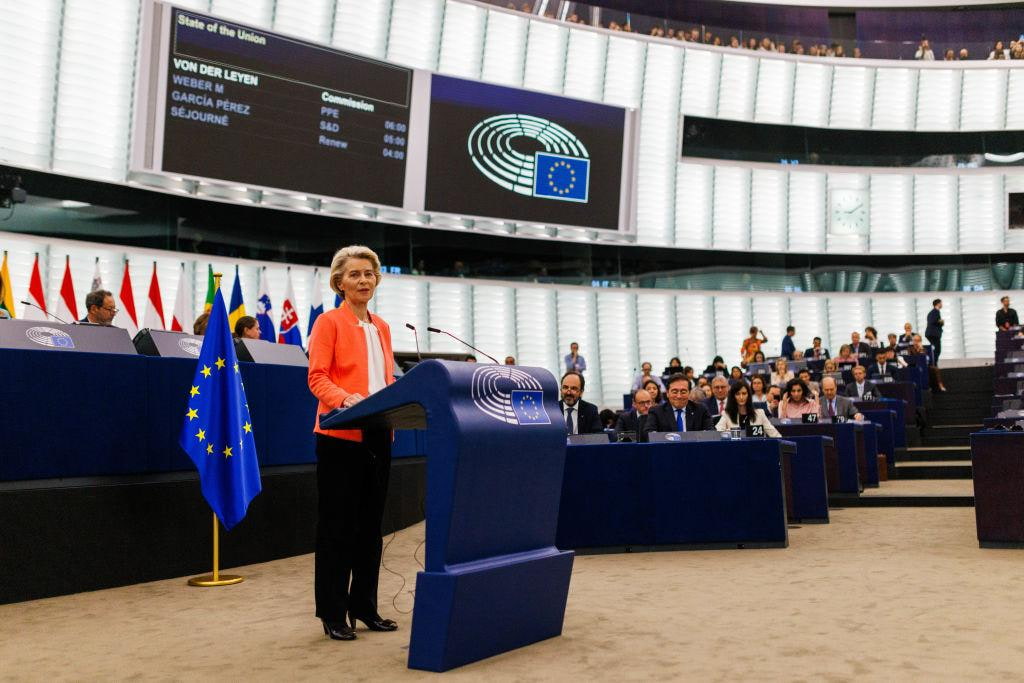
Dublin: Ursula von der Leyen tied her entire autumn agenda to own resources on 16 September 2026, telling the European Parliament in Strasbourg that an ambitious 2028-2034 budget needs revenue raised at Union level, and leaving Ireland’s presidency to sell that idea to 27 capitals before Multiannual Financial Framework talks close in December.
The Commission President spoke for just over an hour. She opened with Dickens and argued that the Union has never been at once this strong and this fragile. Nearly every pledge that followed carried a price tag, and the money to pay for those pledges does not yet exist.
Own resources is the technical term for revenue collected for the EU budget itself rather than transferred from national treasuries. Net contributors have blocked the idea for years, with Germany leading that camp. Ireland chairs the budget negotiations until December 2026, which casts Dublin as the broker rather than the advocate.
Von der Leyen paired the request with a deregulation pitch. She said twelve omnibus proposals now cut administrative costs by roughly 17 billion euro a year, and she pressed again for the Savings and Investments Union, the package meant to stitch Europe’s fragmented capital markets together. She also promised that the single market overhaul agreed under the One Europe, One Market roadmap can finish by the end of 2027.
The numbers she chose set the scale of the bill:
- 17 billion euro in yearly administrative savings claimed from twelve omnibus packages
- 1 billion euro a day, the trade deficit with China she described as a tipping point
- 46 per cent electrification by 2040, which she said would cut the fossil import bill by 260 billion euro a year
- Roughly 80 per cent growth in European defence spending over five years
Her economic diagnosis ran blunter than her announcements. Unemployment sits near record lows, she said, while energy prices and borrowing costs bite, and governments face hard fiscal choices to keep debt sustainable without strangling investment.
Von der Leyen called the months just past the "summer of truth", citing 660,000 hectares burned, 12 million tonnes of crops lost and more than 35,000 additional deaths during heatwaves as she introduced a European Heatwave Plan, a water initiative, a firefighting fleet and a Climate Insurance Alliance.
Parliament answered within the hour, and the answers pointed away from new revenue. Manfred Weber, who leads the European People’s Party, demanded a reform of the Emissions Trading System and the scrapping of the planned combustion-engine ban. Jordan Bardella of Patriots for Europe pressed for European preference in public procurement. Greens co-leader Terry Reintke called for an inquiry committee into weak enforcement of the Green Deal.
That spread matters for the arithmetic. A new own resources decision needs unanimity in the Council and ratification in every national parliament, and the budget itself needs the consent of the same chamber whose largest groups spent the afternoon demanding rollbacks. Von der Leyen named ultra-nationalists, anti-Europeans and Russian interference as the forces trying to split the bloc, days after Alternative for Germany swept a regional election in Saxony-Anhalt.
The competitiveness argument underneath the speech is not new. The Draghi and Letta reports pushed the Commission towards scale, simplification and deeper capital markets, and the Competitiveness Compass turned that diagnosis into an action plan. The 2026 Annual Single Market and Competitiveness Report tracks 29 indicators and warned in January that third country overcapacity is pushing into the EU market while barriers inside it persist.
Brussels has tried to build its own income before. ETS auction revenue, the carbon border levy and a plastics-based contribution have all been floated as own resources since 2020, and capitals have trimmed or deferred each one. The 2028-2034 package revives that argument at a moment when defence, enlargement and repayment of the NextGenerationEU borrowing all compete for the same ceiling.
Ireland now has roughly three months. The presidency must turn a speech listing heatwave plans, a European Security Council, an EU Kids Act and a Canadian associate membership into a budget that finance ministers will sign. Every one of those files reads better with own resources attached, and none of them has a majority for it yet. The full text of the address sits on the Commission’s State of the Union page.