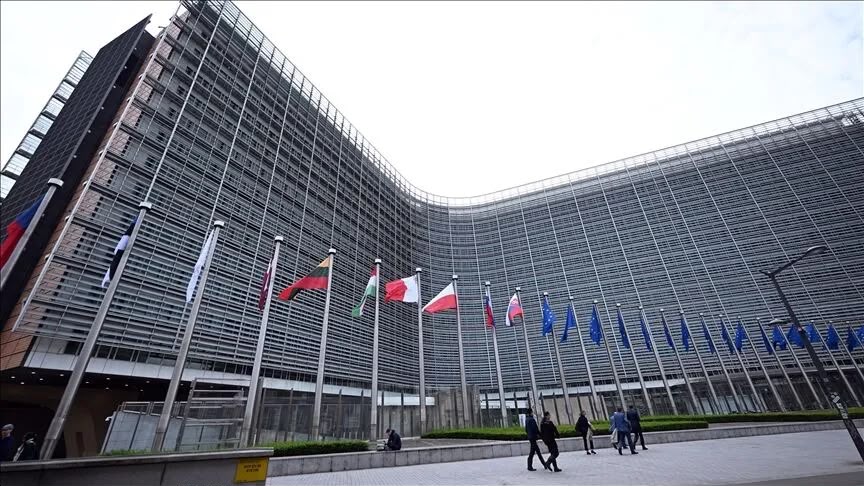

All twenty-seven member states of the European Union hold that Israeli settlements in the occupied West Bank are unlawful. That position is not contested inside the Council. Council conclusions have restated it. Governments reaffirmed it after the International Court of Justice delivered its advisory opinion in 2024. It is repeated by capitals that disagree about almost everything else here.
On 13 July the Union’s foreign ministers considered what to do about it. The Commission had put three options on the table: a full or partial ban on trade from the settlements, tariffs set high enough to make that trade unviable, or a licensing scheme. A ban drew the most support of the three. Nothing was adopted. The matter went to the twenty-seven ambassadors in Coreper, an extraordinary ministerial meeting was described as likely, and the next scheduled Foreign Affairs Council falls on 12 October.
Three months, for a measure its supporters describe as the minimum the Union’s own legal position requires.
Note first what is not at stake. Total EU-Israel trade in goods came to 43.3 billion euros in 2025. The settlement share of that figure is unpublished. As the Global Echo Litigation Center sets out in Importing Occupation: Europe’s Complicity in Palestinian Dispossession, published in June 2026, neither Israel nor the Union collects the data. The working estimate is the one Israel gave the World Bank in 2011: about 2.23 per cent of Israeli exports to Europe, a few hundred million euros a year.
So this is not an economic question. It is a question about whether a legal position the Union holds unanimously can be given any effect at all.
The delay turns on a procedural question, and it is worth saying at the outset why that question decides everything. Whether this counts as trade policy or as foreign policy determines whether fifteen governments can act or whether one can stop them. The same characterisation will govern every future case in which the Union wants an economic instrument to serve a political end. Readers who find voting thresholds dry should note that the outcome here sets the cost of a single veto for years.
Article 207 and Three Threshold Questions
The stated obstacle is procedural. If restricting settlement trade is a commercial policy measure under Article 207 of the Treaties, it passes by qualified majority: fifteen states representing at least 65 per cent of the population. If it belongs to the Union’s foreign and security policy, every capital holds a veto.
The Council’s legal service takes the first view. Officials around the Commission president have argued for the second.
Kaja Kallas, who chaired the discussion, put it plainly enough: a basis in law exists under which the Union may act by qualified majority, and that if the will is there it can move forward. She then acknowledged that no unified line had been reached.
Read those two statements together and the procedural framing collapses. The High Representative is not describing a legal impediment. She is describing an absence of political will, dressed as a dispute over voting thresholds.
Israel’s foreign minister understood this within hours and said so: no consensus, no qualified majority, the attempt had failed again.
A Union unable to determine which rule governs its own decision has not encountered a legal puzzle. It has made a political choice and declined to sign its name to it.
The Objection From Competence
There is a real objection here, and it deserves better than the dismissal it usually receives.
If trade instruments serve foreign policy ends on a majority vote, unanimity in the common foreign and security policy becomes optional. Any objective that admits of commercial framing could be pursued without it. States that accepted the veto as the price of a common foreign policy would find themselves bound on questions they understood to require their consent. This would be a constitutional change achieved through characterisation rather than treaty amendment. Governments raising it are not all shielding Israel. Some are protecting a rule they will want on other files.
Other objections carry weight too. Trade restrictions are blunt instruments, and they reach people who chose nothing. The relationship with Israel holds value in research, security cooperation, and technology that would be costly to damage. The administrative objection is weaker than it sounds, and worth stating accurately. The Union already operates a customs code introduced in May 2023 to implement the Technical Arrangement with Israel, whose stated object is that settlement exports should not receive trade preferences. Classification is not the difficulty. Enforcement is.
The same Global Echo investigation examined more than thirty thousand export documents. It found roughly one in five EU-bound agricultural shipments carrying settlement produce, with origin routinely obscured through relabelling and blending into genuine Israeli stock.
None of these arguments, however, supports the course the Union has actually chosen.
Deferral as Disposition
Because the choice made on 13 July lay not between acting and not acting. It lay between settling the point and leaving it open.
The precedent concern has a remedy, though not the one usually proposed.
There is no advisory route here. Article 218(11) of the Treaties allows the Court to be asked whether an envisaged act is compatible with them, and it can settle questions of legal basis. But it reaches international agreements the Union proposes to conclude. A settlement trade measure would be an autonomous act rather than an agreement, so no institution can ask the Court, in advance, which basis governs.
That leaves a single route. Ministers proceed on the footing their own Council legal service has advised, and any state that objects brings an action for annulment. The Court then rules, and its answer binds everyone. This is how contested competence is meant to be tested in a union of law: someone acts, someone challenges, the Court decides.
Which makes the deferral harder to defend rather than easier. The question cannot be settled by asking. It can be settled only by acting. A Council that declines to act has not postponed the answer. It has decided not to have one.
What the Union has done instead is neither. The Council referred an options paper to a committee, floated a meeting that may or may not occur, and left the next certain date three months out.
In that interval Israel signed its first umbrella agreement with a regional council, covering roughly twelve thousand new housing units and eight billion shekels for the Samaria Regional Council. It followed the Karnei Shomron plan of 14 June, which provided for some six thousand units. Israeli reporting puts the full programme of such agreements at 182,000 units and 52.47 billion shekels. The facts the Union says it opposes are being established in concrete. Brussels is discussing which majority it would need in order to object.
Deferral is not neutrality. Where one party is building and the other is deliberating, delay has a direction.
It has a second consequence, closer to home. Member states have stopped waiting. Spain legislated a ban last September, the Netherlands agreed one in May, Slovenia adopted a similar measure, the Irish parliament passed its prohibition in mid-July, and Belgium followed days later. The common commercial policy is an exclusive Union competence precisely so that twenty-seven customs regimes do not diverge. It is diverging now, one national statute at a time, because the Union will not hold a vote.
What Credibility Requires
The European Union is Israel’s largest trading partner, accounting for 33.1 per cent of Israeli imports and 29.4 per cent of exports in 2025. The association agreement’s trade provisions already exclude goods originating beyond the pre-1967 lines. The Union is therefore not being asked to invent a distinction. It is being asked to enforce one it drew years ago and has never operationalised.
This is what makes the matter a test of something larger than policy toward Israel. Consider the sequence. A Union adopts a position unanimously, holds an instrument that would give it effect, is advised the instrument is available, and then cannot bring itself to use it. That tells every watching partner what its declarations are worth. Every partner watching is drawing conclusions applicable elsewhere.
Three steps should follow before October.
Ministers should schedule the vote and accept the litigation risk, since no other route to an authoritative answer exists. The Commission should publish, rather than circulate, the technical work on customs differentiation, so that the administrative objection may be assessed rather than asserted. And the extraordinary meeting described as likely should be convened with a date attached.
The Union may decide, having done all of that, not to ban trade with the settlements. That would be a decision, taken openly, for which governments could be held responsible by their own electorates. It is a legitimate outcome, and it is not the one on offer.
What is on offer is a committee, a probability and 12 October.
ABOUT THE AUTHOR
Azfar Bukhari is a senior analyst specialising in geopolitics, public diplomacy, migration, international trade, and investment. He is the Vice President (External Relations & Diplomacy) and a regular contributor to The European Post.