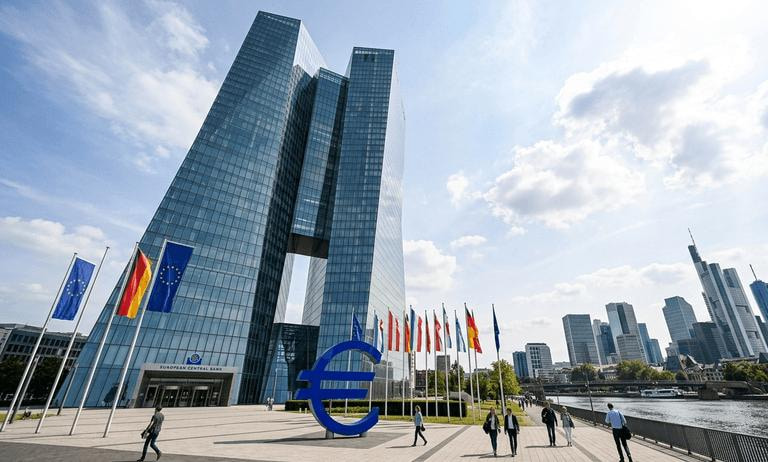
Frankfurt: The ECB rate hike announced on 10 September 2026 has now worked its way into money markets and loan pricing across the euro area, after the Governing Council raised its three key interest rates by 25 basis points for the second time since the conflict involving the United States and Iran pushed energy prices sharply higher. From 16 September the deposit facility rate stands at 2.50 percent, the main refinancing rate at 2.65 percent and the marginal lending facility at 2.90 percent.
The decision reflects a stark shift in the inflation picture. Eurostat’s flash estimate for August put euro area annual inflation at 3.2 percent, up from 2.9 percent in July, with energy prices rising 14.3 percent on the year compared with 10.3 percent a month earlier. Services inflation eased slightly to 3.0 percent and food inflation was contained at 1.1 percent, but the Governing Council concluded that the energy shock risked spilling into wages and broader price-setting if left unanswered.
The new staff projections explain the reasoning behind the ECB rate hike. Headline inflation is expected to average 3.0 percent in 2026 before slowing to 2.5 percent in 2027 and 2.1 percent in 2028, with the later years revised upwards. Inflation excluding energy and food is projected at 2.5 percent this year and 2.6 percent next year before easing to 2.3 percent in 2028, a profile that suggests second-round effects are already under way. President Christine Lagarde warned that the war in the Middle East and recent developments in Russia’s war against Ukraine would keep headline inflation well above the 2 percent target for an extended period.
What surprised markets was the growth outlook. Rather than cutting its forecasts, the ECB raised them, projecting gross domestic product growth of 0.9 percent in 2026, 1.4 percent in 2027 and 1.5 percent in 2028, citing the unexpected resilience of the euro area economy. That combination of stickier inflation and firmer activity removed much of the case for caution, and interest-rate futures now price a third increase by December, although the Governing Council repeated that it is not pre-committing to any particular path and will decide meeting by meeting on the basis of incoming data.
For households and companies, the transmission is already visible. Variable-rate mortgages, which remain common in Spain, Portugal, Italy and the Baltic states, reset against Euribor, which moved higher in anticipation of the September decision. Banks’ funding costs are rising, and corporate borrowers face tighter credit conditions just as the Commission is urging investment in defence, energy and competitiveness. Savers, by contrast, are seeing deposit rates edge up for the first time since the easing cycle that ran through 2024 and 2025.
The fiscal side of the equation is equally delicate. Higher policy rates raise the cost of servicing public debt, which Eurostat recorded at 87.8 percent of GDP across the euro area at the end of 2025, and several governments are simultaneously spending on energy support measures. The ECB has stressed that any such support should be temporary and targeted to avoid adding to demand.
The next test comes at the late-October meeting, when fresh data on wages and energy will show whether this ECB rate hike was enough or merely the second step of a longer tightening cycle.