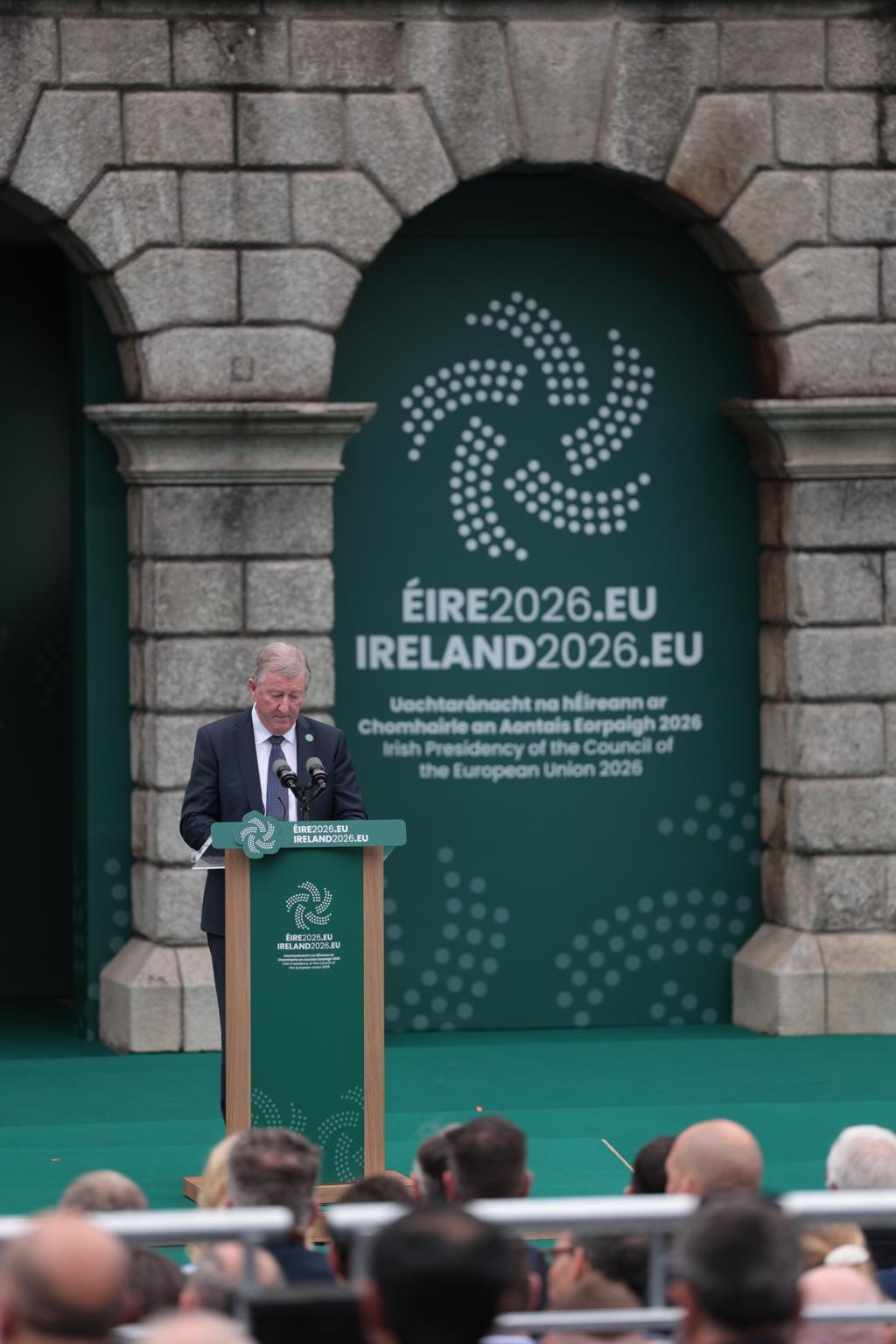
Galway: EU road safety policy was placed on the agenda of the Irish Presidency by a minister whose own constituency is Galway East, and whose country is recording a rising toll on its roads. Seán Canney, Ireland’s Minister of State for transport, chaired an informal meeting of EU transport ministers at Dublin Castle on 20 and 21 September 2026, where governments discussed how connected and automated vehicles might help reverse a trend that has stubbornly refused to improve.
The European Commissioner for transport, Apostolos Tzitzikostas, set out the scale of the challenge at a joint press conference with Canney. Almost 20,000 people die on European roads every year, he said, and up to five times as many suffer life-changing injuries, figures he described as unacceptable. The Union’s target is to halve road deaths and serious injuries by 2030 compared with 2019, a goal that leaves little time for the steep reductions it requires.
The first working session, dedicated to harnessing technological advances to improve road safety, examined how connected and autonomous vehicles and cooperative intelligent transport systems could be used across the single market. Tzitzikostas argued that such systems can help prevent crashes linked to fatigue, distraction or impairment, while also improving traffic flow, reducing congestion and increasing energy efficiency. He acknowledged that new technologies also bring new risks and called for unity among member states, rather than a patchwork of national approaches. Seventeen EU countries signed a joint declaration in June to create testing platforms for autonomous vehicles, a sign that governments want to experiment but have not yet converged on how.
The host country illustrated the stakes. Garda figures cited on 21 September showed 138 deaths on Irish roads so far this year, up from 127 at the same point in 2025, after 190 deaths in all of 2025 and 171 the year before. Canney, facing questions about his record, said the failure was shared by everybody involved, including road users, and pointed to regulations banning under-18s from using e-scooters, due to take effect on 2 October. He said the European toll would be treated as a pandemic if it were caused by disease.
A second session turned to energy. With the crisis in the Strait of Hormuz still weighing on fuel supplies, ministers discussed the impact on transport and how to phase out imported fossil fuels faster while managing demand. That discussion connects EU road safety with a broader set of files, from vehicle standards to the revision of the emissions trading system that now reaches parts of the transport sector.
Informal meetings do not adopt legislation, and the Dublin discussions were designed to prepare the formal Transport Council scheduled for 30 November. The questions ministers take there are practical ones: how quickly automated safety systems can be rolled out across existing fleets, how data from connected vehicles can be shared without breaching privacy rules, and how enforcement of the basics, from speed limits to drink driving, can be improved in countries where progress has stalled. Without movement on all three, the 2030 target for EU road safety is likely to remain an aspiration rather than a trajectory.