
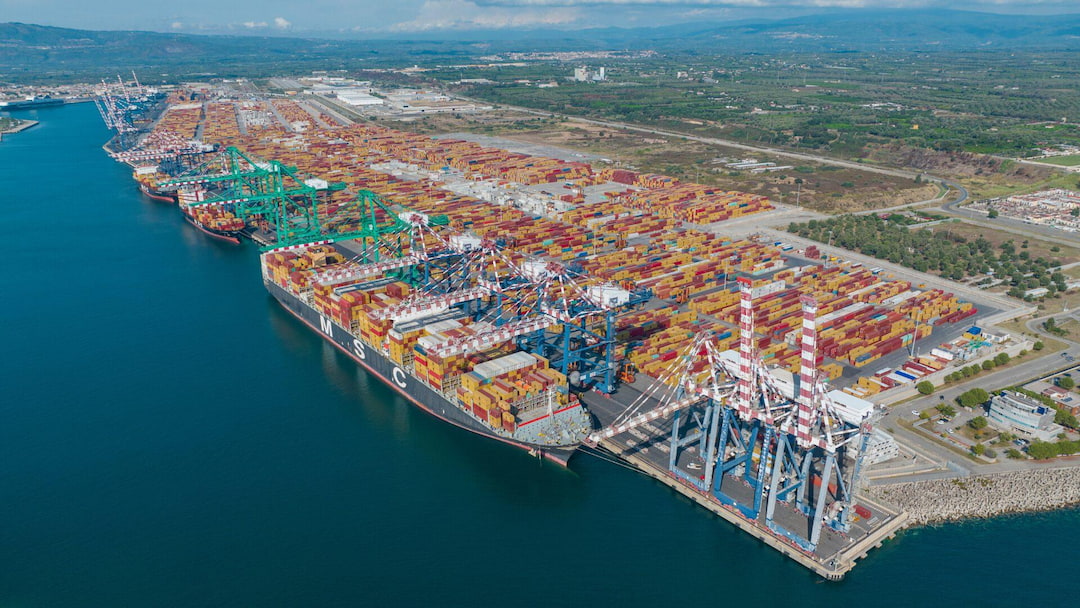
Gioia Tauro: Europe’s transshipment ports and the shipping lines that use them have asked EU lawmakers to strengthen a planned shield against carbon costs in the revision of the Emissions Trading System. In a joint letter published on 10 November 2026, four industry groups warned that traffic could drift to hubs outside the EU unless the rules change.
The signatories are the European Sea Ports Organisation, the Federation of European Private Port Operators, the World Shipping Council and Assarmatori, the Italian shipowners’ association. Their paper, titled Retaining Transshipment Traffic and Investment in European Ports, targets the co-legislators now negotiating the ETS review.
The concern stems from how maritime emissions trading works. Since shipping joined the ETS, carriers pay for half of the emissions on voyages between an EU port and a non-EU port. A container line can therefore lower its bill by relaying cargo through a hub just outside EU waters, where the chargeable leg ends, instead of calling at transshipment ports inside the Union.
The Commission’s proposal already includes a specific transshipment measure under Article 12(3)(g) of the revised ETS Directive. The four associations welcome that step but argue it stops short. They want the incentive to cover journeys that both start and end in the EU, and to apply to every service that makes a transshipment call at an EU port rather than to selected movements.
They also ask for simple, non-discriminatory rules that treat all EU ports alike. Port operators fear that a complex or selective mechanism would add paperwork without stopping cargo from moving, while shipping lines want legal certainty before they redesign their networks.
The stakes are high for transshipment ports in southern Europe, where hubs compete directly with facilities across the Mediterranean. The joint letter warns that the territorial scope of the ETS could leave EU transshipment ports at a competitive disadvantage on intercontinental routes. A loss of relay traffic would reduce demand for dock workers and for services such as towage, bunkering and repairs.
Environmental groups have long argued that the ETS should cover more of each voyage, not less, and they view relief for hubs with suspicion. The industry answers that evasion produces no climate gain at all, because ships still sail the same distance while emissions simply fall outside the EU’s carbon market.
The debate also links to Europe’s wider ports agenda. The Commission presented an EU ports strategy in March 2026 that treats ports as strategic infrastructure, which gives governments an extra reason to keep major hubs busy.
The co-legislators must now decide how far to widen the measure. For transshipment ports from Gioia Tauro to Algeciras and Piraeus, the final wording will shape investment plans and employment for years, and it will show whether the EU can price shipping emissions without pushing cargo to its neighbours.


