

Europe met Washington’s deadline and called the result stability. The more revealing decision was quieter: the Anti-Coercion Instrument, the Union’s strongest economic weapon, was written out of its own trade settlement in all but name.
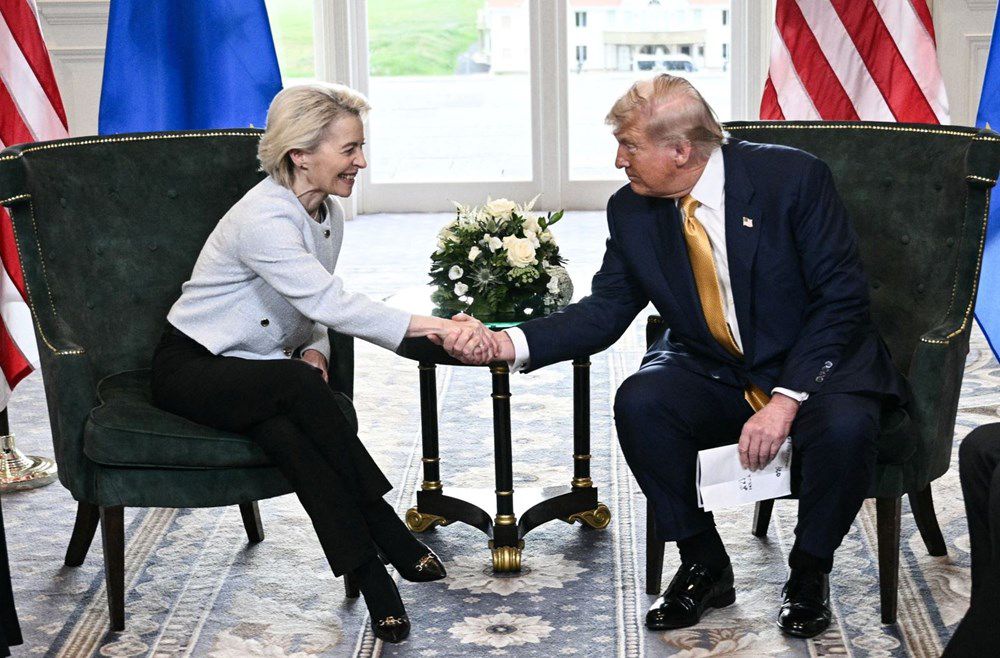
The date on which the transatlantic trade file closed was not chosen in Europe; it was set in Washington, and it was today. Almost a year after Ursula von der Leyen and Donald Trump shook hands at a Scottish golf resort, the implementing regulation is signed. The duties on American industrial goods have fallen to zero. The fifteen percent ceiling on most European exports is now the settled architecture of the relationship. The Commission calls this stability, and on its own narrow terms the claim holds. What the settlement also shows is harder to celebrate: the Union’s strongest defence against economic coercion was kept out of the very deal that coercion produced.
The account deserves a fair hearing before it is tested. Brussels faced a genuine ultimatum. A refusal to ratify by today invited an escalation to twenty-five percent on European cars, a threat aimed squarely at German assembly lines and the supplier networks that feed them. The negotiated outcome removed that risk. It preserved a trading relationship worth more than four billion euros in daily flows, and it did so without a tariff war that would have punished European exporters far more than any drafting concession. The Parliament extracted safeguards along the way. A mechanism would suspend tariff cuts if American imports surge. A trigger reopens the file should Washington keep steel and aluminium duties above the ceiling past December. A sunset closes the arrangement in 2029. A negotiator working under a deadline set by the other side will take that package and call the day a success.
The Anti-Coercion Instrument was the concession that mattered most
Yet the choice that reveals the most was not made at the tariff line. It was made in the text. After the Greenland threats, Parliament’s negotiators pushed to arm the agreement with the Union’s own defensive language, and their lead, Bernd Lange, named suspension clauses against coercion of a member state or threats to the Union’s territorial integrity as conditions the deal could not do without. What survived the trilogue was narrower. The final text lets the Commission suspend the regulation where Washington undermines its objectives or targets European operators, but the explicit deterrent vocabulary MEPs had sought was pared back to a general safeguard. The weapon built to answer economic pressure was kept, at the least, at the edge of the instrument answering it.
The Anti-Coercion Instrument was never a minor file. It entered into force in December 2023 as the Union’s answer to a decade of lessons, from the steel and aluminium tariffs of the first Trump term to Beijing’s boycott of Lithuania after Vilnius allowed Taiwan to open a representative office. The logic was mutualisation: coercion against one member state would meet a response at Union level, drawing on restrictions to market access, public procurement, intellectual property rights, and the licences that foreign firms need to operate inside the single market. It was, in the shorthand that Brussels adopted and then came to regret, the bloc’s economic bazooka.
A deterrent works only if the adversary believes it will be used
Here the defence of the settlement turns against itself. A deterrent is not the possession of a weapon but the credible prospect that it will be used, and by that measure the record is unkind. The Anti-Coercion Instrument has never been formally invoked, and its supporters long treated that silence as proof of success, evidence that the mere fact of the tool had reshaped the calculations of capitals that might otherwise have leaned on individual member states. That reading was always generous. This year it became untenable.
The Union spent early 2026 absorbing exactly the kind of pressure the instrument was designed to deter. The bloc had already come close to activating it once, after Washington’s tariffs of April 2025, before the Turnberry framework defused the dispute. As the Greenland threat resurfaced, the case for reaching for the tool was made plainly. President Macron urged its use in January, and the Brussels institute Bruegel argued that Trump’s threats should be treated as coercion under the regulation, adding that even triggering it would signal European unity against a threat to a member state’s territorial integrity. Instead an American administration threatened tariffs pegged to a political deadline. It tied trade to a demand over Danish territory. And it imposed duties a court in Washington had already found unlawful. If that does not meet the regulation’s own test of a foreign power pressing the Union toward a particular choice, little ever will. The Anti-Coercion Instrument met the clearest confrontation it has yet faced by staying in its holster, while the defensive language MEPs wanted in the settlement was thinned on the way to signature.
Strategic autonomy and the Anti-Coercion Instrument cannot survive as vocabulary alone
The wider cost is to a phrase Brussels has repeated for a decade. Strategic autonomy was meant to describe a Union that could act on its own security and economic interests without waiting for permission. The trade settlement shows what the phrase has quietly become: a vocabulary deployed in speeches and retired in negotiations. The Commission chose the relationship over the deterrent, and that choice may even have been the prudent one in the moment. Prudence and autonomy are not the same thing, and the gap between them is where credibility drains away.
None of this argues that Brussels should have fired the bazooka. Invoking the Anti-Coercion Instrument against the United States would have carried real and asymmetric risks, and reasonable analysts inside the institutions judged the price too high. That judgment is defensible. What is not defensible is the pretence that the tool remains a deterrent after a year in which it was neither used nor, when it mattered, even named. A weapon a government builds, brandishes, and then removes from the table at the first test is not held in reserve. It has been disarmed in public.
The transatlantic file is closed, and the Anti-Coercion Instrument returns to the shelf. The ceiling will hold until the next administration or the next deadline decides otherwise. The more durable lesson sits in how the tool was handled. The Union is learning what the Anti-Coercion Instrument is worth when the pressure comes from a partner rather than a rival, and on the evidence of this year it is worth less than the appearance of calm. A weapon that a bloc designs, names, and then keeps holstered through the clearest confrontation it has yet faced is not a deterrent. It is a monument to the intention of having one.
Sources and Further Reading:
- Regulation (EU) 2023/2675 (Anti-Coercion Instrument), EUR-Lex: https://eur-lex.europa.eu/legal-content/EN/TXT/?uri=CELEX:32023R2675
- Anti-Coercion Instrument, DG Trade and Economic Security: https://policy.trade.ec.europa.eu/enforcement-and-protection/protecting-against-coercion_en
- EU-US trade deal overview, European Commission: https://commission.europa.eu/topics/trade/eu-us-trade-deal_en
- Council and Parliament deal on the tariff regulation, Consilium: https://www.consilium.europa.eu/en/press/press-releases/2026/05/20/eu-us-trade-council-and-parliament-strike-a-deal-to-implement-the-tariff-elements-of-the-joint-statement/
- The end of the Turnberry truce and the case for the ACI, Bruegel: https://www.bruegel.org/first-glance/end-turnberry-truce-how-eu-should-react-us-coercion-over-greenland
ABOUT THE AUTHOR
Sophie Laurent is a Senior Reporter and Policy Analyst specialising in external relations, diplomacy, and European affairs. She writes on geopolitical developments, international policy, and strategic diplomacy for The European Post