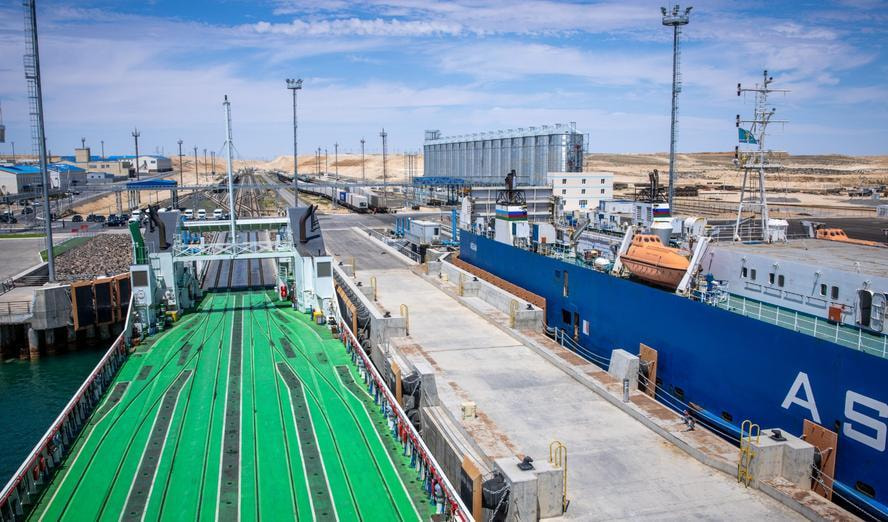
Aktau: The Trans-Caspian corridor is the clearest test of whether the EU’s connectivity diplomacy can turn statements of intent into cargo moving between Europe and Central Asia in 2026. The European Commission launched a Connectivity Agenda Platform in June 2026, and it said agreements with international financial institutions are expected to mobilise up to €2 billion for transport and trade investment.
The platform was unveiled at a ministerial meeting hosted by Commissioners Marta Kos, Jozef Síkela and Apostolos Tzitzikostas. Transport ministers from EU states joined counterparts from Armenia, Kazakhstan, the Kyrgyz Republic, Moldova, Tajikistan, Turkmenistan, Turkey, Ukraine and Uzbekistan, along with G7 and financial-institution representatives. The guest list shows how far Brussels wants its Global Gateway strategy to reach beyond its own neighbourhood.
Participants agreed to strengthen the operational performance of the Trans-Caspian corridor, a route linking Europe and Central Asia through the South Caucasus and the Black Sea region. They also invited the Commission to assess how the Trans-Caspian corridor functions and to propose priority actions that improve its competitiveness. Kos said trade along the route could grow fivefold over the next 15 years, a projection that remains the Commission’s own estimate.
The money deserves a careful reading. The €2 billion is described as an expected mobilisation, built on statements of intent for transport infrastructure, border crossing points and trade facilitation in the Black Sea region and the South Caucasus. The reporting reviewed names no lenders, gives no split by country or project and sets no timetable, so investors cannot yet tell which bottlenecks will be fixed first.
That gap matters because corridors fail at their weakest link, not at their most impressive one. Border queues, port capacity and mismatched customs procedures decide whether a Central Asian exporter chooses this route over alternatives, and a platform that coordinates policy cannot by itself widen a quay or shorten an inspection. The Commission’s assessment of the Trans-Caspian corridor therefore needs concrete deadlines and published results.
The diplomacy is also delicate. The route crosses states with different alignments and interests, and Brussels has framed its Cross-regional Connectivity Agenda, first presented in Luxembourg in October 2025, as a partnership rather than a competition. That framing will be tested if EU funding is seen to favour some transit countries over others.
Three signals will show whether the effort is real: named financing agreements with project lists, a published corridor assessment with priority actions, and measurable falls in crossing times at border points. If they arrive, the Trans-Caspian corridor could anchor Europe’s presence in Central Asia beyond 2026; if not, it will remain an ambition on a map.