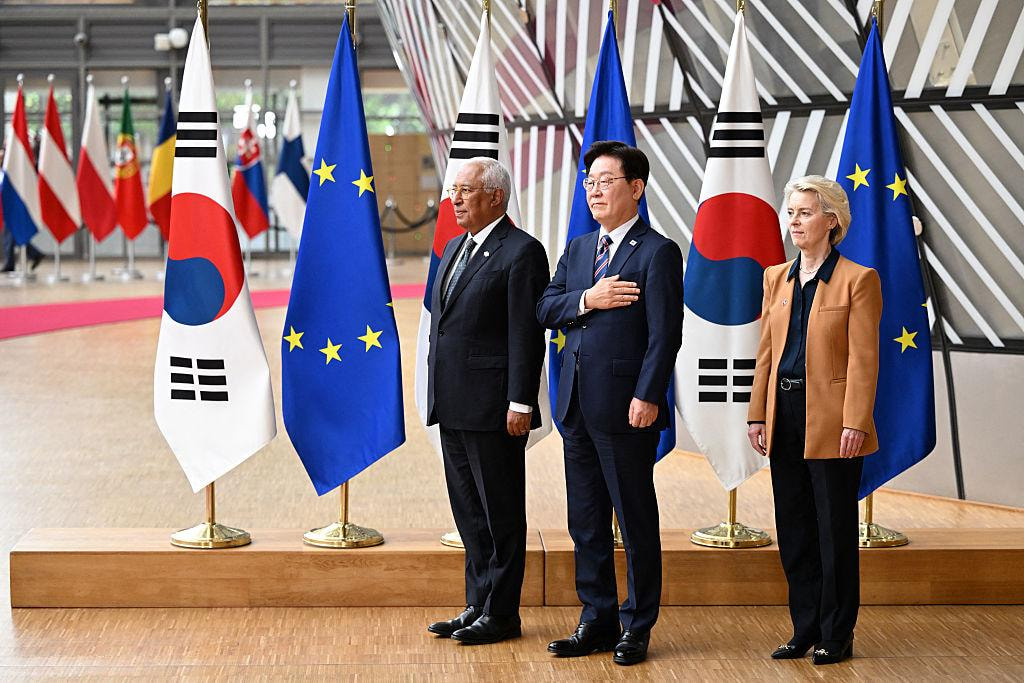
Brussels: The South Korea summit held on 10 June 2026 produced the first signed digital trade agreement between the European Union and Seoul, alongside a pledge to widen their security and defence partnership. European Commission President Ursula von der Leyen and European Council President António Costa hosted President Lee Jae-myung at the 11th meeting of leaders.
The digital trade agreement is the concrete deliverable. According to Anadolu Agency and the Brussels Times, it is meant to ease data flows, support e-commerce and make digital transactions more predictable. Neither outlet published figures on trade or investment, so the economic effect of the South Korea summit cannot yet be measured.
Security took equal space. The Brussels Times reports that the two sides will expand their security and defence partnership to cover cyber and hybrid threats, counterterrorism, maritime security and space. Anadolu says leaders also agreed to begin negotiations on a security of information agreement, which would allow the exchange of classified material, and that Lee hoped it would be adopted soon. Von der Leyen raised North Korean troops fighting alongside Russia in Ukraine and praised Seoul’s support for Kyiv.
The economic track is broader than the headline deal. Leaders launched a competitiveness partnership and a high-level economic dialogue on economic security, trade and industrial policy, plus a high-level energy dialogue. Anadolu names hydrogen, offshore wind and small modular reactors as areas for cooperation. The Brussels Times adds that the EU has completed its internal steps to open talks on a mutual recognition agreement, which would cut double testing, and that negotiations on a passenger name records agreement are finished.
Science and farming also featured. The Brussels Times notes that the first collaborative projects under South Korea’s association to Horizon Europe were welcomed, and that leaders will keep working on market access for EU beef, poultry and pork. Those agricultural lines suggest that the South Korea summit left some old trade irritants open.
The pattern matters for Europe’s Indo-Pacific policy. Brussels is building a network of security and economic ties with partners that share concern about supply chains and regional stability, and Seoul fits that approach. The risk is a long list of dialogues with few deadlines, because neither source gives a date for the next leaders’ meeting.
Three tests will show whether the South Korea summit delivers. Negotiators should start the information security and mutual recognition talks quickly, the digital trade agreement should enter into force without delay, and the new energy dialogue should produce named projects. If they do, the South Korea summit will mark a real upgrade; if not, it will join the many summits that ended with promises alone.