
European Quarter: Mediterranean maritime security now has a dedicated diplomatic channel, after the European Union convened the first EU-Mediterranean Peace and Security Forum in Brussels on 18 November 2026. The meeting brought EU member states, the ten Southern Neighbourhood partners and leading think tanks into one room. Organisers framed it as a deliverable under the third pillar of the Pact for the Mediterranean, which covers security, preparedness and migration management.
High Representative Kaja Kallas could not attend, so Commissioner Hadja Lahbib delivered the opening remarks on her behalf. Her central admission was striking. Lahbib told the audience that the partnership had “never had a single channel devoted to the question of security”, a gap that sat awkwardly beside decades of Euro-Mediterranean summitry on trade, energy and migration.
The guest list showed why that gap mattered. Syrian Foreign Minister Assad Al Shaibani, Maltese Home Affairs Minister Glenn Bedingfield, Egyptian Deputy Foreign Minister Mohamed Abubakr Saleh and Rear Admiral Marco Casapieri, commander of the EU naval operation IRINI, all took part. Their presence placed reconstruction in Syria, the fragile situation in Libya and Lebanon’s effort to disarm Hezbollah inside a single conversation about Mediterranean maritime security.
The sharpest message treated Mediterranean maritime security as a question of law rather than of ships alone. Lahbib noted that 67 countries have pledged to oppose tolls and fees on international shipping routes in support of the UN Convention on the Law of the Sea. Jordan is the only Mediterranean partner to have signed that pledge, and she urged the others to follow. With Iran attacking shipping around the Strait of Hormuz and the Houthis still threatening Bab el-Mandeb, the request carried real weight.
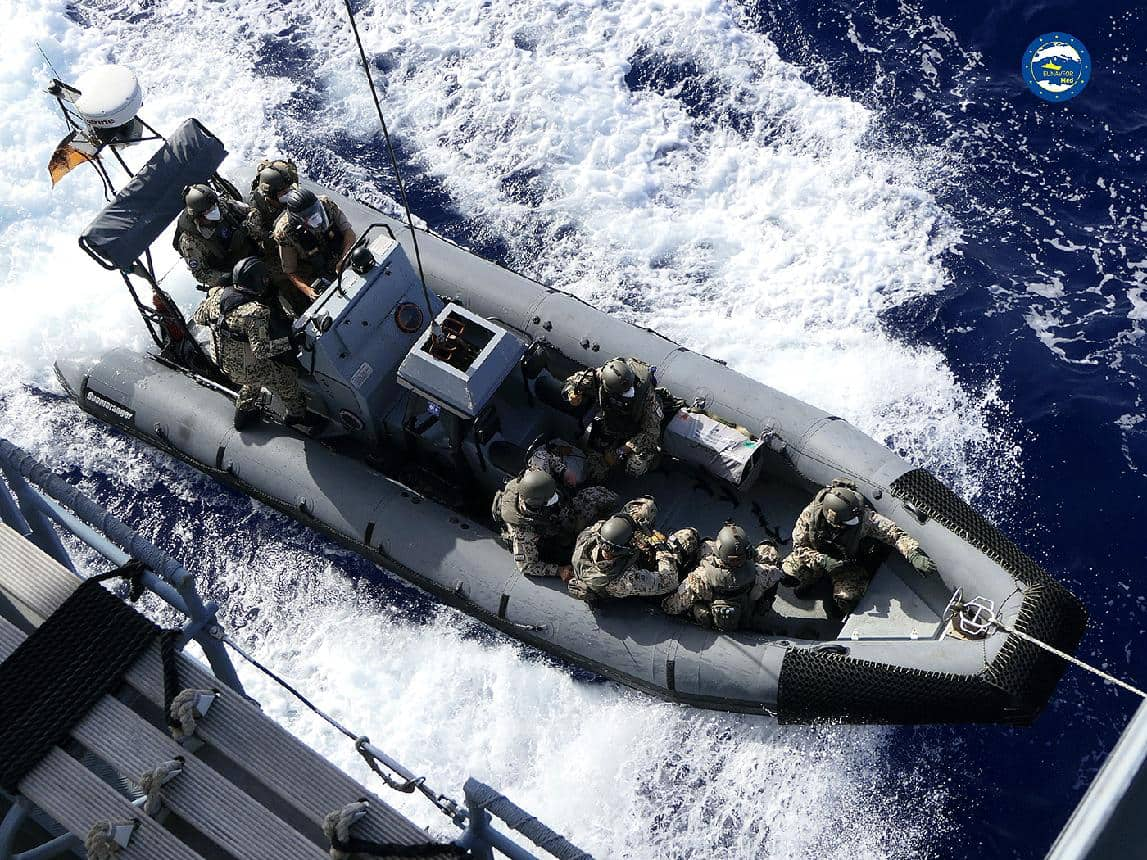
Operation IRINI sits at the centre of the EU’s practical offer on Mediterranean maritime security. Member states have expanded its mandate and renewed it until 2029, with tasks that include helping to protect critical maritime infrastructure and working with the navies and coastguards of Egypt, Libya, Lebanon and Tunisia. Lahbib also reported that EU forces boarded a suspected shadow fleet tanker last week and confirmed that it was flying a false flag. Sanctions evasion now travels through the same waters as migrant boats and arms smuggling.
The forum also connects to the wider Pact action plan that the Commission and the European External Action Service updated on 10 November. That plan now counts 30 actions, including a European Firefighting Hub in Cyprus and new regional cooperation on internal security and border management. Defence planners will note that most of these instruments address Mediterranean maritime security through civilian and coastguard tools, not combat capabilities.
That choice reflects the political limits of the exercise. Southern partners remain wary of any arrangement that looks like Europe outsourcing migration control or policing their waters. An informal forum gives them a seat at the table without binding commitments, which explains both its appeal and its weakness.
The real test for Mediterranean maritime security will come in 2027, when the Commission expects to update the Pact action plan again and IRINI must show results off Libya and Lebanon. If the new forum produces shared situational awareness, joint patrols and more signatures on the freedom of navigation pledge, it will have earned its place on the calendar. If it remains an annual exchange of speeches, the security pillar of the Pact will look thin beside the money flowing into its economic chapters.


