
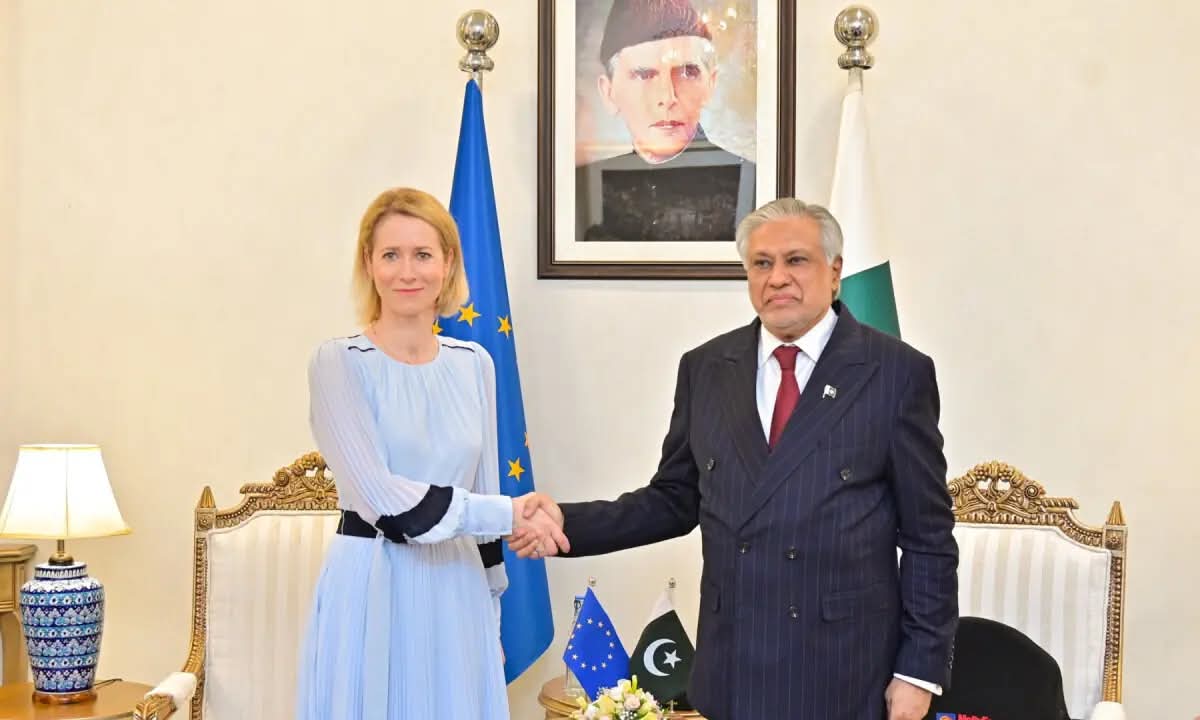

Pakistan has worked its way into the calculations of the major blocs. The European Union’s foreign policy chief has now confirmed the standing. What that relevance costs is the harder question.
This article is offered as analysis in good faith, an examination of the structural reasons behind the European Union’s renewed engagement with Pakistan and the conditions under which that engagement now travels. It examines the conduct of states and institutions, not the character of any nation or people. The analysis is grounded in established fact, and the views expressed are honestly held.
Astate earns standing in international politics through one of two routes. It either accumulates the conventional indicators, weight in trade, depth in capital, mass in arms, until other states must take its preferences seriously, or it makes itself useful in particular files at particular moments to such an extent that the larger powers find they cannot do without it. Pakistan has spent the past two years quietly travelling the second road. The European Union’s foreign policy chief flew into Islamabad on a one-day visit to register that the journey has been noticed.
The cadence was the loudest signal. The eighth EU-Pakistan Strategic Dialogue came seven months after the seventh, in a relationship whose previous high representative engagement, in 2019, had been followed by a near-total silence at that altitude. To compress two such meetings inside a single year, after seven years of effectively no high-level European travel to Pakistan, is not a routine update of the diary. It is a statement, and the statement is that Brussels has revised its estimate of what Pakistan is worth to Europe’s own strategy.
Three files explain the revision, and none of them is incidental. The first is the back-channel between Tehran and Washington that has held a fragile ceasefire together through the worst stretch of this year’s war. Kaja Kallas described Pakistan as the principal mediator and said its efforts had prevented a return to full-blown war on several occasions, language European foreign policy does not use loosely. She added that she now expects the first phase of a Pakistan-mediated agreement to be formally signed, a forward statement the office of the high representative does not offer lightly. The second is the Strait of Hormuz, on which a meaningful share of European energy security continues to rest, and through which any restoration of normal flows runs in part through Islamabad’s diplomatic relationship with Tehran. The third is trade. The bloc is now Pakistan’s single largest export market, exceeding the United States and China combined by Brussels’s own measure, and Pakistan remains the world’s leading beneficiary of the Generalised Scheme of Preferences Plus. These are not the assets of a marginal state.
It would be easy, and inaccurate, to read this as Pakistan’s arrival in the company of the major powers. It has not arrived, and the difference matters. Its economy remains structurally fragile and dependent on cycles of external assistance. Its civilian institutions have been visibly compressed by a series of constitutional revisions whose direction will be examined further below. Its security frontier with Afghanistan has reopened in ways that drain rather than project capacity.
The architecture of this relevance is best understood by counting the patrons. The United States needs the Iran channel kept open, and beyond it the suite of intelligence and counter-terrorism cooperation that has resumed after years of attrition. Beijing has the China-Pakistan Economic Corridor, the deepwater port at Gwadar, and a security relationship with Pakistan’s military that anchors its Indian Ocean posture. The Gulf, in particular Saudi Arabia and the Emirates, has used Pakistan repeatedly as a stabiliser, as a labour partner, and recently as a discreet conduit in conversations with Tehran. Brussels has now joined the queue, with the trade weight, the energy interest, the migration file, and the nuclear-stockpile question that quietly shapes every external assessment of Islamabad. Four patrons, four distinct conditional logics, and a Pakistan that has learned to be partly necessary to each.
Pakistan has not joined the table at the head. It has earned a seat at several others, which is another kind of arrangement, and one that carries its own costs.
To be partly necessary to several powers is itself a form of standing. It is also a form of constraint. Each extracts terms in its own currency. Washington trades intelligence access against political indulgence on the home front. Beijing trades infrastructure against alignment on regional disputes, and on the question of the Indian Ocean. The Gulf trades capital and labour quotas against discretion in places its diplomacy prefers to handle through proxies. Brussels, characteristically, trades preferential market access against a longer list of conventions on human rights, labour rights, and governance, and against the patience with which it expects those conventions to be implemented. The Pakistani state has therefore agreed, formally or otherwise, to be measured against four overlapping rulebooks, none of which it wrote.
This is the framework within which the GSP Plus reminder Kallas delivered in Islamabad must be read. The scheme rests on twenty-seven core conventions, and continued access to the European market depends on demonstrable progress in their implementation. The high representative said as much on a public stage, in a sentence that her hosts will have understood as both compliment and caveat. The European ambassador in Islamabad had been more pointed last autumn, naming blasphemy laws, enforced disappearances, and minority rights as the files Brussels is watching. The post-war order, Kallas observed elsewhere during the same visit, has eroded not because its principles were flawed but because states have failed to enforce them. The dialogue re-stated the conditionality at the only altitude at which it cannot be ignored.
The timing of that re-statement is the part of the visit most worth examining. Pakistan’s coalition government is now negotiating a proposed Twenty-Eighth Constitutional Amendment whose direction remains under discussion but whose elements have already drawn concern. Reporting in the Pakistani press suggests a package that may include extensions of federal tenure, provisions for delaying elections under exceptional circumstances, a revisitation of the National Finance Commission, and adjustments to provincial autonomy whose net effect would touch the Eighteenth Amendment’s settlement on devolution. The most arresting public proposal has been to raise the minimum voting age from eighteen to twenty-five, which in a country with one of Asia’s youngest electorates would withdraw the franchise from a generation.
This proposed amendment must be read against the Twenty-Seventh, passed last November under conditions of considerable parliamentary haste and over a substantial opposition boycott. That earlier amendment created the constitutional post of Chief of Defence Forces, vested it concurrently in the army chief, and granted lifetime rank, privilege, and immunity from criminal proceedings to holders of the rank of Field Marshal. Field Marshal Asim Munir, now both army chief and the new commander, is the first beneficiary. The proposed Twenty-Eighth, whatever its final shape, will arrive in a parliamentary chamber whose deference to non-elected authority has been recently re-calibrated. Its critics, including senior figures within the ruling coalition, read it as a further consolidation of arrangements the elected branch has lacked the political room to refuse.
A European foreign policy chief travelling to Islamabad at precisely this moment, restating the terms attached to the trade preference at the highest available altitude, and meeting both the elected leadership and the Chief of Defence Forces in the same itinerary, was not engaged in routine bilateral maintenance. Brussels was placing a marker, in the most courteous register available to it, against the institutional path on which Pakistan now stands. The same engagement honoured Pakistan’s mediation in language sufficient for the protocol of recognition and the optics of partnership. That two things happened on a single stage in a single day is the architecture of the policy. The mediator is recognised. The terms are restated. The carrot and the conditions are offered together, as they always are in European external action when Brussels has actually decided to engage.
The honest reading, therefore, is neither that Pakistan has become a pole nor that it has been picked up as a convenient adjunct by another anxious capital. It is that Pakistan has earned a particular kind of relevance, a conditional indispensability across several files, and that the European Union has now joined the company of patrons whose interests run through Islamabad. The price of being needed by many is being constrained by each. Whether Pakistan’s politicians can find the room to shape what comes next, or whether what comes next is shaped over them, is the question every patron in the queue will be watching, and Brussels has chosen to do so from the doorstep rather than at a distance. That is the message a careful reader was meant to extract from the calendar. It is also the harder argument the country must now win, on its own terms, if relevance of this kind is to mature into something more durable.
ABOUT THE AUTHOR
Azfar Bukhari is a senior analyst specialising in geopolitics, public diplomacy, migration, international trade, and investment. He is the Vice President (External Relations & Diplomacy) and a regular contributor to The European Post.
