
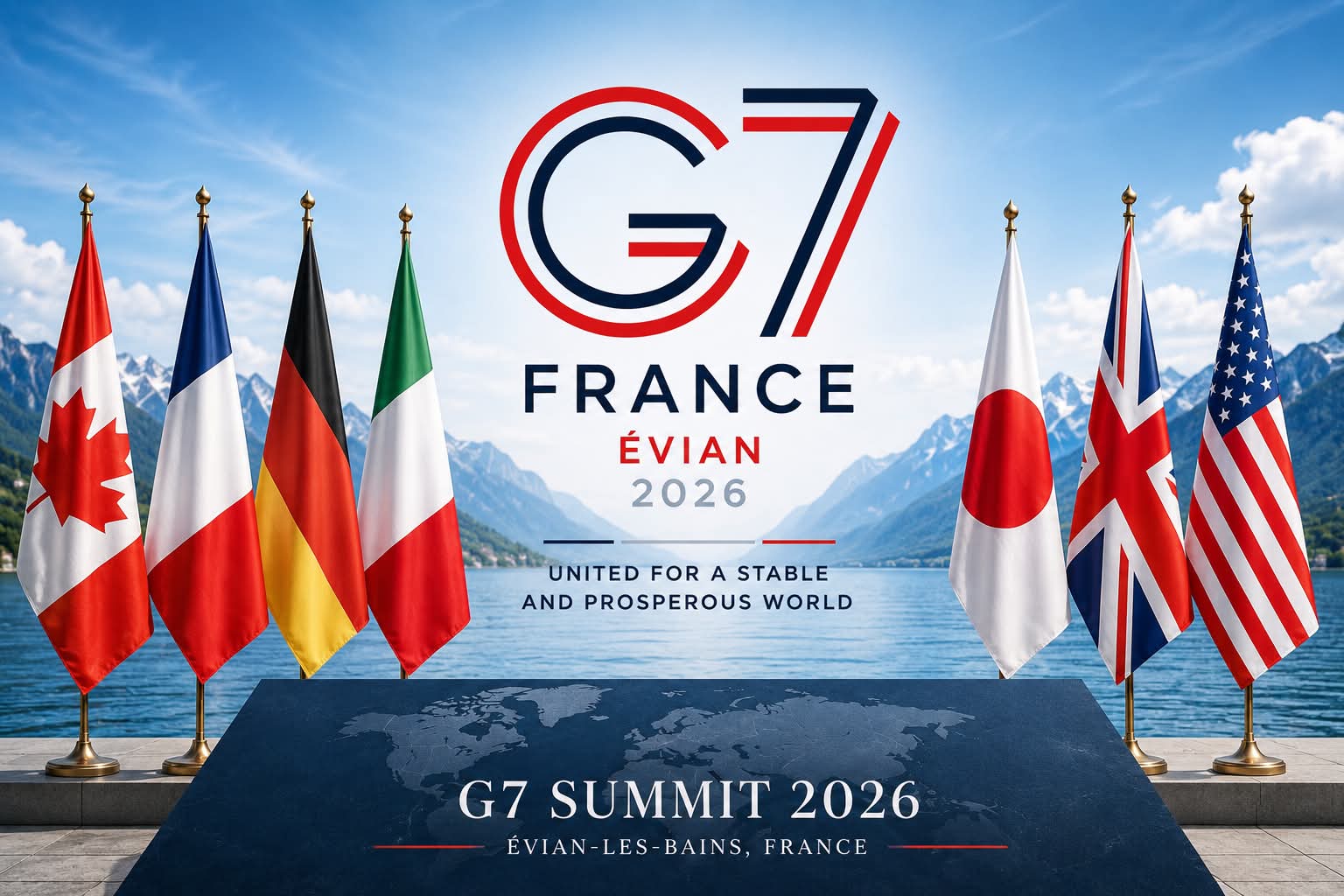

The G7 left Evian this week without the torn-up communique and the departing-aircraft broadside that marked its recent gatherings, and the United States signed the joint statement. The harmony looked like a restoration of Western unity. Read against the text the leaders actually approved, it was something closer to the opposite: a club that preserved its cohesion not by agreeing on the world but by organising itself around the decisions of its most disruptive member.
The Group of Seven gathered at Evian this week and, for the first time in years, departed without a public rupture. There was no torn-up communique, no presidential broadside fired from the cabin of a departing aircraft, no host left to explain why the leader of the world’s largest economy had declined to sign what his counterparts had agreed. The summit produced a joint statement on the gravest questions before it, on Ukraine, on Iran, on the Strait of Hormuz, and the United States put its name to the text. After the acrimony of recent gatherings, the scene at the French resort had the appearance of a restoration, the richest democracies once more speaking as one. It can be read charitably, and many will read it so: as the pragmatic good sense of an alliance closing ranks behind the member who had just delivered a ceasefire. That case has merit, and this argument will return to it in full. Yet the unity is worth examining, because it was achieved by a method the charitable account leaves unexplained, and one that should trouble anyone who mistakes it for strength.
To grasp what happened at Evian, one has to read the statement the leaders actually signed rather than the harmony they performed around it. The document is, on its surface, a model of collective resolve. Its Ukraine section pledges more air-defence systems, interceptors and long-range capabilities, alongside support to see the country through another winter. Its Middle East section welcomes the ceasefire and reaffirms, in a single emphatic line, that Iran will never obtain a nuclear weapon, while its Indo-Pacific section restates opposition to any forcible change to the status quo across the Taiwan Strait. The bloc commits to tougher sanctions on Russian oil and gas and to diversifying energy routes away from the Strait of Hormuz. Beneath that surface, however, runs a single organising principle that the drafters made little effort to disguise. The agenda is Washington’s, and the language records it with a candour that borders on the confessional.
Consider the construction of the text more closely. The leaders welcome the Iran agreement, in the statement’s own words, as one “secured under the strong leadership of President Trump,” and they pledge to support a follow-on settlement to a memorandum credited to the same hand. The new pressure on Moscow is timed, the document explains, to the fact that “President Trump has delivered a deal” reopening the Strait of Hormuz. Three of the statement’s central commitments are framed not as the collective judgement of seven sovereign governments but as endorsements of decisions already taken by one of them. The other six have not co-authored a policy so much as ratified an American one, and the prose, in its repeated genuflection to a single name, reads less like a treaty among equals than like the minutes of a meeting convened to approve a chairman’s report.
This is the inversion that the absence of a quarrel conceals. For the better part of a decade the central drama of these summits was the effort of the other members to hold the American president inside a system the United States had built, to coax or shame him into the consensus the club existed to produce. The drama was humiliating and frequently failed, but it rested on a premise that still had life in it, that the G7 was a body with a collective will to which even its most powerful member could be expected to bend. At Evian that long-standing premise was quietly abandoned. The leaders did not bend the American president toward their consensus; they built their consensus around his decisions, and called the result unity. A club that secures agreement by adopting the preferences of its most disruptive member has not resolved its central tension. It has surrendered to it, and dressed the surrender as a reconciliation.
A club that secures agreement by adopting the preferences of its most disruptive member has not resolved its central tension. It has surrendered to it.
The method extended beyond the text to the choreography of the gathering. The French hosts widened the guest list with partners whose presence functioned less as diplomacy than as insurance, governments bringing energy, geography, or standing in the Global South that the core members increasingly lack, and the summit was reportedly scheduled around the American president’s own calendar. An alliance confident in its collective purpose does not reorganise its membership and its dates around the moods of one participant. It does so only when it has concluded that the participant cannot be moved, and that the alternative to deference is collapse.
What makes the spectacle more than a study in personality is that the deference is now structural, grounded in a distribution of capability that the European members have done little to alter. The single concrete contribution the statement attributes to the Europeans is the naval initiative, led by France and the United Kingdom, to clear mines and protect merchant shipping in the Strait of Hormuz. It is a worthy undertaking and a revealing one, since its purpose is to secure the implementation of a deal that Washington negotiated and the Europeans did not. The division of labour could hardly be more exact. The United States makes the strategic decisions that reshape the region; the Europeans supply the maritime housekeeping that gives those decisions effect. A bloc arranged in that fashion will ratify American policy not because it is browbeaten in any given week but because it has no independent strategic capacity of its own to set against it. The absence of a public quarrel at Evian is therefore not evidence that the relationship has healed. It is evidence that the weaker parties have stopped contesting it.
The United States makes the strategic decisions that reshape the region; the Europeans supply the maritime housekeeping that gives those decisions effect.
The pragmatic case promised earlier now deserves its full hearing, because it is the one Europe’s own leaders would offer. On that account the alignment at Evian is not weakness but prudence: the United States was the party that actually halted the Iran war and reopened the strait, and a serious alliance backs the member who delivers rather than indulging the vanity of a separate line. A united front behind a workable settlement, the argument runs, is plainly superior to a principled disunity behind nothing, and there is no merit in manufacturing a quarrel for the sake of appearing independent. The point has force, and nothing in the conduct of the summit was irrational. Yet pragmatism and dependence are not opposites, and the test of the first is whether it can operate in more than one direction. An alliance that aligns behind Washington when Washington is right has merely been sensible; an alliance that has no capacity to align anywhere else when Washington is wrong has been captured, and the difference between the two is invisible on a day when American and European interests happen to coincide, as they did at Evian. The question the summit leaves unanswered is what the bloc does on the day they diverge, and the honest reading of the statement is that the Europeans no longer have an instrument of their own with which to find out.
None of this is to deny that the substance of the Evian agenda may prove sound, or that an end to the Iran war and a reopened Strait of Hormuz serve European interests as surely as American ones. A united front behind a workable settlement is preferable to a divided one behind nothing, and there is no virtue in manufacturing discord for its own sake. The difficulty is not that the G7 agreed, but that the manner of its agreement tells the watching world something the leaders would prefer it did not. The other powers that now shape events, the ones gathering in Beijing and the Gulf and the rooms of the expanding BRICS, are students of exactly this kind of signal. They will have noted that the Western alliance preserved its cohesion this week by the simple expedient of letting one member decide, and they will draw the obvious conclusion about how much independent weight the others can be expected to bring to any contest in which American and European interests diverge.
There is a deeper irony in the timing. The same statement that defers so completely to Washington also gestures, in its closing lines, toward the Global Convergence for Growth Summit that the French president convened earlier in the month with Chinese participation. The acknowledgement is unmistakable: the great questions of the global economy are now settled in forums where the G7 is one table among several. The leaders at Evian thus performed two contradictory roles at once, presenting themselves as the steering committee of the international order while conceding, in the fine print, that the order has outgrown them. The performance held together for the length of the summit. Whether the thing it was performing, a Western unity that still translates into the power to shape outcomes, survives contact with the world beyond the French Alps is the question the harmony at Evian was designed to avoid asking.
The G7 was created to coordinate the policies of states that, between them, once ran the world economy and much of its politics besides. It met this week and discovered that it can still produce a unified statement, provided the statement follows the lead of its dominant member and leaves the harder business of independent judgement for another day. That is a formula for avoiding ruptures, and it succeeded in avoiding one. It is not a formula for the kind of collective strength the alliance was built to supply, and the distance between those two things is the measure of how much the order convened at Evian has quietly changed.
ABOUT THE AUTHOR
Henrik Jensen is a Brussels-based policy analyst and researcher specialising in EU external relations and strategic affairs, with engagement spanning Europe, South Asia, the Gulf and East Africa. He is a regular contributor to The European Post.