
Xi Jinping is refilling a military command his own purges have hollowed out. Europe should read the churn inside the People’sXi Jinping is refilling a military command his own purges have hollowed out. Europe should read the churn inside the People’s Liberation Army as a reason for vigilance, not reassurance.Liberation Army as a reason for vigilance, not reassurance.
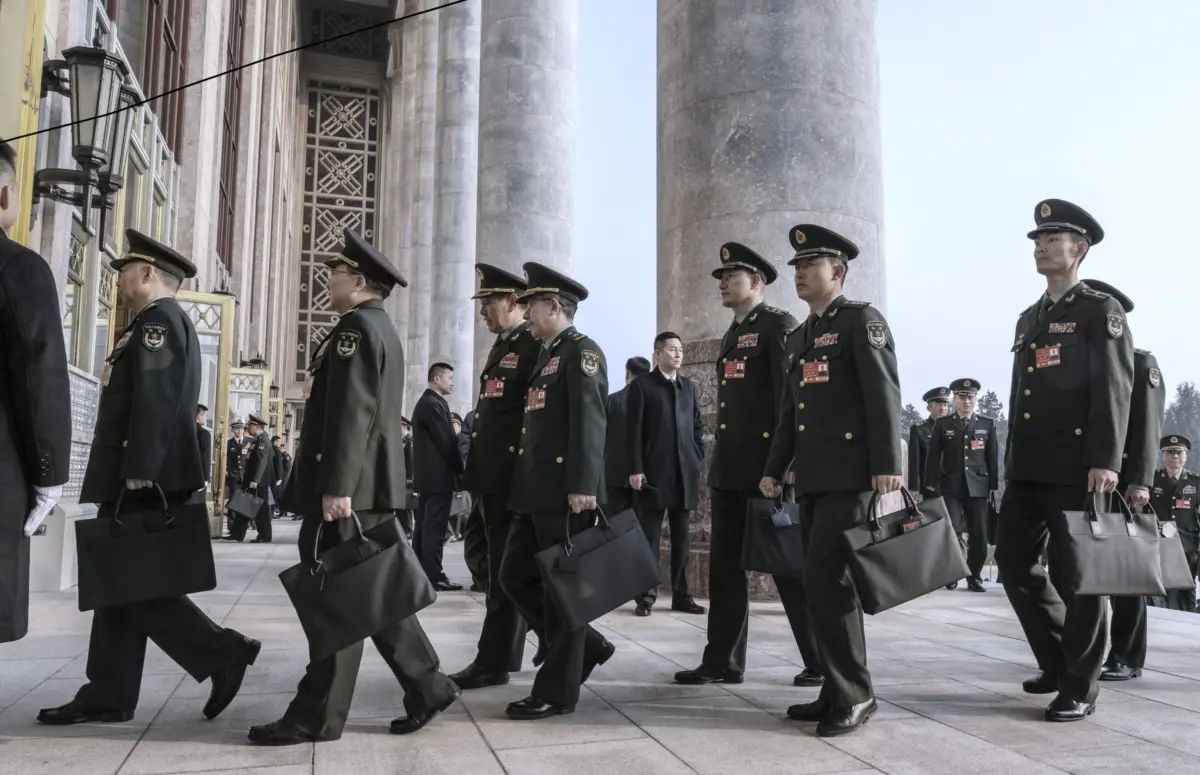
There is a case to be made that a confident commander does not keep auditing his own generals. On 3 July, in a ceremony carried by Chinese state media, Xi Jinping presented promotion orders raising two officers to the rank of general, among them the air force commander Wang Gang. The images were meant to project command and continuity. Read against what surrounds them, they suggest something closer to an unfinished repair. Xi is refilling a Central Military Commission that his own anti-corruption drive has emptied, and the manner of the refilling says as much about the strain inside the People’s Liberation Army as about its strength.
Take the ceremony at its most reassuring first. A modernising military promotes officers as a matter of course, and elevating experienced commanders is the ordinary business of a professional force. Wang Gang, as the Singapore-based analyst James Char of the S. Rajaratnam School of International Studies has noted, belongs to a generation of air force officers with genuine operational experience who have been handed larger roles. On this reading, the promotions are routine renewal, the sign of an institution grooming its next tier rather than a leadership in distress.
A command still half made
That reading thins on contact with the numbers. The Central Military Commission that Xi chairs now has only one other active member, its vice-chairman Zhang Shengmin. Two former vice-chairs, including the military’s most senior general, have been removed or set aside. A body designed to sit at the apex of the world’s largest standing army has been reduced, by its own chairman’s hand, to a pair. And the refilling is cautious rather than decisive. Only four lieutenant generals have been raised, which the National Bureau of Asian Research’s Tristan Tang reads as a signal that Xi is in no hurry, still, in Tang’s phrase, watching and vetting the officers he might one day trust. A leader who has dismantled his military’s two main factions, as Char describes, gains a clean slate. He also inherits the insecurity that made the clearing necessary. The pattern is not new to his tenure. Xi took command in 2012 of a military that a decade of his predecessor’s permissiveness had left, in the Party’s own later verdict, riddled with the sale of rank and the buying of position, and the purges of Guo Boxiong and Xu Caihou that followed were the first great cleansing. That the same instrument is still in use more than a decade on suggests a problem managed rather than solved.
This is the point that should hold European attention. The conventional reading of a purge is that it demonstrates control. A more cautious reading is that a command which must be repeatedly cleansed may be one its master does not yet fully trust, a year before the Party Congress at which a new commission is due. The doctrine Beijing itself proclaims makes the stakes plain: the 2019 defence white paper, China’s National Defense in the New Era, enshrines the absolute leadership of the Party over the army and the chairman’s personal command of it. When loyalty is written into the constitution of the force, the need to keep securing it by removal could indicate loyalty not yet assured. That is not obviously a portrait of a settled instrument.
The strengthening case
There is a serious interpretation that points the other way, and it deserves its hearing. On this account the purges are not a symptom of insecurity but the mechanism of reform. A military riddled with the corruption that felled two vice-chairs could not modernise until the rot was cut out, and clearing entrenched networks is what allows a professional officer class to rise on merit. Char’s own observation, that the removals have dismantled the PLA’s two main factions and handed Xi a clean slate, can be taken as institutional repair rather than institutional distress. Promoting officers with real operational experience, on this account, is precisely what a strengthening force does. The caution Tang identifies becomes not hesitation but rigour, a leader refusing to fill senior chairs until he is sure of the occupants.
That case is coherent, and Europe should not dismiss it. Where it falls short is in what it must assume. It treats the purges as a finished act of cleansing, yet the vetting Tang describes is present tense, and the commission still sits as a pair. A reform completed strengthens an institution. A reform still under way, whose end its own author will not name, leaves that institution in flux. Both accounts can hold at once, and it is the uncertainty they share, not the confidence one of them claims, that ought to guide European planning.
Why the churn matters in Brussels
None of this would concern Europe were the PLA a static garrison force. It is not. The same modernisation drive that the promotions serve is aimed, in Beijing’s own framing, at defending China’s claims in the Pacific, Taiwan foremost among them. Europe has spent years constructing a China policy around a single word, de-risking, the successor to the framing the Commission set out in its 2019 strategic outlook, which cast Beijing at once as partner, competitor, and systemic rival. That posture assumes a degree of predictability in Beijing’s conduct. A military establishment in visible internal transition complicates that assumption in both directions. An unsettled command can be more cautious, wary of adventures while its leadership is unfinished. It can also be less predictable, more exposed to the miscalculation that accompanies any institution reshaped under pressure.
Europe cannot know which way the churn cuts, and that uncertainty is precisely the argument against complacency. A bloc that reads a foreign military’s turbulence as reassurance mistakes disorder for weakness, and weakness for safety. Many China analysts caution that internal consolidation and external assertiveness in Beijing have often moved together rather than in opposition. Xi’s last great military overhaul, set out in the State Council’s 2015 defence white paper and carried into the theatre-command reorganisation of February 2016, unfolded alongside the corruption purge that cleared its path, and in the same years China built and then fortified its artificial islands across the South China Sea. A leadership securing its command at home is not obviously a leadership content to wait abroad. European planning on Taiwan contingencies, on supply-chain exposure, on the pace of de-risking, should be indexed to the volatility of Chinese decision-making, not to a hope that a distracted command means a passive one.
The european task
The practical conclusion is unglamorous and therefore easy to defer. Europe should treat the visible flux at the top of the PLA as a reason to accelerate the work it already knows it must do. That means reducing critical dependencies at a realistic pace. It means coordinating a genuinely common line on Taiwan rather than twenty-seven national ones. And it means building the analytical capacity to read Chinese military politics for itself, rather than through borrowed lenses.
Semiconductors show what that means in the concrete. The most advanced chips are fabricated overwhelmingly in Taiwan, and Europe’s own industrial base, from automotive to defence electronics, runs on them. A disruption in the strait, whether from miscalculation or design, would not be a distant Asian crisis but an immediate shock to European production lines. Brussels has answered with a Chips Act meant to lift its share of global manufacturing, yet the timelines run to the 2030s while the political risk is present now. The gap between a decade-long industrial plan and a near-term contingency is precisely the space in which a distracted or unsettled Chinese command becomes a European problem. A commission half empty in Beijing is, read correctly, an argument for filling Europe’s own capacity gaps faster.
Xi will complete his reshuffle in his own time, and the new commission will bear his mark alone. The question for Europe is not who fills those chairs, but whether it will read the manner of their filling clearly. A leader still testing the loyalty of his own generals may be telling the world something about the confidence of his command, and Europe should listen, and prepare, rather than mistake another power’s uncertainty for its own security. A commission half empty in Beijing is not a reassurance to be banked. It is a warning to be acted on. The continent that learns to read other powers’ ambiguities, and to move before they resolve, is the one that will help write the next order rather than inherit it. Europe has spent too long mistaking the watching for the acting, and the clock on that habit is no longer its own to set.
The Weekly Editorial
This is the editorial position of The European Post, published weekly on matters of European and international strategic significance. It represents the view of the Editorial Board.