
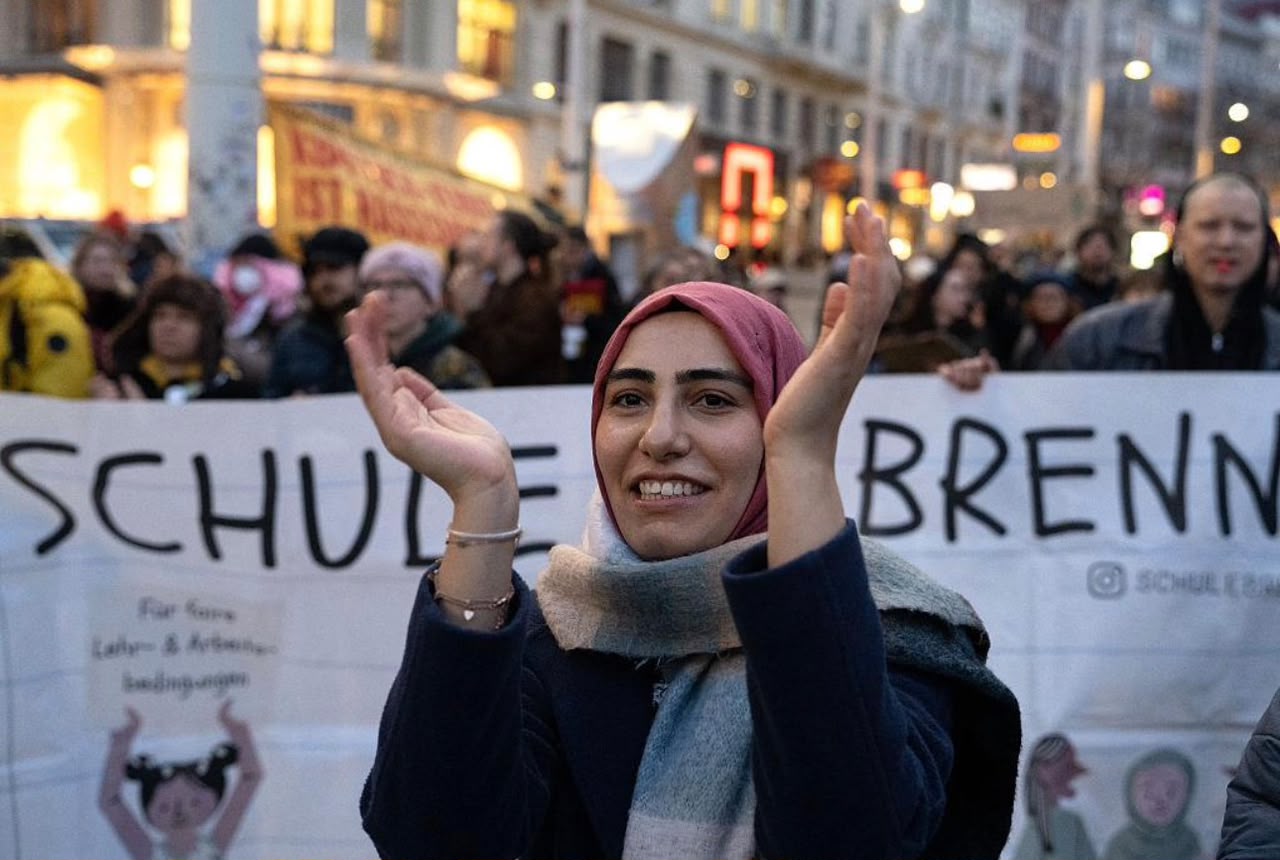
Girls under fourteen returned to Austrian classrooms this month under a law that decides, for the first time in a generation, what they may wear on their heads. The measure barring headscarves for pupils below that age took effect on 7 September in Vienna, Lower Austria and Burgenland, with the rest of the country following days later, and it has already produced exactly what its critics predicted: mothers walking daughters to school gates in defiance, a fresh constitutional challenge filed on the first day of term, and a government insisting it has done nothing more than protect children. The government’s language of child protection deserves a hearing. What it should not receive is a pass on the two costs that language is obscuring: a minority community pushed further from institutions built to serve it, and a security calculation the government has not made in public.
The Case The Government Makes
Austria’s governing coalition, an alliance of the conservative Austrian People’s Party with two centrist partners, built its bill on a specific premise: that a headscarf worn by a six or ten year old is rarely her own choice, and that a state committed to gender equality has standing to intervene before that choice hardens into habit.
Integration Minister Claudia Bauer has described the covering as a sign of oppression and a tool for controlling girls from early childhood. Chancellor Christian Stocker has gone further, calling separately for a constitutional ban on political Islam. The bill passed the National Council by a wide margin in December, with support from the far-right Freedom Party and opposition only from the Greens, the chamber’s smallest bloc.
There is a version of this argument any liberal state should take seriously in the abstract. Coercion of minors sits outside the protection normally owed to family autonomy, and European legal systems already draw lines around what parents may impose on children in the name of belief. But a law is not judged on the best version of its stated purpose. It is judged on what it does, to whom, and through what machinery, and on all three counts this one strains the government’s own justification past the point of credibility.
A Law That Has Already Failed Once
Austria tried this before and lost. A near-identical ban targeting girls under ten was struck down by the Constitutional Court in 2020 on the grounds that it was discriminatory, since it singled out one religious garment while leaving other forms of covering, and other faiths’ dress, untouched. The 2025 law raises the age threshold and widens its reach to both public and private schools, but the flaw that sank the earlier version, a law that names one community’s clothing rather than regulating covering as a category, has not been cured.
The government’s estimate of roughly twelve thousand affected girls is extrapolated from a 2019 study, not a current count, and Amnesty International has separately warned the measure will add to a racist climate already directed at Austria’s Muslim minority, who make up about eight percent of the population. The Islamic Religious Community in Austria, the body that formally represents the country’s Muslims, pledged to support families challenging the measure before the Constitutional Court, an early attempt the court declined to hear in July only because the law had not yet entered into force. That procedural barrier fell on 7 September, the first day of the new school year, when a mother and her two daughters filed a fresh application asking the court to repeal the ban on its merits, alongside a separate filing by lawyers representing other affected pupils.
The enforcement design compounds the problem. A school must first hold a conversation with a pupil found wearing a headscarf and her guardians. Repeated defiance escalates the matter to child and youth protection services, and parents who persist face fines between one hundred fifty and eight hundred euros. A policy sold as shielding girls from coercion is enforced through a process that puts those same girls under state monitoring for a choice their families may have made for reasons of faith or custom, and it assigns teachers, already stretched thin according to Reuters, the task of opening a conversation the family on the receiving end will likely experience as an accusation.
The Suppression This Produces, and The Security Question it Opens
Set the legal history aside and look at what the law does to a community’s relationship with the state. Twelve thousand girls, and the families around them, now encounter Austrian public institutions, at the point where a child first enters them, through fines, referrals to protection services, and a chancellor publicly linking their faith to a phenomenon he wants criminalized outright. That is not integration policy. It is a state telling a minority that its visible presence in public institutions is itself the problem being managed, and there is a substantial body of research in migration and security studies suggesting that this kind of institutional exclusion, not religious observance itself, is what pushes young people in minority communities toward alienation from the state and, in a minority of cases, toward the informal networks that fill the space a hostile state has vacated. That causal chain is contested rather than proven; European security services have flagged both directions, cases where integration failure preceded radicalization and cases where heavy state intervention in religious practice hardened resentment rather than easing it. What is not contested is that Austria has chosen a policy that maximizes contact between the state and minority families at their most vulnerable point, a child, without a public accounting of that risk from the ministries that would have to manage its consequences.
Why This is Not Only an Austrian Question
Education sits within member state competence, and the European Commission has every institutional reason to leave a schools dress code to Vienna. But the Union does not stay silent on everything a member state does inside its own competence when that conduct touches rights it has bound itself to protect. The Charter of Fundamental Rights guards freedom of religion and non-discrimination in terms that apply whenever EU law is in play, and the Union has built an increasingly assertive architecture around the rights of minors, from the child sexual abuse material regulation to the platform restrictions for teenagers the Commission is due to unveil this week. A body willing to legislate on how a fourteen year old may use social media has said nothing substantive about a law that puts state officials in a room with a fourteen year old and her parents over a piece of fabric.
This is not an argument that Brussels should overrule a national legislature on school uniform policy. It is an observation that the Union treats some domestic measures affecting children and minorities as legitimate national variation while treating others as urgent enough for supranational rulemaking, and the line tracks political convenience more than legal principle. A law a domestic constitutional court has already rejected once, that a member state’s own human rights community regards as corrosive to social cohesion, and that is now producing confrontation at school gates in the capital, is not a smaller matter than platform design rules for teenagers. It is a less comfortable one, sitting at the intersection of religion, migration politics and a rising far right that several member states’ governing coalitions have chosen to accommodate rather than confront.
The Cost of Choosing Not to Look
Europe’s institutions built their legitimacy in part on the claim that fundamental rights would not stop at a border once a government found it convenient to test them. That claim does not require the Commission to intervene in Austrian classrooms. It does require an answer to a simple question: does the Union consider a state-enforced dress restriction on children, backed by fines and child protection referrals, to be its business. Silence is itself an answer, and it is the answer easiest to give when the political cost of a considered one would fall on relations with a government whose coalition partner sits on the European right’s rising flank. Austria’s ban is now before its Constitutional Court a second time, and may fall as its predecessor did. If it does, Brussels will have avoided the argument by outsourcing it to Vienna’s own judges, an outcome that spares the Commission discomfort but answers nothing about what happens, in the meantime, to twelve thousand girls and the community around them.
The Weekly Editorial
This is the editorial position of The European Post, published weekly on matters of European and international strategic significance. It represents the view of the Editorial Board.