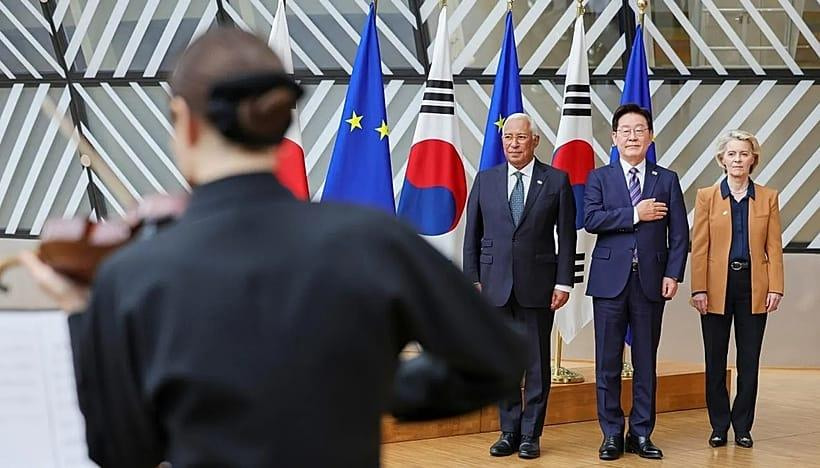
Brussels: The EU Korea digital trade agreement is the most concrete result of the 11th summit between the European Union and South Korea, held in Brussels on 10 June 2026. European Council President António Costa and Commission President Ursula von der Leyen received President Lee Jae Myung, and the three leaders used the meeting to turn a long strategic partnership into specific commitments on data, technology and security.
According to an analysis by the Konrad-Adenauer-Stiftung, the signing of the digital agreement was the summit’s most striking success. The Korea digital trade agreement complements the 2011 free trade agreement, recognises electronic contracts and signatures in law, facilitates cross-border data flows and bans mandatory disclosure of source code, while preserving high personal data protection standards. It follows a similar agreement signed with Singapore in July 2025.
The Korea digital trade agreement matters because bilateral trade is already large. Trade in goods reached 124 billion euros in 2025, according to Commission figures cited by Eunews, and Korea is the EU’s eighth-largest trading partner while the Union is Korea’s third. At a trade committee in April, Commissioner Maroš Šefčovič and Trade Minister Yeo Han-koo also launched a dialogue on trade, supply chains and technology, giving officials a standing channel to manage disputes over vehicles and electronics.
Security cooperation moved in parallel. The Security and Defence Partnership signed in November 2024 is to expand into cyber, maritime security and disinformation, and both sides agreed to work toward negotiations on a security of information agreement. They also welcomed the conclusion of talks on a passenger name records agreement, which must now be signed and ratified. Shared language on North Korea, Ukraine and the Middle East reflects common concern, and China is addressed only implicitly.
Defence industry access sits outside the Korea digital trade agreement and remains unresolved. Korean firms can join consortia that benefit from the EU’s SAFE loan programme if their share stays at or below 35 percent of contract value, and Seoul would like that cap lifted. The analysis says Korea, unlike Canada, has not signed an agreement trading a higher share for financial participation, so stronger involvement is under discussion rather than agreed.
The summit also confirmed that Korea, associated with Horizon Europe since 2025, will keep cooperating under the next research framework for 2028 to 2034, and the leaders announced plans for high-level economic and energy dialogues.
For European diplomacy, the EU Korea digital trade agreement is a model that can be reused with other Asian democracies. Its success will depend on whether the new dialogues deliver quick answers on data rules and defence procurement, and whether the next summit shows more than a longer list of working groups.