Tashkent: The Trans-Caspian Transport Corridor is Europe’s most practical attempt to build a trade route between the European Union and Central Asia that avoids Russian territory, and its early financing shows how much work remains on basic infrastructure. At an investors forum in Tashkent on 27 November 2025, the Commission and its partners announced a package of studies, loans and guarantees that is now being turned into projects.
Commissioner Jozef Síkela, responsible for international partnerships, said the forum showed concrete progress after leaders agreed a year earlier to accelerate the corridor’s development. Enlargement Commissioner Marta Kos called for a credible, long-term alternative to the Northern Corridor and said cargo on the Middle Corridor has grown four-fold since 2022 and could triple again by 2030 with the right investments.
The money announced is modest but targeted. A Team Europe programme worth 15 million euros will support customs, trade facilitation and regulatory harmonisation, while the World Bank will manage 10 million euros of preparatory studies and the European Bank for Reconstruction and Development another 5 million euros. These studies decide which bottlenecks come first, which is why the Trans-Caspian Transport Corridor depends on planning as much as on concrete.
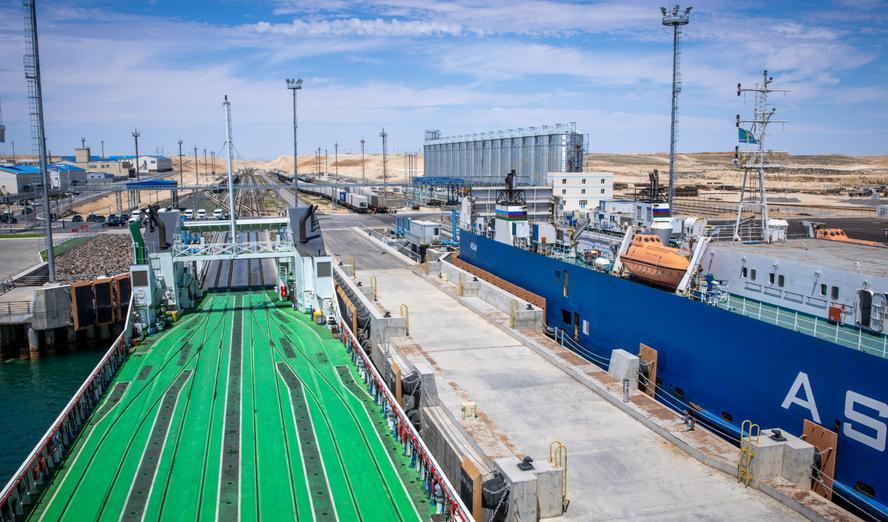
Physical projects on the Trans-Caspian Transport Corridor are concentrated on roads and ports. The EU contributed 10.4 million euros toward the modernisation of Aktau Port in Kazakhstan within a 35 million euro EBRD loan, and 15.46 million euros toward upgrading 31.7 kilometres of road between Karabalta and Chaldovar in Kyrgyzstan. The European Investment Bank is also envisaged to lend up to 150 million euros for road rehabilitation in Kazakhstan with an EU guarantee of 8.8 million euros, and up to 100 million euros for an 87 kilometre stretch of the A380 highway in Uzbekistan.
The pattern is deliberate, because the Trans-Caspian Transport Corridor is only as fast as its slowest link. Freight crossing the Caspian Sea needs ports that handle containers quickly, roads that connect them to rail terminals, and customs procedures that work the same way in each country. A single weak link, such as a slow border or a damaged highway, can erase the time advantage of the route.
There is also a geopolitical reason for backing the Trans-Caspian Transport Corridor. Central Asian governments want more than one export route, and European importers want secure supplies of critical raw materials and energy. Offering credible financing gives Brussels influence without political conditions that partners often resist.
The test for the Trans-Caspian Transport Corridor is therefore delivery. Published timelines, transparent procurement and measurable reductions in border waiting times will show whether the forum’s pledges built a corridor or only a list of announcements.