
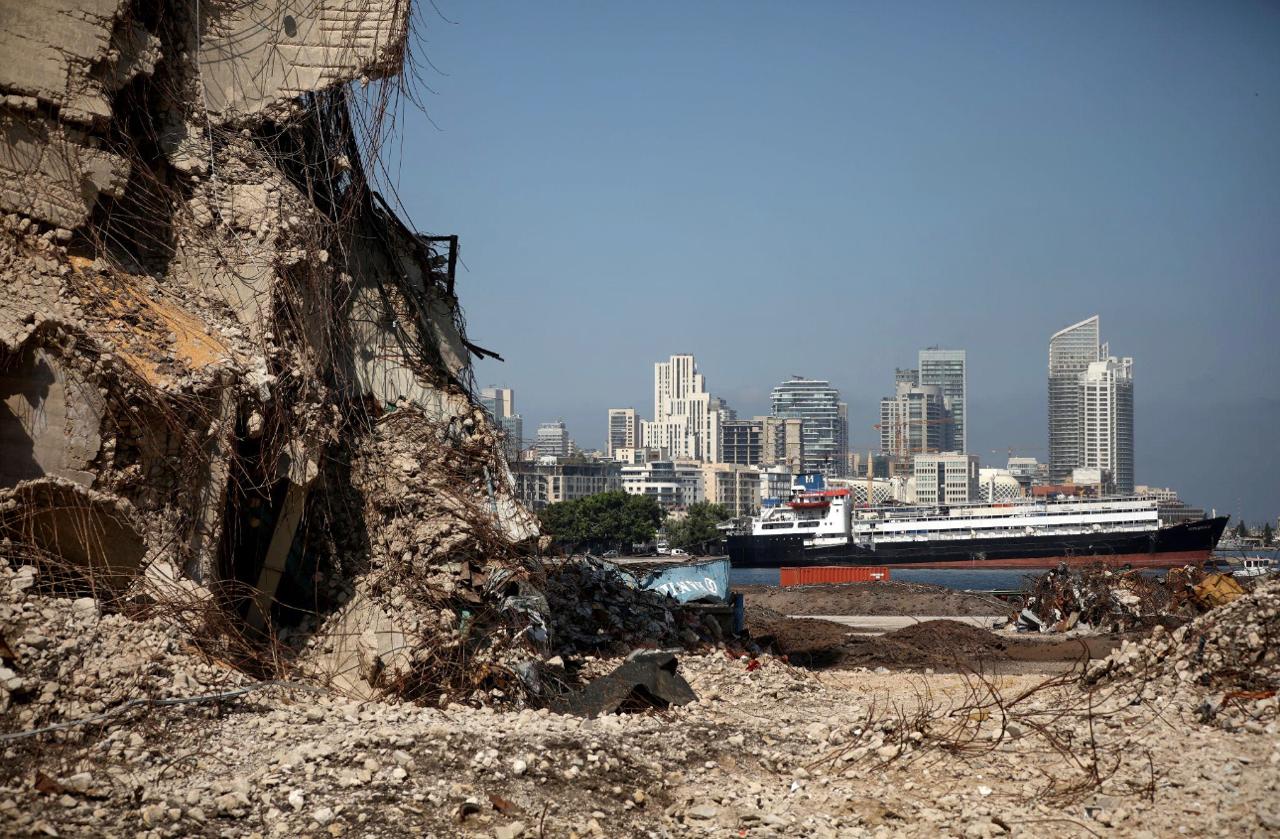
Hezbollah rejected the Washington-brokered Israel-Lebanon ceasefire on 4 June. The European Union has spent two years building a Lebanon doctrine on the assumption that the country would converge on reform under the discipline of a functioning truce and a reformist coalition. Neither condition is now operating. The architecture Europe has built exists. The Lebanon it was built for does not yet.
Hezbollah’s general secretary Naim Qassem rejected the Washington-brokered Israel-Lebanon ceasefire on 4 June, calling the demand that the movement’s fighters withdraw from southern Lebanon under continued bombardment a posture of surrender, and Israeli strikes resumed within hours. The agreement, the third extension of a 16 April truce broken and rebuilt repeatedly since the spring, had been negotiated between the Israeli and Lebanese ambassadors in Washington with the Hezbollah leadership pointedly excluded, and its failure within a single news cycle is the symptom of a structural problem the European Union has spent two years constructing its Lebanon doctrine around without acknowledging. The doctrine assumed the country would converge on reform under the discipline of a functioning truce, a coalition government, and a parallel disarmament process; none of those conditions is operating as the bloc speaks.
France led the Paris Conference of 24 October 2024, which mobilised initial international support and named the framework Brussels has followed since: a ceasefire, accountability for violations of international humanitarian law, reconstruction tied to reform, the strengthening of Lebanese state institutions, the disarmament of armed groups under United Nations Security Council Resolution 1701, the deployment of the Lebanese Armed Forces in the south, and political reconciliation. A second Paris conference, on the Lebanese armed forces specifically, was convened on 5 March 2026 with twenty-one states in attendance, and the European External Action Service has carried the framework across the two High Representatives who have held the brief. The World Bank, in its March 2025 assessment of damage from the 2023-2024 phase of the conflict alone, estimated reconstruction needs at eleven billion United States dollars, of which three to five billion would require public financing; the 2026 war has added to the bill in ways the next assessment will document, though the order of magnitude is now established.
Each condition Brussels and Paris have placed on disbursement is, on its own terms, defensible: the International Monetary Fund agreement on which Lebanon has been negotiating since 2022 is the standard prerequisite for any sovereign whose financial system has collapsed; the banking restructuring legislation, partially passed in early 2026, is necessary to restore confidence in the country’s monetary architecture; the loss-sharing law, still pending in the Lebanese parliament, would determine who pays for the gap between the central bank’s assets and its liabilities, the question that has paralysed every government since the 2019 crisis; and the disarmament track, anchored in Resolution 1701, is the precondition for any genuine restoration of state authority over Lebanese territory. Each demand is legitimate in isolation, and each presupposes a political process the country has not yet produced, with the cumulative effect that legitimate demands premised on absent preconditions become a form of policy paralysis dressed as institutional discipline.
The June rejection is therefore not a procedural irritation but the latest signal that the political settlement on which the framework depends is not converging. Hezbollah is weaker than it was before the September 2024 Israeli campaign that killed Hassan Nasrallah and much of the movement’s senior leadership, yet it has not been removed: it retains the parliamentary bloc, the southern social base, and the veto over reconstruction conversations that it has held since 2006. The conditions Europe has set, on this question in particular, ask the Lebanese state to do something it has not been able to do in four decades, and President Joseph Aoun and Prime Minister Nawaf Salam, who took office in early 2025 with the reformist mandate Brussels has rightly welcomed, cannot deliver the southern withdrawal of armed groups by signing a paper at the next Paris conference.
The conditions Europe set are legitimate. The Lebanon those conditions were built for does not yet exist.
Europe therefore faces a choice it has been deferring through three Paris conferences and two years of communiqué. The first option is to maintain the current conditionality and continue withholding reconstruction disbursement until reforms are complete, on the grounds that releasing funds without reform incentives would reproduce the elite-capture model that produced the 2019 financial collapse and that the bloc owes the Lebanese public an architecture protected from the political class which ruined its institutions. The second is to suspend that discipline and release reconstruction funds against humanitarian need rather than political progress, on the grounds that holding relief hostage to reforms a state in continuing crisis cannot deliver is, in practice, the choice not to help at all. Each position has its constituency in Brussels, and neither has been chosen, because choosing either requires admitting that the present doctrine has been built for a country that does not yet exist.
Honesty would require splitting the file. Humanitarian assistance, basic public services, and the rehabilitation of essential infrastructure should be decoupled from political reform conditionality and disbursed against operational benchmarks the United Nations Development Programme and the European Investment Bank can verify directly, bypassing the Lebanese ministries the regime is rightly cautious about. The macro reforms, namely the IMF agreement, the banking restructuring, and the loss-sharing law, would remain conditional and released in tranches against verified progress, while the disarmament question, handled through Resolution 1701 and the Lebanese Armed Forces, would operate as a separate political process on its own timeline and not as a precondition for European money. The result is messier than the architecture as it stands, which has the analytical clarity of a single bargain, and closer to the country that has to be helped.
The other unspoken question is whether France can continue to carry the European share of this file alone. Paris has led the diplomatic effort since 2024 through its historical ties, its francophone bureaucratic links, and its peacekeeping presence in southern Lebanon under UNIFIL, but the 2027 French presidential election is now eighteen months out and President Macron’s domestic position is the weakest of his second term. The bloc’s southern member states, Italy, Greece, Cyprus, and Malta, each carry exposures to Lebanese instability through migration pressure across the eastern Mediterranean and through their own UNIFIL contributions, yet a doctrine led from Paris alone, with the rest of the bloc subsidising, is not in any meaningful sense a European posture. It has to be a collective stance in which Italian defence capability, Cypriot port infrastructure, Greek medical capacity, and the Commission’s financial instruments are coordinated in advance of the next emergency rather than improvised during it, and that work has not been done. The next Paris conference, if there is one, should be where the bloc begins it.
The European Post’s position is that the architecture for Lebanon is not absent: it is real, it is documented, and it is the most coherent international framework any Western actor has produced for the country since 2006. It is also wrong, structurally, for the Lebanon that has just received a Hezbollah veto on the third extension of its own ceasefire. The reform conditions Europe has set will outlive any one Lebanese government, and the reconstruction needs Europe has assessed will not wait that long, so the bloc has to choose, now, between the doctrine it has built and the country it was built for. Choosing the doctrine is the easier path; choosing the country is the harder one, and the one a Union that takes its Mediterranean policy seriously will have to take.
Notes:
- The 2026 Israel-Lebanon ceasefire entered into force on 16 April 2026 as a ten-day truce mediated by the United States, was extended on 23 April for three weeks and on 15 May for forty-five days, and was supplemented on 1 June by a separate understanding between Israel and Hezbollah on the suspension of strikes on Beirut’s southern suburbs. The 3 June Washington-brokered Israel-Lebanon ceasefire agreement, announced jointly by the Israeli and Lebanese ambassadors at the State Department, was rejected by Hezbollah leader Naim Qassem on 4 June.
- The framework of seven indispensable steps was set out in the statement of the European High Representative following the 24 October 2024 International Conference in Support of the People and the Sovereignty of Lebanon, hosted by the President of the French Republic and the Secretary-General of the United Nations. The text is available through the European External Action Service. The 5 March 2026 Paris conference on the Lebanese Armed Forces, chaired by France and attended by twenty-one states, was the second institutional iteration of that architecture.
- United Nations Security Council Resolution 1701, adopted on 11 August 2006, established the framework for the cessation of hostilities between Israel and Hezbollah following the July 2006 conflict, called for the disarmament of all armed groups in Lebanon, and provided the mandate for an expanded United Nations Interim Force in Lebanon (UNIFIL) to support the deployment of the Lebanese Armed Forces in the south. The resolution has been formally reaffirmed at successive Security Council renewals and remains the principal multilateral basis for Lebanese sovereignty over its southern territory.
- The World Bank’s Rapid Damage and Needs Assessment for Lebanon, published in March 2025, covered damage and losses from 8 October 2023 to 20 December 2024 and estimated total reconstruction and recovery needs at approximately eleven billion United States dollars. The assessment did not cover the additional damage produced by the 2026 Lebanon war, which a successor report will quantify.
Editorials in The European Post represent the considered position of the publication. They are developed and edited by the Editorial Board, published without individual byline, and offered in the public interest as a contribution to European policy debate.