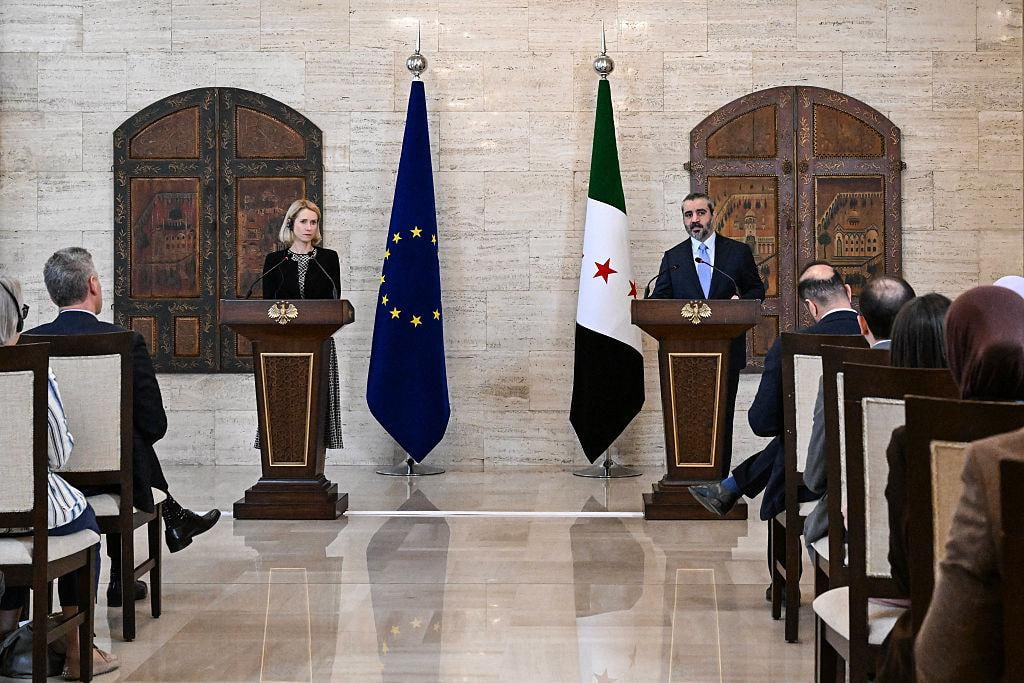
Damascus: The EU-Syria partnership entered a new phase on 29 September 2026, when High Representative Kaja Kallas travelled to Damascus and offered to upgrade a relationship that has lacked a full diplomatic channel for more than a decade. She held a joint press conference with Foreign Minister Asaad al-Shaibani at Tishreen Palace, three weeks after EU Ambassador Michael Ohnmacht presented his credentials to President Ahmad al-Sharaa. It was the first time since 2012 that the Union has had an ambassador accredited at that level in the Syrian capital.
The money on the table is large but not new. The EU says it has committed €620 million for 2026 and 2027 across recovery, humanitarian needs and institution-building, and it has mobilised a further €51.5 million through foreign policy instruments, including about €18.85 million for demining. The bilateral development strand comes to €280 million over two years, or €140 million a year, against €139 million in 2025. The EU-Syria partnership upgrade is therefore a political signal first and a budget increase second.
Kallas tied further investment to conditions. She said that any deeper EU-Syria partnership depends on security, clear rules, the rule of law and functioning institutions in Syria. On 8 September the EU told the UN Human Rights Council that a new constitution and an inclusive political system are essential, and it named the People’s Assembly, the Constitutional Court and Kurdish-language teaching as milestones. Brussels has not published benchmarks, however, and the 2026-27 programming dropped the “gradual and reversible” wording that governed support in 2025.
Damascus wants more than reassurance. Shaibani said the two sides discussed a new agreement to replace the 1977 Cooperation Agreement, and he called for the lifting of the remaining sanctions on Syrian state institutions. Damascus also asked to be included in the EU’s 2028-2034 Multiannual Financial Framework, a request that will meet scrutiny in capitals already arguing over a tight budget. Public reports do not say how Kallas answered on sanctions.
Reconstruction finance is the next test for the EU-Syria partnership. The European Bank for Reconstruction and Development and the European Investment Bank are discussing support for Syrian projects, though no agreement has been reached. The Commission is also funding a Technical Assistance Hub in Damascus, with workshops on public financial management, public-private partnerships, public debt management and joint-stock companies. Its own 2026-27 programming calls Syrian absorption capacity a “binding constraint”, an honest admission that weak institutions, not a shortage of cheques, limit what can be delivered.
The European Parliament adds a second track. Its Foreign Affairs Committee was due to vote on EU-Syria political relations on 1 October, which shows that MEPs want a say before any new agreement takes shape. A second High-Level Political Dialogue is expected before next summer, following the first one in May, and technical talks on recovery will continue through the rest of this year.
The EU-Syria partnership will be judged less by the Damascus press conference than by whether benchmarks appear. If Brussels defines clear steps on the constitution, institutions and accountability, a new agreement to replace the 1977 text becomes credible to sceptical member states. Without them, the upgrade risks becoming a promise that each side reads differently, and the EU-Syria partnership could stall while technical talks drag on.