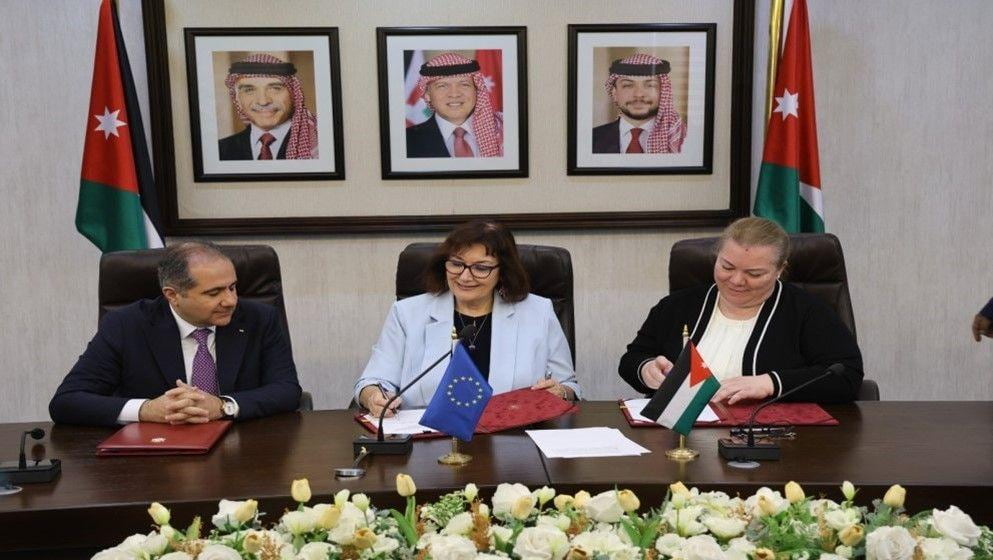
Amman: The EU-Jordan strategic partnership moved from declaration to delivery on 7 May 2026, when Mediterranean Commissioner Dubravka Šuica and Jordan’s Minister of Planning and International Cooperation, Zeina Toukan, signed financing agreements worth €135 million. The signing came during Šuica’s first official visit to Jordan.
The money splits across several lines. A total of €30 million goes to technical and vocational training aimed at young people, women and persons with disabilities. Another €25 million funds integrated border management and internal security, while €80 million supports Syrian refugees and the Jordanian communities hosting them.
The package also covers €12.3 million to expand data capacity at the Aqaba Digital Hub, financed through a European Bank for Reconstruction and Development loan guaranteed by the European Fund for Sustainable Development Plus. That item is strategic out of proportion to its size, because it ties Jordan’s digital ambitions to European finance.
These agreements implement the strategic and comprehensive partnership concluded in January 2025, under which the EU has pledged €3 billion for Jordan over 2025 to 2027. A summit in Amman in January 2026 reaffirmed the relationship, and an EU-Jordan investment conference is planned later in 2026. The EU-Jordan strategic partnership therefore has a clear calendar of deliverables.
Šuica said the agreements would boost investment and strengthen economic ties, and she pointed to the Pact for the Mediterranean as the wider framework. For Brussels, Jordan is a stable partner on a volatile edge of the region, supporting Syrian refugees while neighbouring Syria, Gaza and Lebanon remain unsettled.
The mix tells its own story. Education and digital funding speaks to Jordan’s economic needs, while border and security money reflects European priorities on migration and stability. Critics of such packages often ask whether security support strengthens accountability or weakens it, and the funding announcement reviewed here does not answer that question about the EU-Jordan strategic partnership.
Jordan’s role in regional diplomacy adds weight to the EU-Jordan strategic partnership. Amman has long acted as an interlocutor between European governments and partners across the Levant, and its stability is a stated interest of the Union. Funding for border management supports a country that borders Syria, Iraq, Israel, the West Bank and Saudi Arabia, a geography that gives security cooperation real operational meaning.
Delivery will be the measure. With €3 billion pledged over three years and €135 million signed in one visit, most of the commitment still has to become projects. The investment conference later this year is the next place to check whether the EU-Jordan strategic partnership attracts private capital alongside public grants.