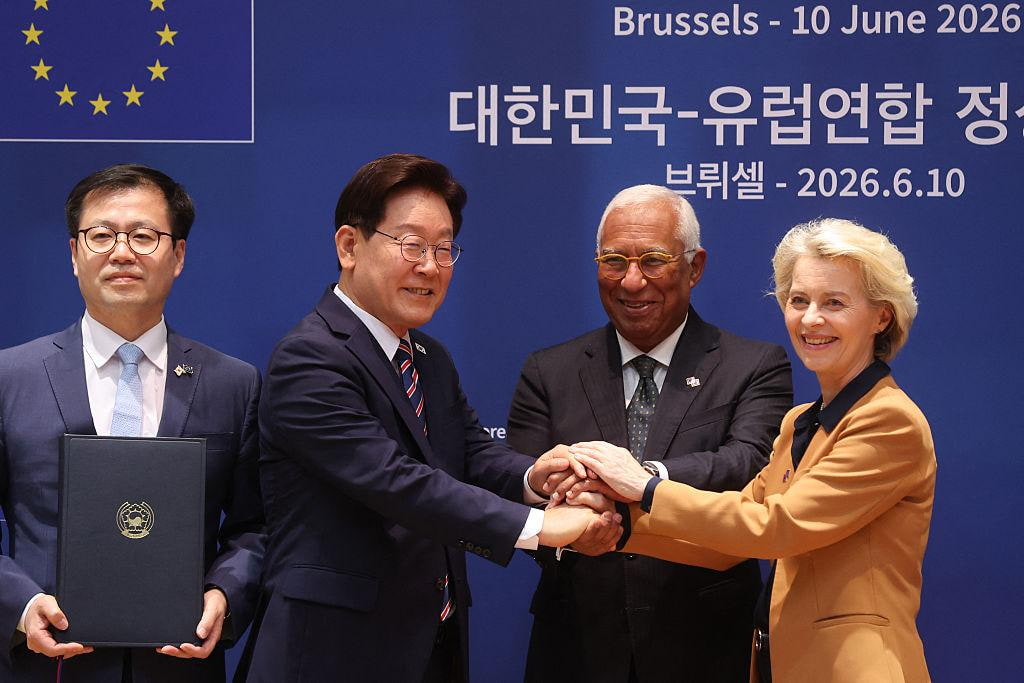
Seoul: The thirteenth meeting of the EU-Republic of Korea Trade Committee, held in April, has produced what trade officials on both sides describe as the most consequential bilateral economic development since the 2011 free trade agreement entered into force. Endorsement of the final text of a Digital Trade Agreement, alongside the launch of a new Strategic Dialogue on Trade, Supply Chains and Technology, signals that Brussels and Seoul are recalibrating their partnership to address the digital and geo-economic realities that the original FTA could not anticipate.
The Digital Trade Agreement, expected to be signed at the EU-Korea Summit later this year, establishes binding rules on cross-border data flows, prohibitions on data localisation requirements, protections for source code, and recognition of electronic contracts and signatures. The framework draws on similar commitments contained in the EU’s recent digital agreements with Singapore and Japan, but it goes further on consumer protection and trusted data transfers, reflecting both sides’ interest in setting a high-standard template that other middle powers might adopt.
For Korean exporters, the agreement removes friction that has accumulated as digital services have grown to represent an increasing share of bilateral commerce. Cloud providers, fintech firms, and platform companies operating between Seoul and European markets have long navigated a patchwork of national rules on data handling, often duplicating compliance infrastructure to meet overlapping requirements. The DTA replaces much of that fragmentation with predictable obligations enforceable through the existing FTA dispute settlement machinery.
The strategic significance, however, extends beyond compliance economics. The agreement positions the EU and Korea as standard-setters in a rule-making landscape increasingly contested between American free-flow preferences and Chinese state-control models. Korean officials have been explicit that the DTA gives Seoul greater leverage when negotiating with both Washington and Beijing on digital rules, by demonstrating viable alternatives that combine market openness with regulatory rigour.
The accompanying Strategic Dialogue addresses a broader set of vulnerabilities. Its agenda includes critical raw materials, battery supply chain resilience, and protection of advanced technology supply chains. Korean industrial conglomerates, particularly Samsung, SK Hynix, and LG Energy Solution, occupy central positions in European supply networks for semiconductors and electric vehicle batteries. Both sides have an interest in formalising the relationship before strategic competitors disrupt it.
Preparations are also under way for an EU-Korea Future Strategic Partnership, intended for endorsement at the summit. Diplomats describe the proposed framework as broader than any existing EU partnership with an Asian democracy, encompassing trade, technology, security, and people-to-people exchanges within a single governing architecture. Whether the partnership ultimately matches that ambition or settles into a more conventional cooperative arrangement will depend heavily on the political bandwidth both sides can sustain through the second half of the year.
Trade defence remains a managed irritant. The Commission’s February imposition of anti-dumping duties on Korean acrylonitrile-butadiene-styrene resin imports created brief friction, though Seoul’s response was notably restrained, an indication that the broader trajectory of the relationship outweighs sectoral disputes. That maturity in handling commercial friction may prove the partnership’s most useful asset.
If the summit later this year delivers what April’s meetings have promised, the EU-Korea relationship will have evolved from a competent free trade arrangement into something approaching the kind of strategic partnership Brussels has long claimed to want with advanced Asian democracies but rarely produced.