
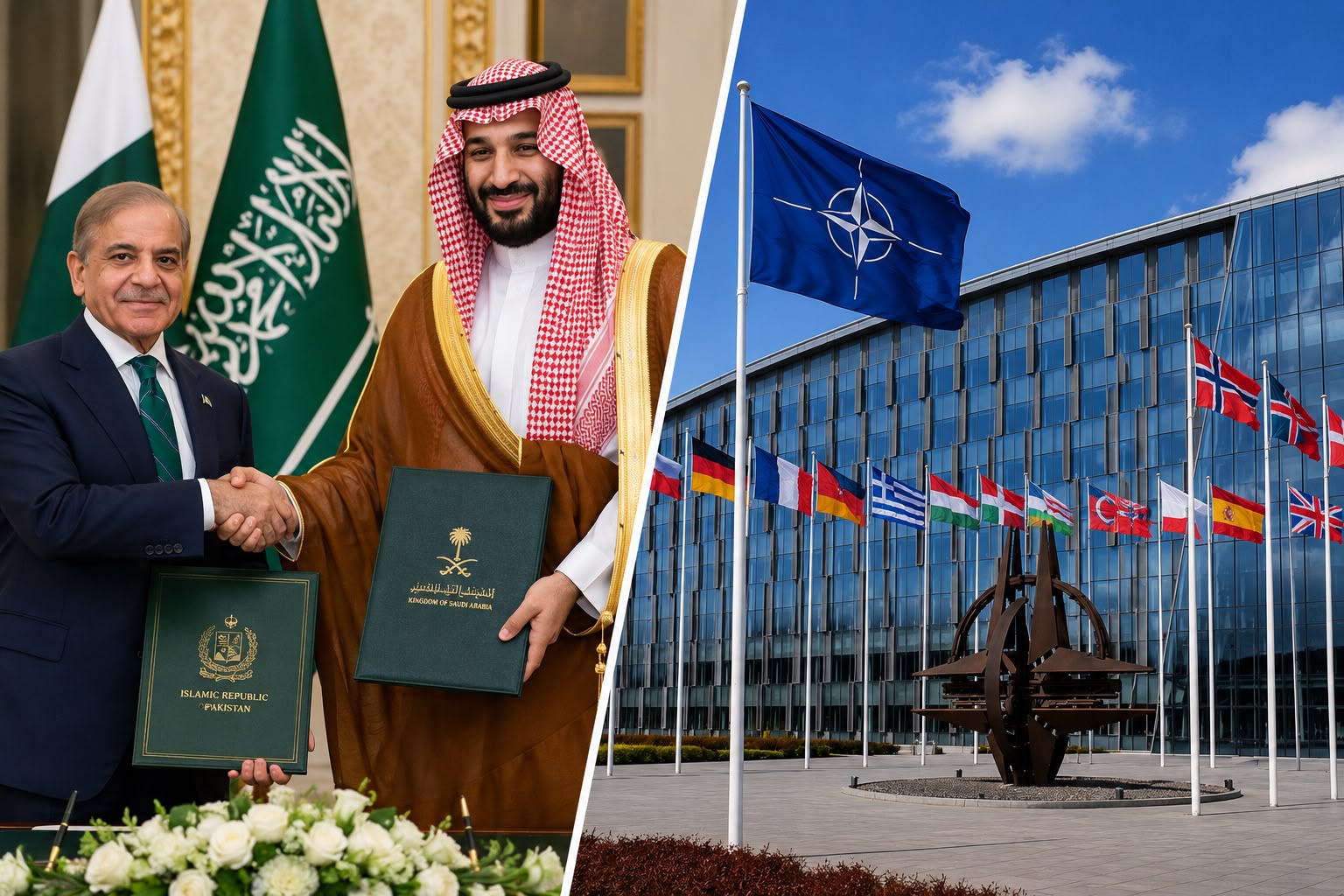

A mutual defence pact signed less than a year ago is being tested in practice rather than in seminar rooms, and the answer emerging from Islamabad has more to teach Brussels than most of this week’s commentary has allowed. Saudi Arabia and Pakistan concluded a formal mutual defence pact in September 2025, declaring that aggression against either state would be treated as aggression against both. That clause has now met its first real dilemma. Saudi strikes on Sanaa International Airport, followed by a Houthi retaliatory strike on Abha, have reopened a conflict Riyadh had kept largely dormant for four years, and commentators from Islamabad to New Delhi are asking whether Pakistan is obliged to act.
Europe should be watching closely, not out of solidarity with either party, but because the question Pakistan now faces is structurally identical to the one Brussels keeps posing to itself and rarely has to answer under pressure: does a mutual defence clause actually compel action, or does it simply create the expectation of a conversation?
The Clause and the Crisis
The Pakistan-Saudi pact was signed a week after an Israeli strike on Doha, a sequence the Belfer Center notes was no coincidence, at a moment when Gulf states were openly questioning the durability of American security guarantees. The agreement itself states, in language released by both governments, that “any aggression against either country shall be considered an aggression against both” (NBC News). Pakistan has since deployed roughly 8,000 troops, a squadron of about sixteen JF-17 fighter jets, and a Chinese-made HQ-9 air defence system to Saudi soil under the arrangement, a deployment confirmed by Reuters, citing three security officials and two government sources. When a Mahan Air flight carried a Houthi delegation home from Tehran following the funeral of the late Iranian Supreme Leader, Saudi Arabia struck the runway at Sanaa to prevent it landing. According to Al-Monitor, citing US officials speaking to Axios, Crown Prince Mohammed bin Salman informed President Trump in advance and received Washington’s backing for the strike, though this account has not been independently confirmed by either government. The Houthis answered with missiles and drones aimed at Abha, ending a four-year truce with Riyadh, according to contemporaneous reporting (Daily Jagran).
Pakistan’s own signalling has leaned toward restraint rather than commitment. Retired General Ghulam Mustafa, cited by Atalayar, said Pakistani authorities remain committed to de-escalation and dialogue between all parties, not intervention. Defence Minister Khawaja Asif’s own position has been more ambiguous. At the pact’s signing in September 2025, he told Geo TV that Pakistan’s capabilities, understood to include its nuclear arsenal, “will be made available to [Saudi Arabia] according to this agreement.” He subsequently told Reuters that nuclear weapons were “not on the radar,” an unresolved contradiction that has never been clarified since.
The Precedent Islamabad Remembers
This is not the first time Riyadh has asked Islamabad to fight the Houthis. In 2015, at the start of the Saudi-led coalition’s campaign in Yemen, Pakistan’s parliament voted against sending troops, a decision the Belfer Center notes was reached despite considerable Saudi pressure and considerable historical debt. Khawaja Asif, defence minister at the time as well, told parliament that Pakistan would defend Saudi sovereignty but did not want to be “part of any proliferation,” explaining in contemporaneous reporting (Gulf News) that Islamabad feared fanning sectarian tensions “in Pakistan and the Muslim world.” That decision was made without a formal mutual defence pact in place. The current one exists, and Pakistan’s hesitation has reappeared anyway.
The lesson is not that Pakistan is an unreliable partner. It is that a mutual defence clause, however formally worded, does not remove the underlying political calculation it was designed to bypass. It simply raises the diplomatic cost of the calculation being visible.
Collective Defence in Practice, Not Theory
Europe has almost no experience testing its own equivalents under comparable strain, which is precisely why this episode carries lessons beyond South Asia and the Gulf. NATO’s Article 5 has been formally invoked exactly once, by the United States after September 2001, and what followed was a negotiated coalition of national contributions rather than an automatic collective response. Article 4, the lower-threshold consultation clause, has been invoked considerably more often, including by Poland and Estonia in September 2025 over Russian drone and jet incursions, precisely because it commits members to talk rather than to act.
The European Union’s own mutual defence clause, Article 42.7 of the Treaty on European Union, has been invoked once, by France on 17 November 2015 following the Paris attacks. The response was a patchwork of bilateral support rather than coordinated EU military action, and no precedent exists for how the clause would function against a genuine state-on-state attack on a member.
Set against that record, Pakistan’s caution over its own mutual defence pact looks less like an exception and more like the pattern every comparable clause has followed. A mutual defence pact functions as a political commitment that requires fresh political will at the moment it is tested, not a legal trigger that removes the need for that will.
What This Means for Europe’s Alliance Debates
The relevance to Brussels is not abstract. European strategic autonomy debates, the Hague spending targets, and repeated German and French statements about the end of an assumed American security guarantee are all premised on the idea that Europe needs alliance structures it can actually rely on. Pakistan’s experience with its own mutual defence pact is a live demonstration of what such reliance actually requires in the moment it matters: not a signed text, but a government prepared to absorb the domestic and regional cost of honouring it.
There is also a second-order pattern worth naming. Middle powers are increasingly building bilateral security architecture of their own, modelled on the Atlantic template but independent of it. That is consistent with a broader shift toward a world organised around several competing centres of gravity rather than one, in which Europe is one emerging pole among others rather than the guarantor of the system. A mutual defence pact signed in Riyadh and tested in Sanaa is as much evidence of that shift as anything happening in Brussels or Washington.
The Case for Reading This Differently
The comparison to 2015 has real limits, and a fair analysis has to weigh them before reaching for the “it depends” conclusion. Three differences argue that this mutual defence pact carries more weight than the informal solidarity Pakistan offered Riyadh a decade ago.
First, 2015 involved a request; this involves a signed treaty with published, if partial, text. A formal instrument changes the reputational cost of inaction in a way an informal appeal never could, particularly for a government that signed it publicly and celebrated it as a strategic upgrade.
Second, Pakistan has already forward-deployed troops and aircraft on Saudi soil under the pact, a costly signal that did not exist in 2015. Forces already in place are a different proposition from forces that would need to be sent.
Third, Khawaja Asif’s own on-record remarks at the pact’s signing, that Pakistan’s capabilities “will be made available” to Saudi Arabia, were followed within days by his statement to Reuters that nuclear weapons were “not on the radar.” Neither government has reconciled the two statements since. That contradiction alone, regardless of how it is read, means the pact carries an unresolved dimension that the informal 2015 arrangement never had.
These points do not overturn the comparison to NATO’s and the EU’s own thin invocation record, but they are the strongest case against treating Pakistan’s current hesitation as simple continuity with the past, and any serious analysis owes them a hearing before drawing conclusions.
The Turn
Even accounting for that case, the 2015 precedent, the current ministerial signalling, and the thin invocation record of NATO’s Article 5 and the EU’s Article 42.7 all point the same direction. Alliance clauses of this kind are declarations of intent, not mechanisms of automatic action, and every government that has signed one has ultimately reserved the right to decide, case by case, whether this is the case worth the cost. A signed treaty and forward-deployed troops raise that cost of inaction considerably, but they have not yet produced a different outcome than 2015 did, only a slower and more public version of the same calculation.
Europe’s own alliance debates would benefit from saying that plainly, rather than treating Article 5 as a settled guarantee that merely awaits reaffirmation. Islamabad is being asked to answer, in public and under pressure, the question Brussels has mostly had the luxury of leaving theoretical. The honest answer, on the evidence so far, is the same in both capitals: it depends.
ABOUT THE AUTHOR
Azfar Bukhari is a senior analyst specialising in geopolitics, public diplomacy, migration, international trade, and investment. He is the Vice President (External Relations & Diplomacy) and a regular contributor to The European Post.
