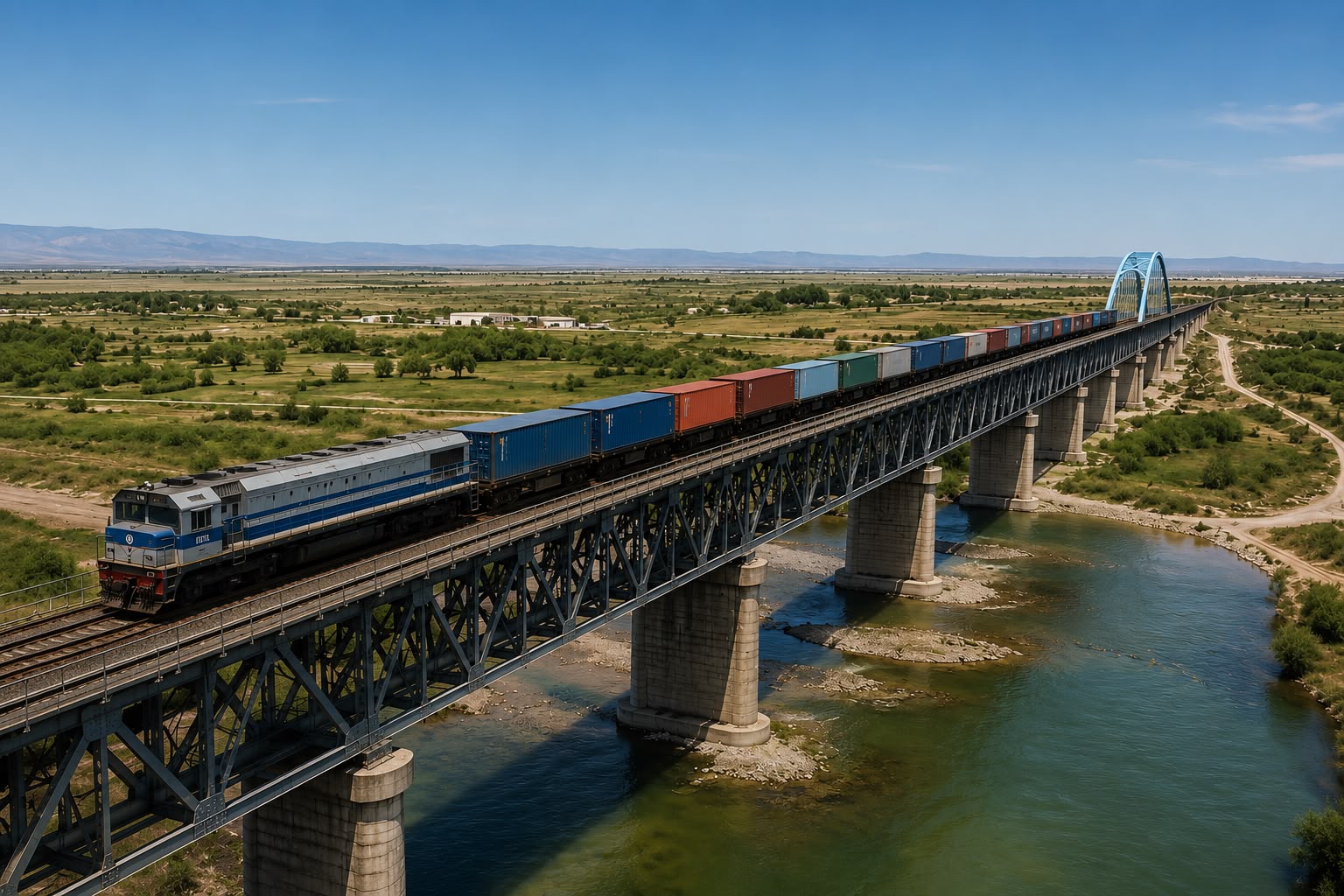

The consequential act of this week’s fighting was not the ninety targets struck along Iran’s coast, nor the missiles that fell on Bahrain and Kuwait. It was a single cruise missile that hit a railway bridge in Golestan province, six hundred miles from the Strait of Hormuz and nowhere near a warship. Iran attributes the strike to American forces, and Washington has neither confirmed nor denied it. The Aq Tekeh Khan bridge carries freight, not troops. It connects Iran to Turkmenistan, and through Turkmenistan to Kazakhstan, China and the overland trade that sanctioned states use to breathe. If the attribution holds, someone treated commercial infrastructure as a military objective, and in doing so wrote a doctrine whose real subject is not Iran at all.
The framing everywhere else places this strike inside the Hormuz story, one more blow in a campaign to reopen the strait. That reading misses the geography. The bridge sits on the wrong side of the country. It has nothing to do with freedom of navigation and everything to do with the corridor that Iran built precisely to survive the closure of its Gulf ports. This was not a strike against Iran’s ability to fight. It was a strike against Iran’s ability to trade around the blockade, and that is a different category of act with a much longer reach.
The Bridge Doctrine names a target no ceasefire covered
Call the principle by a name, because it needs one. What I would call the Bridge Doctrine holds that infrastructure carrying sanctioned goods is a legitimate object of attack, regardless of whether it moves anything military, and regardless of whether the states relying on it are party to the war. The label is mine, not Washington’s; no official has articulated it as policy. The attribution is contested too: the IRGC’s local corps blamed a US cruise missile, and independent outlets note that Washington has not confirmed the strike and the claim has not been verified. That ambiguity does not weaken the doctrine. It sharpens it. A precedent that operates under deniability, where the striking power neither claims nor disowns the act, is more corrosive than an announced policy, because it establishes the behaviour while evading the accountability. A doctrine does not require a spokesman to become operative. It requires only a precedent, and the strike supplied one.
Until Wednesday that principle had no standing in this conflict. American operations had concentrated on IRGC boats, missile sites and coastal batteries, the recognised furniture of a shooting war. The bridge near Aqqala broke that pattern, extending the target set from weapons to the arteries of commerce.
The distinction matters because a railway bridge is a dual-use asset in the most consequential sense. It moves civilian cargo, sanctions-evading trade and, in wartime, materiel, all across the same span. Once a belligerent decides that the first two functions justify destruction, every trade corridor in a contested region inherits the status of a potential battlefield. The doctrine does not stay where it was written. It travels along the very routes it was designed to sever.
The dual-use question the law of armed conflict never settled cleanly
International humanitarian law is not silent on infrastructure, but neither does it resolve the matter as tidily as either side would prefer. The governing rule, codified in Article 52 of Additional Protocol I and treated by the ICRC as customary international law, limits lawful attack to objects that by their nature, location, purpose or use make an effective contribution to military action, and whose destruction offers a definite military advantage. A rail bridge moving IRGC materiel can meet that test. A rail bridge moving oil revenue and civilian freight is far harder to fit within it, and the burden of proof sits with the party striking.
Two further principles bear on the bridge. The proportionality rule forbids an attack expected to cause civilian harm excessive in relation to the concrete military advantage anticipated, and the precautions rule requires a belligerent to verify that an object is a lawful target before striking it. Dual-use infrastructure is the hardest case these rules confront, because the same span serves the war effort and the civilian economy at once, and the lawful answer turns on evidence about what the object actually contributes at the moment of attack.
The counterargument to any confident verdict deserves its place. Assessments of dual-use infrastructure under the law of armed conflict are highly fact-specific, and an outside observer rarely possesses the intelligence on which a targeting decision rested. It is possible that the northern rail line was carrying military cargo that would satisfy the effective-contribution test, in which case the strike sits within the law rather than outside it.
The point is not that the attack was manifestly unlawful. It is that the doctrine treats the dual-use question as already answered, when the law treats it as the whole of the inquiry, and a precedent built on skipping that inquiry is what travels down the corridor.
The steelman for Washington is coherent and deserves to be stated at full strength. Iran spent the year rerouting its economy overland to defeat a naval blockade, turning the northern rail line into a lifeline for oil revenue and Russian cargo alike. A blockade that can be bypassed by rail is not a blockade. From that premise, striking the bypass is not an escalation but the completion of an existing policy, and the target was chosen precisely because it carried sanctioned trade rather than despite it. On its own logic the argument closes.
Here the logic turns against its author. The premise that sanctioned trade infrastructure is fair game cannot be confined to Iranian bridges, because the corridors that carry Iranian cargo are the same corridors, and in several cases the identical rail networks, that Europe has spent a decade and tens of billions of euros trying to build into the backbone of its own economic security. The doctrine written to strangle Tehran describes, with equal precision, the map Brussels has staked its future on.
Europe’s corridor strategy runs through the same terrain
Consider what the European Union has committed to the overland space. At the first EU-Central Asia summit in Samarkand in April 2025, the Commission and Council launched a twelve billion euro Global Gateway package and elevated relations to a strategic partnership, with three billion euros of that package allocated specifically to the Middle Corridor. The commitment built on the ten billion euros the Commission had already pledged to trans-Caspian connectivity the previous year, and it was accompanied by a coordination platform launched with Turkmenistan in Ashgabat, the same Turkmenistan the struck bridge connects to Iran.
The purpose of that spending is the point. The Middle Corridor exists to give Europe an overland route to Asia that bypasses Russia and reduces exposure to the maritime chokepoints, from Hormuz to the Red Sea, that this war has shown to be so fragile. It runs from western China through Kazakhstan, across the Caspian to Azerbaijan, then Georgia and Turkey. The corridors overlap with Iran’s northern network. The rail gauges connect. The underwriters are the same firms. Europe’s answer to chokepoint vulnerability is a lattice of bridges and border crossings indistinguishable, to a targeting officer, from the one that fell this week.
That is the exposure the Bridge Doctrine creates for Europe, and it is one no European decision produced. A precedent set in Golestan province does not require Brussels to have been consulted. It requires only that a future belligerent, in a future contest between the United States and China over Eurasian connectivity, reach for the tool this strike has now placed within reach. The moment infrastructure became a legitimate target, every kilometre of the Middle Corridor acquired a wartime risk premium that no Global Gateway grant can retire.
The precedent outlives the war that produced it
Precedents in the use of force are rarely returned to the shelf. The strike on a shipping lane during the tanker wars of the 1980s became a template. The interdiction of vessels on the high seas, once exceptional, is now routine. A doctrine that trade infrastructure may be destroyed when it carries the wrong cargo will not expire with this ceasefire, whenever one holds. It will sit in the repertoire, available to any power willing to argue that a rival’s corridor is really a supply line.
The states most immediately exposed are the ones with the least ability to object. Kazakhstan and Turkmenistan built their transit strategies on the promise that overland routes would be safer than the sea lanes, that a rail line through Central Asia carried less risk than a tanker in a contested gulf. The Bridge Doctrine inverts that promise. It tells every landlocked state that invested in connectivity to escape maritime vulnerability that the land is now vulnerable too, and that the vulnerability arrives by cruise missile without warning or declaration.
For Europe the lesson is more searching than the familiar complaint about absence from the diplomacy. The Union has treated connectivity as an economic project, a matter of grants, feasibility studies and single-window customs reform. The strike on the Aq Tekeh Khan bridge reveals connectivity as a security project instead.
A corridor is only an asset for as long as the powers around it agree to treat it as commercial ground rather than a legitimate target. That agreement is precisely what Washington suspended this week. Europe has been financing the rails. It has not been securing the principle that the rails are off limits, and that principle, not the money, is what the Bridge Doctrine has now put in doubt.
The bridge in Golestan will be repaired within days. The doctrine it announced will outlast the reconstruction by years. Brussels can keep writing cheques for the Middle Corridor, and it should, because the strategic case for overland diversification is sound. But a corridor whose neutrality can be revoked by a single missile is not the insurance policy Europe believed it was buying. The task now is not another investment forum. It is to establish, before the next war rather than after it, that trade infrastructure is not a target, and to make that claim carry the weight of a red line rather than the hope of a communique.
ABOUT THE AUTHOR
Martin Keller is a Senior Reporter and Policy Analyst specialising in external relations, diplomacy, and European affairs. He writes on international policy, and strategic diplomacy for The European Post.