
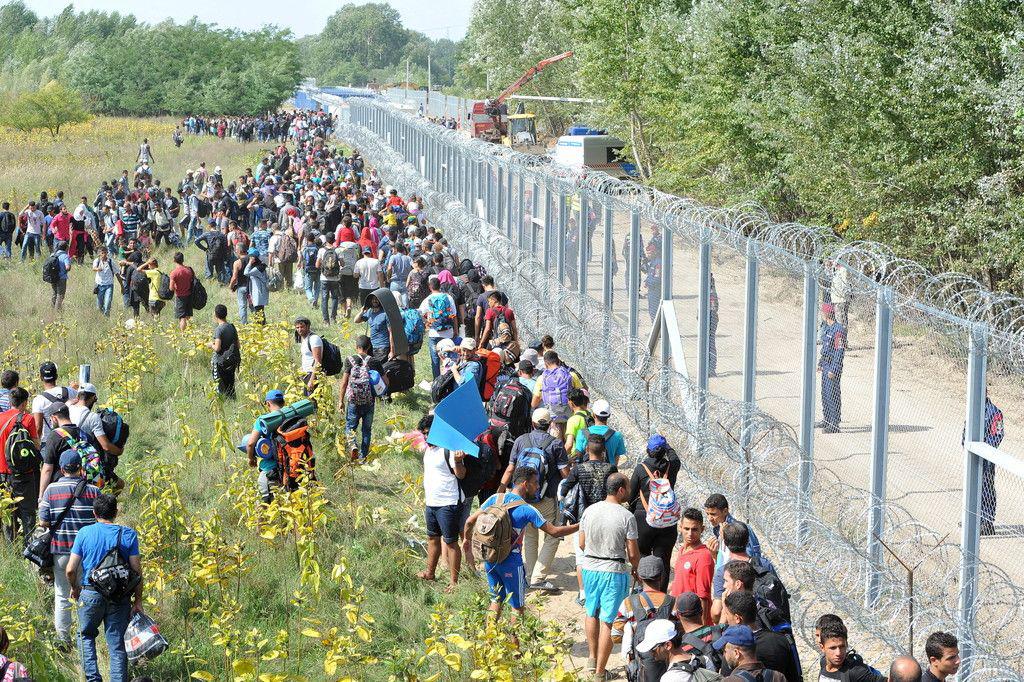

From the Americas to the southern tip of Africa, the door is closing on the migrant of every kind, the labourer, the investor, and the refugee alike. Europe is among the leaders of the turn, raising its citizenship walls, exporting its borders, and narrowing even the right to seek protection, all while it still describes itself as the liberal conscience of the world.
A deadline falls in South Africa today that no statute ever set. A movement calling itself March and March has told every undocumented foreigner to be gone by 30 June, and although the government calls the date a demand with no legal basis, the threat has acquired a life the law never granted it. At least four foreign nationals have been killed in the weeks of mobilisation, and the country’s security command, NATJOINTS, reports that more than twenty-five thousand people have been repatriated as the date approached. Outside consulates in Cape Town and Johannesburg, Malawians and Zimbabweans queue with the belongings they could carry. The deadline binds no one in law and frightens almost everyone in fact, which is the point. It is a vivid illustration of how the new intolerance works, not as a single decree from above but as a chorus, each voice adding to a pressure no one actor has to own. And it is only the loudest instance of something far wider.
The pattern is not South African alone, and that is what makes it worth pausing over. Within a single month this summer the turn against migration showed its face on three continents. On 12 June the European Union’s Pact on Migration and Asylum became fully applicable, rewriting how the bloc screens, detains, and returns those who reach its borders. Days earlier the Council and Parliament had clinched their deal on the Return Regulation, the toughest shift in European deportation policy in decades, carried by centre-right lawmakers voting alongside the far right. And across the Atlantic, immigration raids and mass detentions have become the organising feature of an American summer. The drivers differ from place to place, and the instruments differ more. What recurs is a reflex visible in the gap between fear and fact: in South Africa, polling by the Human Sciences Research Council shows the share wanting no immigrants at all rising to 42 percent by 2025, even as foreign workers hold a small fraction of formal jobs; in Europe, the Commission’s own Eurobarometer surveys have found the average citizen believes the immigrant population to be roughly twice its real size. When something at home goes wrong, the newcomer is the answer reached for first, whether or not the numbers support it.
How local anger becomes a global signal
It would be wrong to call the sentiment unfamiliar. South Africa endured lethal xenophobic riots in 2008, and again in 2015 and 2019. Europe has cycled through migration panics for a generation. The United States has nativist seasons written into its founding. What sets this moment apart is its timing and its reach. The hostility has synchronised. A stabbing in Belfast, a raid in Minnesota, and an ultimatum in Johannesburg now travel through the same networks within hours, each lending the others a borrowed sense of momentum and permission. The Belfast riots this month consciously echoed Britain’s Southport unrest of 2024. South Africa’s 30 June deadline spread across social platforms faster than any official could correct it. The local grievance is real in each case; the synchrony that makes them feel like a single global verdict is manufactured.
Beneath almost every instance lies the same machinery: economic insecurity meeting a visible outsider. South Africa is the sharpest current case, and the most instructive, because the fear is so easily checked against the data. Research from the University of the Witwatersrand finds that even handing every job held by a foreigner to an unemployed citizen would lower unemployment only from about 43.6 to 37.6 percent. The pain is real. The story told about its cause is not. That gap between distress and misdirected blame is the engine, and it runs from Johannesburg to the American Midwest.
South Africa shows the mechanism in full, the pressure on the migrant distributed across four levels that no single hand commands. Vigilante movements run mock arrests and blockade clinics; parties from the Patriotic Alliance to ActionSA launder the street slogan into a campaign theme; the state condemns the vigilantes while approving its own far-reaching immigration reform; and parliament tightens the detention law. The 30 June deadline itself was issued by none of them. It was the work of one organiser, Nkosikhona Ndabandaba, who told CNN he was its architect and then, in the same breath, that once the protests began he could not control the people of South Africa. A man lights the fuse and disowns the blast. That is the signature of this politics: when cruelty is spread across so many hands, no single hand answers for it, and the migrant feels all of them at once.
Why Brussels should read Johannesburg as a preview
None of this is a distant African matter, even if the cases resist being flattened into one. The South African street and the European statute book are not the same instrument, and it would be facile to pretend they were. What they share is a set of conditions: economic insecurity that finds a visible outsider, parties competing to name that outsider before an election, and a digital ecosystem that carries the rhetoric across borders within hours. The Belfast riots this month borrowed from a British template; the Johannesburg deadline spread through the same online machinery that amplifies European anti-migrant movements. The resemblance is real without being identity, and its most telling expression is not in Johannesburg but in the capitals that have spent decades calling themselves the conscience of the world on migration.
Where the turn cuts deepest: asylum
Much of this is ordinary, if contested, politics. A state that doubles a citizenship wait or curbs a golden-visa scheme is managing immigration, a sovereign choice that voters are entitled to make and to argue over. But one strand of the turn reaches past immigration management into something Europe has long claimed as a defining value, and that is asylum. No bloc has done more to write itself as the refuge of the persecuted. Europe gave the world the 1951 Refugee Convention, lectures other governments on the duty to shelter those who flee, and treats the right to seek protection as part of its moral identity. That is the commitment now being narrowed. The Union’s asylum and migration pact, fully applicable since 12 June, lets member states detain arrivals for screening and channel many into accelerated border procedures with thinner safeguards. The Return Regulation, agreed by the co-legislators this month, allows member states to set up deportation centres outside the bloc, the so-called return hubs, and to impose extended entry bans and detention on those who do not comply. Greece has openly canvassed African states about hosting such facilities. Through funding to North Africa and the Sahel, Brussels already pays other governments to hold people before they can reach European soil to claim protection at all. Restricting who may settle is one thing. Narrowing who may even ask for refuge is another, and it is here that the broad turn against migration begins to test something Europe insists it stands for.
Portugal and Britain: the law and the street move together
Watch the statute and the pavement close in step. Portugal spent a decade as Europe’s standing rebuttal to the idea that the continent had shut its doors, selling residence to investors and offering one of the Union’s most generous naturalisation routes, citizenship after five years. Now it has both halves of the new politics in view. On the street, the hard-right Chega has marched tens of thousands through central Lisbon under banners reading not one more. In the statute book, under Organic Law 1/2026, the residency requirement for citizenship was doubled in May to ten years, passed with the centre-right governing on Chega’s votes, the same mainstreaming of the fringe traced from Johannesburg. It spares no one, not even the investors who staked half a million euros on a passport that once lay five years off and have now carried the change to the Constitutional Court. When the most welcoming country in Europe doubles the wait even for the wealthy it courted, the idea that the turn is selective falls apart.
Britain is running the same play, a beat behind and in its own idiom. Its street chapter runs from the riots that spread from Southport in the summer of 2024, after a false rumour cast a knife attacker as a Muslim migrant, to this year, when Britain First marched through central Manchester demanding remigration and mass deportations until police imposed a dispersal order and made arrests. Its legislative chapter is arriving now. The government’s 2025 white paper, titled with unusual candour Restoring Control over the Immigration System, proposes to double the qualifying period for indefinite leave to remain from five years to ten, with citizenship rules to be aligned upward afterward and refugees facing a wait as long as twenty years. The measure is not yet law; a consultation closed in February and ministers target the autumn. But the direction is set, and the slogan heard on the Manchester march, send them back, has by now travelled from the pavement into the chamber. Two of Europe’s historically more open societies, the one that sold passports and the one that built an empire on movement, are converging on the same ten-year wall.
South Africa, then, is not the subject here but the warning at the edge of it. Europe sits earlier on the same curve, holding the restrictive statutes, the parliamentary majorities assembled with the far right, the normalised language of return. What it has not yet met at scale is the moment the rhetoric escapes the institutions altogether, when a self-appointed organiser sets a deadline the state must scramble to disown. The lawmakers who have normalised the language of expulsion inside the chamber would recoil at a vigilante checkpoint in Johannesburg. They should grasp that the one runs upstream of the other. A politics that offers the outsider as the answer to every domestic failure does not stay polite, and it does not stay in the chamber.
The differences are real, and so is the pattern
The objection writes itself, and it deserves an answer rather than a dismissal. A vigilante setting a deadline at knifepoint is not the same thing as a parliament amending a residence requirement after a consultation and a court review. The first is lawless and violent; the second is procedural, bounded by judicial oversight and the ballot box, and in Portugal’s case already partly struck down by a constitutional court. To collapse the two would be both wrong and lazy. A European interior ministry does not send mobs from house to house, and the migrant facing a longer naturalisation wait is in no physical danger. These are different instruments operating under different rules, and any honest account must say so plainly.
Nor are the pressures behind the turn imaginary, and they deserve more than a passing nod. In much of Europe, housing supply has not kept pace with arrivals, and rapid inflows can raise rents and lengthen social-housing queues in exactly the neighbourhoods least able to absorb them. Public services feel it too: schools absorbing pupils who do not yet share a language, health systems already stretched, all asked to do more without matching funds. There are fiscal questions that do not vanish because they are uncomfortable, about whether recent, lower-earning arrivals draw more in services than they contribute in their first years. Integration is genuinely hard and genuinely slow, and where it stalls, parallel communities and mutual suspicion can follow. And security concerns, though routinely inflated and exploited, are not always invented; a state that cannot say who has entered its territory has a real problem of legitimacy. Voters who raise any of this are not all bigots, and a politics that waves the concerns away cedes the ground to those who will weaponise them.
Granting all of that is what makes the closing observation worth stating plainly, as my own view. The honest case for restriction is a case about capacity, and capacity can be built. The case that travels faster is the one that needs no building, only a target. Both the legislature and the mob reach for that target; the distance between a statute and a club is the distance between law and barbarism, and it is not small. But procedure can also make a restrictive instinct respectable, and respectability is what lets it spread. The risk worth watching is not that Europe will descend into vigilantism. It is that it will achieve the same exclusions by lawful means and feel absolved by the paperwork.
The age does not announce its intolerance through a single tyrant or a single law. It accumulates quietly, in many registers at once, until a citizenship office in Lisbon, a settlement rule in London, or a date no one was obliged to obey in Johannesburg does the work that no one will claim. Most of it is the ordinary stuff of borders, tightened a notch at a time. The part that should give Europe pause is the narrowing of refuge itself, because that is the line the continent once drew to separate itself from the regimes people flee. Whether the line holds will depend on whether Europe still remembers the difference between controlling who comes to live and forgetting who is entitled to ask for protection.
ABOUT THE AUTHOR
Azfar Bukhari is a senior analyst specialising in geopolitics, public diplomacy, migration, international trade, and investment. He is a regular contributor to The European Post.